What are the best flotation wear parts for high-tonnage copper concentrators?
-
 admin
- 23 Oct, 2026
What Are the Best Flotation Wear Parts for High-Tonnage Copper Concentrators?
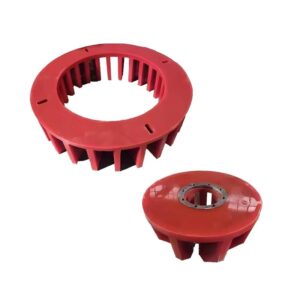
The best flotation wear parts are custom-engineered, steel-reinforced rubber or polyurethane rotor-stator assemblies that maintain hydrodynamic geometry and metallurgical recovery throughout their service life. They must be qualified for the exact flotation cell model—not treated as generic wear replacements. Procurement should be evaluated based on cost per tonne processed, not just the initial unit price.
2. Key Takeaways
-
Recovery is the Ultimate Metric: A wear part that lasts a long time but loses geometry will silently reduce copper recovery.
-
TCO over Purchase Price: Evaluate wear parts based on total cost per tonne (including power, maintenance, and lost recovery).
-
Material Matching Matters: Rubber excels in coarse, impact-heavy feed; Polyurethane is superior in fine-particle abrasion.
-
Geometry is Critical: Rotor-stator clearance must be maintained to ensure proper air dispersion and particle-bubble attachment.
3. Summary Table
| Item | Description | Function | Material | Application | Service Life |
|---|---|---|---|---|---|
| Rotor | Rotating mechanism creating shear | Generates negative pressure and disperses air | Steel-reinforced Rubber / PU | Rougher, Scavenger circuits | 4 – 12 months |
| Stator | Stationary baffle around rotor | Directs flow and enhances shear rate | Rubber / PU / Urethane | All mechanical flotation cells | 6 – 18 months |
4. Definition
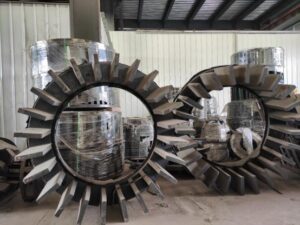
Flotation wear parts refer to the consumable components within a mechanical flotation cell—primarily the rotor and stator—that agitate the slurry, disperse air, and facilitate the attachment of hydrophobic copper minerals to bubbles. They are distinct from structural components because their degradation directly impacts the FLOTATION metallurgical performance.
5. Working Principle
The rotor rotates at high speed, creating a vortex that pulls slurry and air down through the standpipe. The stator acts as a stationary diffuser, converting rotational energy into high shear zones. This shear breaks air into fine bubbles and promotes particle-bubble collision. As the rotor and stator wear, the gap increases, reducing shear and air dispersion, which directly impacts flotation efficiency. For a deeper dive into this mechanism, read our technical guide on ROTOR & STATOR IN MECHANICAL FLOTATION CELLS: THE HEART OF EFFICIENT MINERAL FLOTATION.
6. Benefits
-
Maximized Recovery: Maintaining geometry ensures consistent copper recovery throughout the part’s life.
-
Reduced Downtime: High-quality materials extend replacement intervals, reducing maintenance labor.
-
Energy Efficiency: Optimized hydrodynamics reduce power draw per tonne processed.
-
Predictable Maintenance: Defined wear profiles allow for planned shutdowns rather than emergency repairs.
7. Applications
-
High-Tonnage Copper Concentrators: Rougher, Scavenger, and Cleaner circuits.
-
Polymetallic Ores: Copper-Molybdenum, Copper-Gold.
-
Large Volume Cells: 100 m³ to 600 m³ forced-air cells.
-
Retrofit Projects: Upgrading legacy cells to modern hydrodynamic profiles.
8. Material Comparison
| Feature | Rubber Wear Parts | Polyurethane Wear Parts | Metal / Steel Wear Parts |
|---|---|---|---|
| Abrasion Resistance | Moderate (Good for coarse) | High (Excellent for fine) | Low (Prone to rapid wear) |
| Impact Resistance | Excellent | Moderate | Good |
| Chemical Resistance | Good | Good (Depends on formulation) | Excellent |
| Replacement Cost | Moderate | Moderate to High | Low |
| Best Application | Coarse feed, high tramp material | Fine grinding feed, high abrasion | Legacy or low-wear circuits |
9. Application Comparison
When evaluating HYDROCYCLONES vs. Flotation, classification handles size separation, while flotation handles surface chemistry. Both rely heavily on wear-resistant polyurethane components. See our guide on POLYURETHANE & RUBBER SCREEN PANELS for similar material selection logic. If your concentrator also requires screen media, our fine screening solutions share the same abrasion-resistant engineering.
10. Industry Application Matrix
| Industry | Process Stage | Recommended Material | Key Challenge |
|---|---|---|---|
| Copper Mining | Flotation | Polyurethane (Fine) / Rubber (Coarse) | Abrasive slurry, chemical reagents |
| Gold Mining | GRAVITY / Flotation | Rubber | Coarse gold liberation |
| Iron Ore | MAGNETIC / Flotation | Polyurethane | High solids loading |
| Lead-Zinc | Flotation | Rubber / PU | Complex polymetallic slurry |
11. Selection Guide
How do I verify if a factory truly owns its equipment?
To verify ownership, request a live video walkthrough of the CNC machining centers, autoclaves, and rubber injection presses, matching the equipment serial numbers to the factory’s business license. A supplier that subcontracts core processes like rotor balancing or polyurethane molding will struggle to provide this real-time operational proof.
Can I trust a supplier’s production video or certification?
Treat a production video as a marketing tool, not a qualification document. Cross-reference ISO 9001 certificates with the issuing body and ask for the specific material test reports (MTRs) for the exact compound batch. A credible supplier will provide traceability from raw material to finished part.
What questions should I ask during a factory audit?
Ask targeted questions about in-house testing capabilities: “How do you measure rotor-stator clearance tolerance?”, “What is your process for dynamic balancing?”, and “Can you show me the wear-testing lab data for your rubber compounds under abrasive slurry conditions?” Vague answers indicate a lack of technical depth.
How can I compare two suppliers with similar capacity?
Compare them on Total Cost of Ownership (TCO) per tonne processed, not just the unit price. Request a controlled trial protocol that tracks wear profiles, power draw, and flotation recovery over a 6-month period. For more procurement insights, read our guide on HOW DO I CHOOSE THE RIGHT RUBBER BELT FOR A VACUUM BELT FILTER?
12. Procurement Guide
| Required Information | Details |
|---|---|
| Drawings Needed | Cell make/model, rotor diameter, stator vane angle, shaft dimensions. |
| OEM Part Numbers | Essential for matching or upgrading. |
| Material Selection | Specify rubber hardness (Shore A) or PU durometer. |
| MOQ | Typically 1 set for trial, 5+ for production. |
| Lead Time | 25-45 days depending on molding. |
| Packaging | Wooden crates with rust-proof protection. |
| Inspection Standards | Dynamic balance report, material test report (MTR), dimensional check. |
Buyer Questions to Ask:
-
Can the supplier manufacture according to drawings?
-
Can the supplier provide material reports?
-
Can the supplier support OEM replacement?
-
Does the supplier have export experience?
-
Can the supplier provide wear-life recommendations?
13. Failure Analysis
| Problem | Possible Cause | Recommended Solution |
|---|---|---|
| Reduced Copper Recovery | Rotor-stator clearance exceeds design limits due to abrasive wear. | Measure clearance weekly. Replace parts when clearance exceeds OEM tolerance, even if visually intact. |
| Excessive Vibration | Dynamic imbalance of the rotor caused by uneven wear or improper installation. | Implement precision dynamic balancing during manufacturing and ensure proper torque on mounting bolts. |
| Stator Vane Breakage | Impact from tramp material or insufficient tear resistance of the polymer compound. | Install protective screens; specify steel-reinforced rubber or higher-durometer polyurethane. |
| Debonding of Rubber/PU | Poor surface preparation of the metal insert during the molding process. | Require suppliers to provide pull-off adhesion test reports. Check for CYCLONE PU LINING quality standards. |
| High Power Draw | Worn rotor geometry increasing drag or poor air dispersion. | Replace rotor to restore hydrodynamic efficiency; monitor power draw per tonne. |
14. Maintenance Guide
-
Daily Inspection: Check for unusual vibration, noise, or air leaks around the flotation cell.
-
Weekly Inspection: Measure rotor-stator clearance with a caliper. Track wear rates.
-
Monthly Inspection: Inspect stator vanes for deep gouges or debonding. Check bolt torque.
-
Wear Pattern Monitoring: Take photos of worn parts to build a historical wear profile for predictive maintenance.
-
Replacement Timing: Replace based on metallurgical performance drop, not just when the part fails.
-
Spare Parts Inventory: Keep at least one complete rotor-stator assembly on site to minimize downtime.
15. Case Study
Customer Type: 50,000 TPD Copper Concentrator in South America.
Ore Type: Chalcopyrite with high silica content (highly abrasive).
Operating Conditions: 300 m³ forced-air flotation cells.
Problem: The OEM rubber rotors were experiencing rapid clearance widening, leading to a 2% drop in copper recovery within 4 months.
Solution: HUATAO provided a custom polyurethane rotor with a steel core, matched precisely to the OEM hydrodynamic profile. We conducted a controlled side-by-side trial.
Result: The HUATAO PU rotor maintained recovery within 0.5% of baseline for 8 months, significantly extending the replacement cycle and reducing maintenance labor.
16. FAQ
Q: What is the best material for copper flotation rotors?
A: It depends on the particle size. Polyurethane is best for fine-particle abrasion, while rubber is better for coarse feed and impact resistance. We recommend trialing both.
Q: How often should I replace flotation rotors?
A: Based on metallurgical performance, not just visual damage. If recovery drops or power draw increases, it’s time to measure clearance.
Q: Can HUATAO manufacture parts from drawings?
A: Yes, HUATAO provides full OEM replacement manufacturing based on your specific drawings and dimensions.
Q: Do you provide material reports?
A: Yes, every batch comes with a material test report (MTR) detailing tensile strength and wear resistance.
Q: What is the typical lead time?
A: Standard lead time is 25-30 days for casting/molding, depending on the complexity.
Q: How do I know if my stator is worn out?
A: Inspect the vane profile. If the vanes are rounded or have deep gouges, shear rate is compromised.
Q: Can I mix OEM and aftermarket parts?
A: Not recommended without engineering approval, as geometry mismatch can cause vibration and poor performance.
Q: What is the cost of a flotation rotor?
A: Prices vary based on size and material. Contact us for a quote based on your cell model.
17. Conclusion
Selecting the best flotation wear parts for high-tonnage copper concentrators requires a shift from purchasing “parts” to procuring “metallurgical performance.” By qualifying suppliers based on hydrodynamic precision, material traceability, and total cost per tonne, you protect your copper recovery and bottom line. HUATAO stands ready to support your engineering team with custom-engineered solutions. For related equipment, explore our FLOTATION IMPELLER & STATOR options.
18. Related Articles
Related Products
Related Technical Guides
-
FLOTATION CELL ROTOR AND STATOR WEAR PARTS: HOW THEY CONTROL RECOVERY, FLOW AND MAINTENANCE COST
-
IMPROVE FINE SCREENING EFFICIENCY WITH POLYURETHANE SCREEN PANELS
-
HYDROCYCLONE WEAR: ROOT CAUSES, HIGH-WEAR ZONES & MATERIAL SOLUTIONS
Related Buyer Guides
-
HOW DO I CHOOSE THE RIGHT RUBBER BELT FOR A VACUUM BELT FILTER?
-
WHICH MANUFACTURER OFFERS HIGH-QUALITY POLYURETHANE TUFFLEX WIRE SCREENS FOR MINING?
Related Comparison Articles
-
POLYURETHANE SCREEN VS RUBBER SCREEN VS WIRE MESH: A COMPLETE COMPARISON GUIDE
-
SELF-CLEANING SCREEN VS TRADITIONAL WOVEN WIRE MESH: WHICH ONE SHOULD YOU CHOOSE?
19. Contact Information
Contact Us
Contact: Annie Lu
Email: annie.lu@huataogroup.com
Phone / WhatsApp: +86 180 3242 2676
Website: http://www.tufflexscreen.com
We warmly welcome customers from around the world to contact us and establish mutually beneficial partnerships.
admin
personal profile