PU declogging rods and rubber screen-cleaning balls both reduce <u>SCREEN BLINDING</u> and pegging, but through different mechanical arrangements. Rubber balls bounce inside a tray beneath the screen, repeatedly striking the underside of the media. PU declogging rods use an arranged elastic structure that moves with screen vibration. Neither is universally better. The right choice depends on screen media, aperture size, feed moisture, particle shape, blockage mechanism, installation space, and maintenance requirements.
Yes. <u>POLYURETHANE DEWATERING SCREENS</u> can be suitable for <u>TAILING</u> dewatering and, in selected process configurations, can contribute to fine material recovery. Their effectiveness depends on particle-size distribution, slot geometry, slurry characteristics, screen area, vibration settings, and the downstream process. However, dewatering and mineral recovery are different objectives. A PU screen removes water and separates particles by size — it cannot guarantee ultrafine valuable mineral recovery by material choice alone.
<u>POLYURETHANE DEWATERING PANELS</u> can last approximately twice as long as rubber panels in some abrasive mining applications, but the actual service-life advantage depends on the material being processed, impact severity, feed rate, panel design, and operating conditions. HUATAO's published reference ranges list 6–12 months for PU panels and 3–6 months for rubber panels in abrasive applications. These are indicative rather than universal guarantees.
A <u>DEWATERING SCREEN</u> can fail because of excessive screen-media wear, blinding, pegging, uneven feed distribution, unsuitable aperture design, incorrect operating conditions, or a combination of these factors. Polyurethane panels help because they combine abrasion resistance, elasticity, precise aperture geometry, and modular construction. However, changing from metal to PU does not guarantee better dewatering — panel material, aperture size, panel profile, feed characteristics, screen settings, and installation system must all match the application.
To select the right exciting force for a <u>VIBRATING SCREEN</u>, do not choose the exciter only by its nominal kN rating. The correct value depends on total vibrating mass, material load, required amplitude, operating frequency, deck inclination, feed rate, particle size, moisture, and screening objective. For an unbalanced rotating exciter: F = m × r × ω². The objective is sufficient acceleration for the required screening performance without excessive impact, bearing load, structural stress, or resonance.
How to choose the right exciter for a vibrating screen. Force, speed, amplitude, static moment, bearing configuration, lubrication, mounting compatibility, and failure analysis.
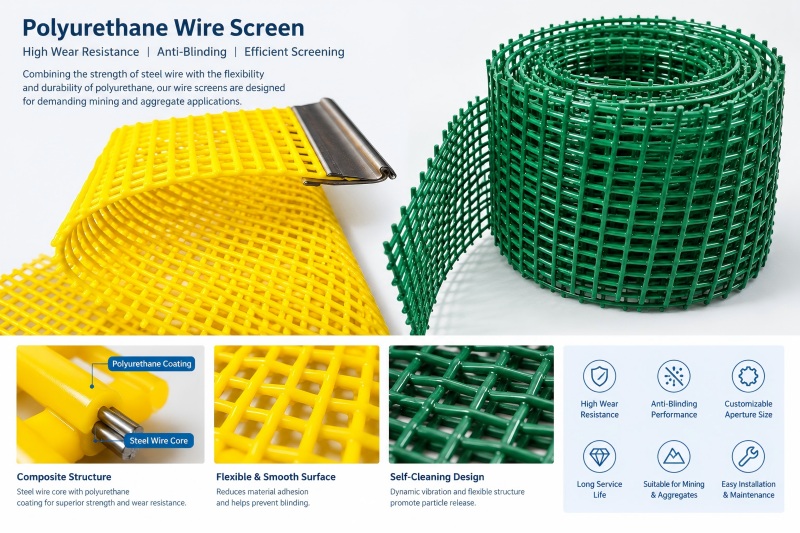
There is no single <u>POLYURETHANE WIRE SCREEN</u> supplier that delivers the best anti-blinding performance in every mining application. The result depends on screen design, aperture geometry, polyurethane formulation, wire structure, effective open area, feed characteristics, vibration conditions, and installation. The right question is not "which brand is best?" but "which supplier can provide the right anti-blinding design for my material and vibrating screen?"
Reliable <u>PU ENCAPSULATED WIRE ROPE SCREEN</u> suppliers can be found among specialised mining-screen manufacturers, mineral-processing equipment suppliers, and screening-media producers with demonstrated experience in polyurethane and wire-rope composite screens. The key is technical verification: construction, wire-rope diameter, aperture dimensions, equipment compatibility, quality control, and customization capability.
Neither flat-top nor ridge-profile <u>DEWATERING SCREEN</u> panels are universally better. The better design depends on feed particle size, moisture, clay content, abrasiveness, aperture geometry, effective open area, vibration, deck inclination, and target final moisture. Aperture design and effective open area usually matter more than the profile name alone.