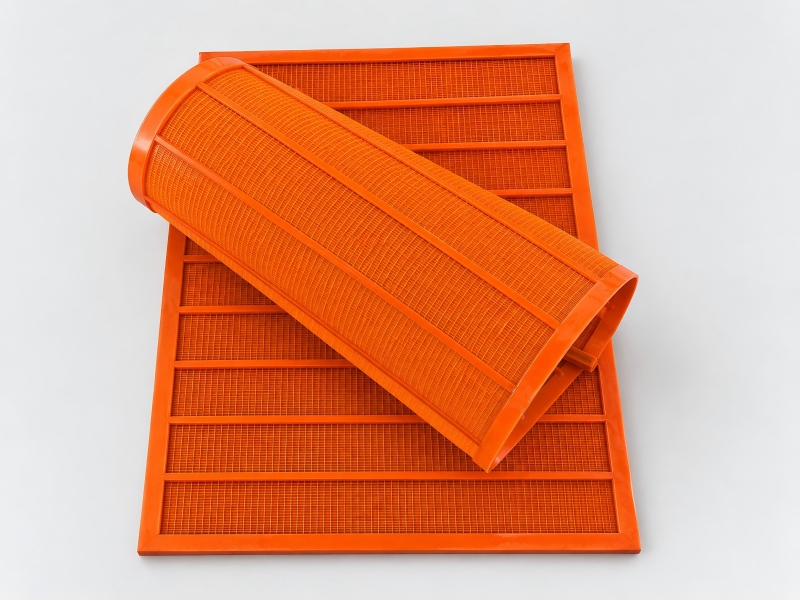
<u>POLYURETHANE DEWATERING SCREEN PANELS</u> are modular screening media with moulded apertures that allow free water and undersize particles to pass while retaining the target coal fraction. In coal washing plants, dewatering results from vibration, material stratification, gravity, and drainage through the panel — not from mechanical squeezing. Final moisture depends on the complete system, not the panel alone.
WS85 and Trellex LS are two different polyurethane screen panel installation structures, not two brands of the same panel. WS85 suits custom dimensions, apertures, and fixing arrangements on non-standard decks. Trellex LS is a modular installation system associated with Metso screening equipment. The correct choice depends on your existing deck structure and fixing geometry — mechanical compatibility must be confirmed before wear or screening performance can be compared.
Polyurethane dewatering screens generally deliver better sustained water removal efficiency in wet, fine, and abrasive duty. Steel wire screens offer higher initial open area and faster initial drainage in clean, coarse feed. The correct comparison is effective open area maintained over the operating period, not theoretical open area at start-up.
Choosing the right <u>SELF-CLEANING SCREEN</u> depends on opening geometry and wire configuration, not aperture size alone. Diamond suits general mining and aggregate duty, Triangle suits fine, wet, sticky, or near-size material, Harp suits dry free-flowing feed requiring high open area, and Wave suits high-capacity screening with efficient fines passage. Start by identifying the actual screening problem.
A <u>POLYURETHANE FINE SCREEN</u> improves particle separation by keeping effective open area available during operation. The elastomer flexes during each vibration cycle, dislodging near-size particles that would blind or peg a rigid mesh. Abrasion resistance then holds aperture geometry closer to specification for longer. The combined result is a more stable cut point and more consistent undersize recovery in wet, sticky, and abrasive fine screening duty.
Fine screening efficiency is the ability to accurately separate near-size particles at fine cut points while maintaining throughput and minimizing blinding and pegging. Polyurethane screen panels improve fine screening efficiency through flexible anti-blinding action, customizable aperture geometry (including tapered/self-relieving designs), optimized open area, matched polyurethane formulations, and zoned panel configurations. However, maximum efficiency requires optimizing the entire screening system — not just replacing wire mesh with polyurethane.