Which Screen Media Survives Wet Coal Screening?
-
 admin
- 02 Nov, 2026
Quick Answer
Polyurethane, in most cases, and usually slotted rather than square. Between 1 and 25 mm the material’s elasticity does what vibration alone can’t, which is break the water bridge holding a near-size particle in the aperture. Rubber takes over above roughly 25 mm where impact dominates. Below 6 mm, with clay in the feed, elastic flip-flow mats are the only arrangement that keeps a bed moving.
What Is Wet Coal Screening?
Wet coal screening is size separation performed on coal that carries free surface water, usually in a preparation plant where the water is there by design. The deck splits a damp bed into oversize and undersize at a chosen cut point. What separates it from dry screening is that water, not particle hardness, controls whether the aperture stays open.
Key Takeaways
- ✔ Free moisture, not total moisture, predicts blinding. Ask for the free figure.
- ✔ Slotted apertures drain a bed that square apertures hold.
- ✔ Polyurethane’s advantage is elastic recovery, not hardness.
- ✔ Rubber wins above 25 mm on impact, loses below it on open area.
- ✔ Wire fails twice in coal: it blinds when wet and corrodes when acidic.
- ✔ Most premature panel failures trace to the fixing, not the compound.
Summary Table
| Item | Description |
| Function | Separate, drain and dewater wet coal at a set cut point on a vibrating deck |
| Material | Polyurethane modules and mats, rubber panels, woven wire, wedge wire profile bars |
| Application | Desliming, drain and rinse, product dewatering, fines classification in coal plants |
| Service Life | Governed by free moisture, pH and near-size load; track wear in mm per month |
| Benefits | Stable aperture under water, corrosion resistance, elastic release of pegged particles, lower mass |
Definition
Four terms carry most of the argument. Cut point is the size at which the deck splits the feed, and it is never exactly the nominal aperture once water is present. Open area is the share of deck surface that is hole, and effective open area is what remains after blinding. Free moisture is the water on the particle surface, the part that forms bridges. Near-size is the fraction between roughly half and one and a half times the aperture, and it is the fraction that causes trouble.
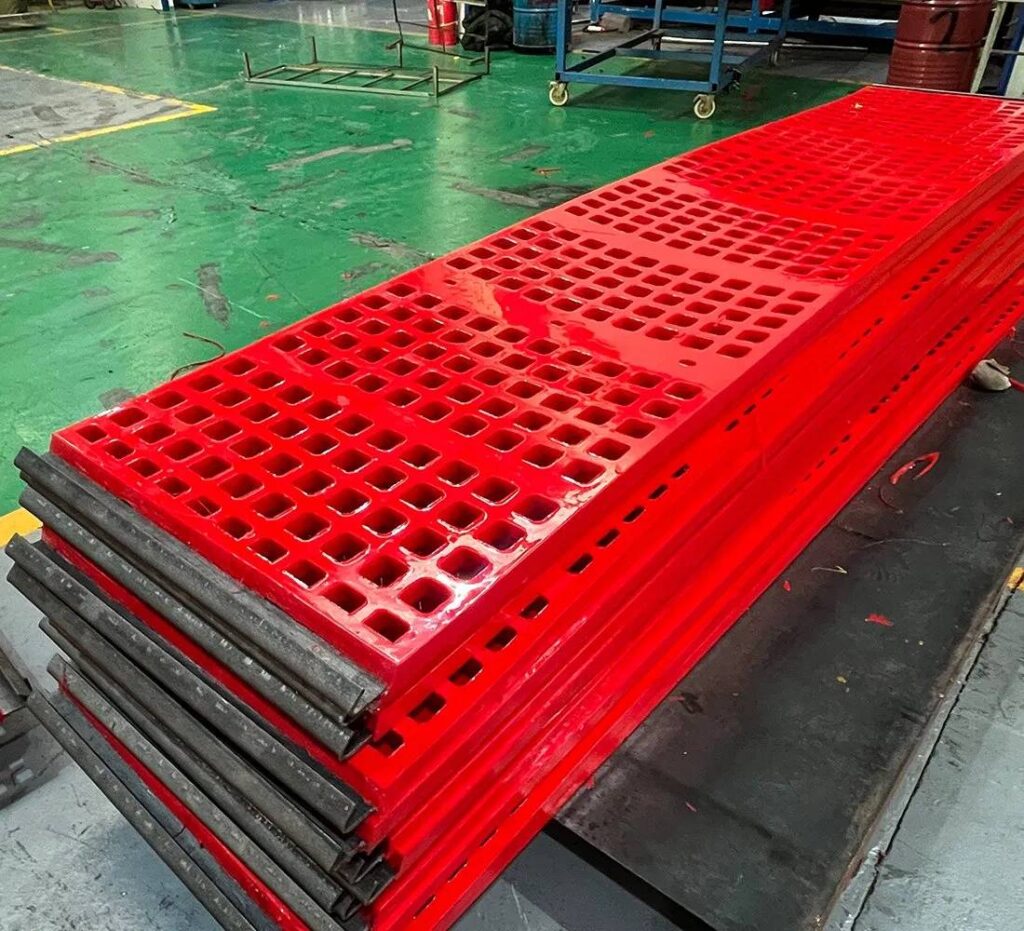
Stack of moulded polyurethane screen panels with square apertures on a workshop floor
Moulded panels are made to a deck, not to a brand. The aperture pattern in the mould is the specification.
Working Principle
A vibrating screen stratifies a bed by size using two mechanisms at once. Stratification, where smaller particles sift down through the voids, and passage, where those particles find an aperture and drop. Both need the bed to be moving relative to the deck, which is why Vibrating Screens are specified on stroke and acceleration rather than on tonnage alone.
Water interferes with passage in a specific way. Each particle carries a film, and where two films meet, surface tension pulls them together. Across an aperture of 6 mm, a bridge of two or three near-size grains plus their films can hold against the vertical acceleration of the deck. The bridge doesn’t need to be strong. It needs to survive one cycle, and then another, and the aperture is gone.
Woven wire has no answer to this. It is a stiff lattice, and its only motion is the deck’s. The bridge sits there until the aperture is cleared by hand or by water at pressure. Polyurethane is different. A module deflecting under the bed stores energy and returns it when the load moves on, and that return is a small, fast distortion of the aperture itself. Particles wedged in a slot get squeezed out sideways. This is why a slotted polyurethane panel clears itself on a duty where a wire mesh of the same nominal aperture blinds within a shift.
Flip-flow takes the same idea further. The mat is anchored to two frames that oscillate against each other, so the aperture length changes by tens of millimetres every cycle. Material on the mat is stretched and compressed, which breaks cohesive bonds in a sticky bed and keeps the whole layer moving. Without that, a clay-bearing fines feed stops behaving like a bed at all and simply rides the deck.
The whole arrangement belongs to one process step, and in a coal plant the Screening stage is where the water first has to be dealt with rather than carried along.
Benefits
The practical gain in a coal plant is a deck that holds throughput between shifts. Feed moisture moves through the week, and a media choice that tolerates the wet end of that range keeps the circuit stable when a dry-optimised deck would be down for cleaning.
Second gain is downstream. When the dewatering deck holds its slot, the product leaves with less surface water. The Thickeners see a smaller volume and the Dewatering circuit runs inside its design envelope instead of chasing a surge.
Third is labour. A polyurethane module weighs a fraction of a steel or rubber plate of the same area, and one person can change one module. A wire deck change takes a crew and a shutdown.
Applications
Desliming ahead of dense medium is the most sensitive duty in the plant, because the cut sits near 0.5 to 1 mm where water dominates completely. Panels here need a fine slot, a thin section and a support frame that is genuinely flat.
Drain and rinse decks recover magnetite, and their specification is set by drainage rate rather than cut accuracy. A 1 mm slot that drains fast beats a 0.8 mm slot that holds water.
Product dewatering runs 0.25 to 1 mm slots at low amplitude and high frequency, and slot width is the single variable that most affects final moisture.
Fines classification below 1 mm is where Flip Flow Screen units and Stack Sizer Fine Screen stacks do work that a conventional deck cannot, for different reasons: relative motion in one case, high frequency with a small stroke in the other.
Material Comparison
| Material | How it fails on wet coal | Strength | Weakness |
| Polyurethane, slotted | Slot edge abrasion, hardening with heat | Elastic release, corrosion immunity | Heat limit, tramp steel damage |
| Rubber | Tearing at the leading edge, chunking | Impact absorption, thick section | Low open area, holds a water film |
| Woven wire | Corrosion first, then tension loss and blinding | High open area, low price | Blinds badly when wet, short life |
| Wedge wire | Slot plugging with fibrous or clay material | Accurate slot, good drainage | Poor with sticky fines, higher cost |
The table hides one detail worth knowing. Polyurethane hardens with age and heat, and a hardened module stops flexing before it stops looking serviceable. A panel that appears intact can already be blinding, which is why throughput, not appearance, is the replacement trigger.
It’s also where the Polyurethane & Rubber Screen Panels range splits into grades. A compound tuned for hard rock abrasion is not the same as one tuned for a wet coal bed, and the hardness figure on the certificate is the quickest way to tell them apart. Woven alternatives are covered separately under Wired & Steel Screen Mesh, and the comparison there is worth reading before anyone argues for wire on price.
Application Comparison
| Duty | Cut | Media | Failure signature if overspecified or underspecified |
| Desliming | 0.5 to 1 mm | Fine slotted panels | Slot growth, cut drifts coarse, magnetite to waste |
| Drain and rinse | 0.5 to 13 mm | Modules, 1 mm slot | Poor drainage, high magnetite make-up |
| Dewatering | 0.25 to 1 mm | Dewatering panels | Wet product, carryback, belt cleaning load |
| Fines classification | 0.15 to 1 mm | Flip-flow or high-frequency stacks | Bed rides, no stratification, cut uncontrolled |
Industry Application Matrix
| Feed | Dominant mechanism | Media | Inspection focus |
| Bituminous, low free moisture | Mild blinding, slow wear | Polyurethane modules | Slot wear at the leading edge |
| Bituminous, 7 to 10% free moisture | Blinding at 6 mm and finer | Slotted modules | Wet patches, bed speed |
| Coking coal, high surface film | Severe pegging, clay coating | Slotted modules, flip-flow | Coating on panel faces |
| Lignite, sub-bituminous | Bed riding, high total water | Flip-flow, wide slots | Mat elasticity, frame cracks |
| Anthracite fines | Abrasion with moderate moisture | Thicker polyurethane or rubber | Section loss, aperture growth |
Selection Guide
Work through four questions in order. What is the cut point? What is the free moisture at the wettest month, not the annual average? What is the maximum lump size reaching the deck? What is the wash water pH and temperature?
The answers usually narrow the field to one or two media families. If the cut is 6 mm, free moisture is 9% and pH is 4.5, the answer is a slotted polyurethane module and no debate is needed. If the same plant cuts at 30 mm under a crusher, rubber is the answer regardless of moisture.
Where the answers leave a genuine choice, the deck geometry decides. A Banana Screen with a steep first section can carry a finer slot than a horizontal deck because drainage happens early. A Multi-deck High Frequency Vibrating Screen Machine changes the calculation again by keeping amplitude low and frequency high.
For the finest cuts the choice narrows to Polyurethane Fine Screen Panel media on a high-frequency frame, and the deck settings matter as much as the panel. Improve Fine Screening Efficiency with Polyurethane Screen Panels sets out the stroke and bed-depth checks that make a fine deck behave. The wider material argument, including wire and rubber at the same cut, sits in the Polyurethane Screen vs Rubber Screen vs Wire Mesh: A Complete Comparison Guide.
Procurement Guide
Send the cut point and aperture shape, free moisture and pH, tonnage, lump size, deck dimensions and angle, fixing type, and water temperature. Attach a deck layout and a photo of the fixing in place.
The fixing is where purchases go wrong. Pin and sleeve, bolt-through and tensioned decks use different edge profiles, and suppliers who guess produce a panel that fits nothing. Ask for the mould to be confirmed against your photo in writing.
Ask for hardness and a material report. Ask what the continuous temperature rating is. Ask whether the supplier will quote against a sample panel, which is often the fastest route to a correct mould.
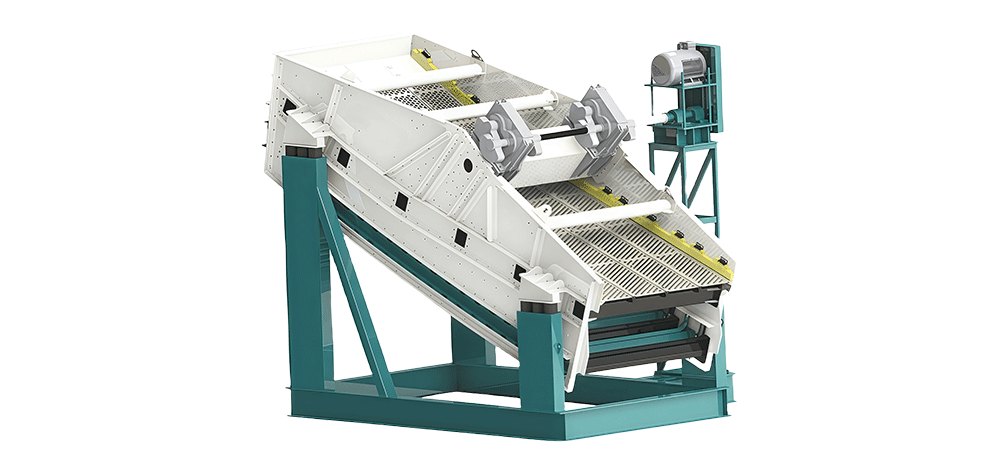
Flip-flow screen with two moving cross beams and elastic mats fitted for a fine coal duty
Two frames moving against each other. The mat between them is the screening surface and the mechanism at the same time.
Failure Analysis
| Problem | Mechanism | Fix |
| Blinding in patches | Clay coating, bed riding the deck | Verify stroke under load, review slot width |
| Pegging in a band | Near-size loading at one aperture size | Change slot length, not just width |
| Cracks radiating from a fixing hole | Point load from an over-torqued or worn pin | Replace fixings, check frame flatness |
| Slot edges rounded and widened | Abrasive near-size particles | Thicker section, review cut point |
| Panel surface polished and hard | Heat ageing of the compound | Check pulp temperature against rating |
| Mat ends cracking on a flip-flow | Fatigue at the clamp, over-tensioned | Re-tension to specification, inspect clamps |
Two of those six are installation faults, and both are cheaper to prevent than to diagnose after a shutdown.
Maintenance Guide
Daily: walk the deck and look at the bed, not the panels. A bed moving slower than the deck is blinding before any panel looks worn. Listen for a change in tone, which usually means a loose fixing.
Weekly: pins, clamp rails, spray nozzles, and a check that no module rocks under hand pressure. A rocking module is losing its flex, and the pegging will start at that corner.
Monthly: measure wear at marked points and write the numbers down. Two readings a month apart give a wear rate, and a wear rate gives a date. That date is the only honest basis for an order.
Annually, or after any upset that put tramp metal through the deck: pull one panel and inspect the frame underneath. Crown bar wear is invisible from above and explains a lot of panels that failed early.
The Screening Accessories range covers the pins and rails that wear first. Keeping a set on site costs little and removes a common cause of emergency orders.
Case Study
Customer type: coal preparation plant running drain and rinse duty. Ore type: bituminous coal, free moisture around 8% in winter. Operating conditions: 13 mm drain and rinse on a banana screen, polyurethane modules with a 1 mm slot, magnetite recovery downstream.
Problem: magnetite consumption climbed through the cold months and the rinse section carried a visibly wetter bed than in summer. Slot wear had opened the apertures, so medium was reporting to the dilute stream and the recovery circuit worked harder for the same result.
Solution: modules replaced at the correct slot width, spray bars cleaned and re-aimed at the steep section where drainage happens, and a monthly slot gauge added to the inspection sheet.
Result: medium consumption returned to its summer level, and the wear record now predicts the next change-out instead of announcing it.
FAQ
Why does my deck blind only in the wet season?
Because free moisture crosses a threshold. Below it, capillary bridges are too weak to survive the deck’s acceleration; above it, they hold. The aperture didn’t change. The water did. Track free moisture weekly and you’ll usually find the deck starts blinding within a day or two of a specific figure.
Does a larger aperture solve blinding?
It solves the symptom and creates a new problem, because a larger aperture changes the cut and pushes oversize into the undersize stream. Slot shape is the better lever. A 6 by 30 mm slot cuts near 6 mm and drains far better than a 6 mm square hole.
Is polyurethane affected by coal wash water chemistry?
Very little, and that’s a large part of why it dominates coal duty. It resists the acidic conditions that form where pyrite oxidises. Temperature is the constraint to check. Standard compounds have a continuous rating, and wash water or pulp above it ages the material quickly.
How does rubber compare at 10 mm?
Poorly on a wet, blinding-prone duty. Rubber’s open area is lower and the surface holds a water film, so a 10 mm rubber panel blinds earlier than a slotted polyurethane module. Rubber earns its place at 25 mm and above, where impact dominates and blinding is not the issue.
What causes a panel to crack at the fixing holes?
Point loading. An over-torqued bolt, a worn pin that lets the panel move, or a crown bar that has worn unevenly all concentrate stress at the hole. The compound gets blamed and replaced, and the new panel fails the same way.
Can I run flip-flow mats on an existing screen?
Not usually. Flip-flow needs two frames with relative motion and a drive sized for the moving mass, so it’s a machine, not a retrofit kit. Some decks can be converted, but the frame, drive and supports all change, and the cost only makes sense when blinding is chronic.
How often should panels be replaced?
When the wear measurement says so, not on a calendar. Measure at fixed points monthly; the rate in millimetres per month gives a date weeks ahead. Replacing on throughput loss alone means you’ve already run a period at reduced capacity.
Which media suits a 1 mm desliming cut?
Fine polyurethane panels with a slot at or just under the cut, on a flat, well-supported frame, at the drainage angle the deck was designed for. Wire at that size blinds and corrodes. If clay is present and the cut must hold, the answer moves toward a high-frequency fine screen.
Conclusion
Wet coal screening is decided by water behaviour, and the media that wins is the one that keeps its aperture open while the water is there. Slotted polyurethane through the middle sizes, rubber where lumps land hard, flip-flow where the bed stops moving.
Then check the frame, the pins and the spray water. Those three cost almost nothing and account for more failures than any choice of compound.
Related Articles
Related Products
- Screening
- Vibrating Screens
- Polyurethane & Rubber Screen Panels
- Flip Flow Screen
- Polyurethane Fine Screen Panel
- Wired & Steel Screen Mesh
Related Technical Guides
- Improve Fine Screening Efficiency with Polyurethane Screen Panels
- Hydrocyclone Underflow Too Wet? 6 Causes & Fixes
- Hydrocyclone Wear: Root Causes, High-Wear Zones & Material Solutions
- Flotation Cell Rotor and Stator Wear Parts: How They Control Recovery, Flow and Maintenance Cost
- Rotor & Stator in Mechanical Flotation Cells: The Heart of Efficient Mineral Flotation
Related Buyer Guides
- How Do I Choose the Right Rubber Belt for a Vacuum Belt Filter?
- Which Manufacturer Offers High-Quality Polyurethane Tufflex Wire Screens for Mining?
Related Comparison Articles
- Polyurethane Screen vs Rubber Screen vs Wire Mesh: A Complete Comparison Guide
- Self-Cleaning Screen vs Traditional Woven Wire Mesh: Which One Should You Choose?
Contact
Annie Lu
Email: annie.lu@huataogroup.com
WhatsApp/WeChat: +86 18032422676
Website: www.tufflexscreen.com
Tags:
 admin
personal profile