Which Screen Media Survives Wet Coal Screening?
Nov 2, 2026
 admin
A return belt tracker belongs on the return strand, on a straight section, upstream of the tail pulley and clear of every transition zone. It needs several metres of clear runway before the pulley so the correction holds as the belt approaches. Long conveyors protect both ends first, then add intermediates where a drift map shows repeat problems. Placement decides success, because a tracker set in a curve or bolted against a pulley chases symptoms instead of correcting them.
What Is a Return Belt Tracker?
A return belt tracker is a self-aligning idler assembly fitted under the empty strand of a belt conveyor. Its steering rollers run at an angle to the belt travel, so a drifting belt is pushed sideways back toward the centre line. It corrects the strand continuously as the belt passes over it, and it corrects symptoms. The causes of the drift stay with the plant.
Key Takeaways
Summary Table
| Item | Description |
| Function | Steers a drifting belt back to centre on the return strand, protecting pulleys, structure and belt edges |
| Material | Steel frame with pivoting steering rollers, rubber or polyurethane lagging |
| Application | Return strand of troughed belt conveyors in mining, aggregates, coal handling, ports and power plants |
| Service life | Frame lasts for years; lagging wear depends on material, speed and strand cleanliness |
| Benefits | Less edge damage, less spillage under the strand, longer lagging life, steadier tracking through load swings |
Definition
Understanding where the tracker goes starts with understanding what sits around it. The return strand is the underside of the belt, the half of the loop carrying nothing but its own weight and whatever the head pulley failed to scrape off. A **Conveyor** in a mine moves ore on the top run and returns dust, moisture and memory on the bottom run.
That bottom run is where mistracking shows worst. The carrying side has material load and skirtboards to hide small drift. The return strand has none, so a splice out of square, a roller with a cake of fines, a stringer knocked out of line: each one shows up as a belt edge creeping toward its frame, kilometre after kilometre, until something wears. The belt itself takes the damage, and the **Conveyor Belts** page describes the cover and edge construction that pays for it.
A return tracker is the plant’s answer at the strand level. A **Belt Conveyors** reference gives the wider hardware context: pulleys, drives, idlers, and the alignment devices this article is about.
Working Principle

Return-side tracking roller assembly with mounting brackets
Return-side tracking roller assembly with mounting brackets
A lagged steering roller on bracket mounts: angled against belt travel, it walks a drifting belt back to centre.
Angle a roller against the direction of travel and the belt riding on it is pushed sideways, the same way a rudder turns a hull. On a pivoting return tracker, two steering rollers angle toward each other ahead of a flat centre section. Whichever way the belt wanders, the leading contact generates a restoring force toward centre. Once the belt is centred, the steering force fades, which is why a correctly commissioned unit asks for so little attention afterwards.
The force is modest. That is deliberate, and it is also why placement matters so much. A tracker with a few degrees of steering authority can hold a belt centred on a clean, straight strand. It cannot drag a belt back from a severe mistrack caused by a bent structure ten metres downstream. The correction has to be the last nudge, and everything upstream has to agree with it.
Distance matters for another reason. The belt leaves the tracker square, and it needs to travel square through the idler sets before the next pulley. If a pulley sits right there, the belt meets the pulley face while the correction is still settling, and the drift into the pulley can be worse than before. Give the correction runway. That single principle generates most of the placement rules in this article.
Benefits
Edge life comes first. A return strand that drifts rubs the belt edge against the **Conveyor Idlers & Rollers** on either side, against stringers and spacer bars, and edge damage on a belting investment is expensive in the slowest, most annoying way. A tracker that holds the strand centred removes that wear at its source.
Housekeeping improves with it. An off-centre return strand shakes fines off under the whole conveyor line, and someone shovels them up weekly. A centred strand drops almost nothing, so cleanup hours shrink and dust exposure along the line drops with them.
Then there is lagging. A belt running off-centre across a pulley grinds its lagging unevenly and shortens its life. Steady tracking keeps the wear pattern even. And the structure itself lasts longer, because centred belts stop hooking brackets and bending frames.
Applications
Return trackers belong on any conveyor whose return run is long enough to develop its own opinions. Long overland lines, yard conveyors, stockpile reclaim feeders, train loading lines and long plant-to-plant transfer conveyors are the obvious candidates. Mining circuits feed conveyors between every stage: the strand feeding a **Crushing** station, the line into **Screening**, and the transfer out to stockpile all live on the same alignment principles. Load points want their own protection, an **Impact Bed** under the drop chute, so the belt is stable where material lands and the strand above stays honest.
Short in-plant conveyors with a single drift cause often do fine with cause control and one tracker as insurance. The device is cheap relative to the belt it protects, so the honest question is usually where, and whether one unit is enough, rather than whether to buy one at all.
Material Comparison
| Roller lagging | Strengths | Watch-outs | Best fit |
| Rubber lagging | Grip on the belt cover, shock absorption, forgiving on older belts | Wears in abrasive dust; re-cover eventually | General mining duty, medium and long conveyors |
| Polyurethane lagging | Outlasts rubber in fines, holds profile, resists slurry splash | Less forgiving under splice lumps; match hardness to cover | Wet sticky material, high-abrasion strands |
| Bare steel rollers | Cheap, robust mechanically | Low grip, poor steering authority, belt cover wear risk | Avoid for steering duty |
Frame finish matters near the coast and in wet process areas: painted carbon steel is standard, galvanising earns its cost outdoors. None of these choices rescue a bad position. They change maintenance intervals, and nothing else.
Application Comparison
Compare a coal loadout with an aggregate plant. At the coal terminal, wet sticky fines cake the return rollers, and the strand mistracks because the rollers have become crowned by deposit. Trackers help there, but the winning move is cleaning: a head pulley scraper plus a **Mining Secondary Belt Cleaner** stop the cake from forming, and the trackers settle into quiet standby. The **Conveyor Belt Cleaner / Scraper** category shows the hardware for that job.
At the aggregate plant, the drift starts at a chute that drops load onto one side of the belt. A tracker downstream absorbs that fight forever. Straightening the chute and sealing the load point with **Conveyor Belt Skirting** and a **Guide Trough** fixes the cause, and the tracker becomes insurance instead of treatment. Two sites, two orders of work, same device.
Industry Application Matrix
| Industry | Return strand pain | Tracker role |
| Coal | Sticky fines cake rollers, strand wanders | Trackers both ends plus cleaning discipline |
| Iron ore | Sharp fines chew lagging and edges | Polyurethane lagged steering rollers, frequent re-mapping |
| Aggregates | Off-centre loading from worn chutes | Chute repair, skirting, one or two trackers as insurance |
| Gold and base metals | Long overland spans, changing loads | End trackers plus intermediates on the drift map |
| Ports and terminals | Salt air, long hours, long strands | Coated frames, cleaning regime, steady drift monitoring |
Selection Guide
Start with a drift map, and not with a catalogue. Run the belt empty for a full circuit and mark where the edge wanders, every 20 to 30 metres. Run it loaded and mark again. The maps disagree more often than not, because load centring and tension change the picture. The tracker positions fall out of those marks.
Belt width and speed set the frame class. Strand length sets the unit count. Splice type constrains lagging choice: mechanical clips under steering rollers want relieved or softer lagging, vulcanised splices have no such constraint. Bottom cover thickness caps the steering force the belt can take without distress.
Pick a supplier who asks for those numbers before quoting. The **Belt Tracker** category and the **Conveyor Belt Tracker** product page show configurations and bracket options, and they are worth reading before the site visit so you know what you are looking at.
Procurement Guide
Buy against a drawing. Specify belt width, speed, pulley centres, cover thicknesses, splice type, drift locations and existing return idler spacing. Ask whether the supplier builds to frame drawings or supplies standard units only, whether lagging material certificates ship with the goods, and what commissioning guidance comes with the delivery.
Five questions separate serious suppliers from catalogue sellers. Can you manufacture to our drawing? Can you provide material reports? Can you support OEM replacement for our installed trackers? Do you have export experience to our region? Can you give wear-life advice for our material rather than a generic number? The fifth question is the tell: a supplier who answers it with questions about your material and cleaning regime is a supplier worth shortlisting.
Failure Analysis
| Problem | Possible cause | Recommended solution |
| Tracker sits at its adjustment limit | Off-centre loading or carryback upstream | Fix the chute, service cleaners, then re-map the strand |
| Edge wear worsens after fitting | Over-adjustment or frame out of square | Re-square the frame, ease the angle, watch a loaded run |
| No correction at all | Caked or seized steering rollers | Clean the strand, free or replace rollers, re-check |
| Drift returns downstream | Tracker too far from the drift origin | Re-map, reposition or add an intermediate unit |
| Lagging wears fast | Abrasive dust, stuck material | Upgrade lagging material, improve cleaning upstream |
| Mistracks only when loaded | Structure or tension problem | Survey stringers and take-up with a belt engineer |
Tracking unit with steering roller installed under the return strand
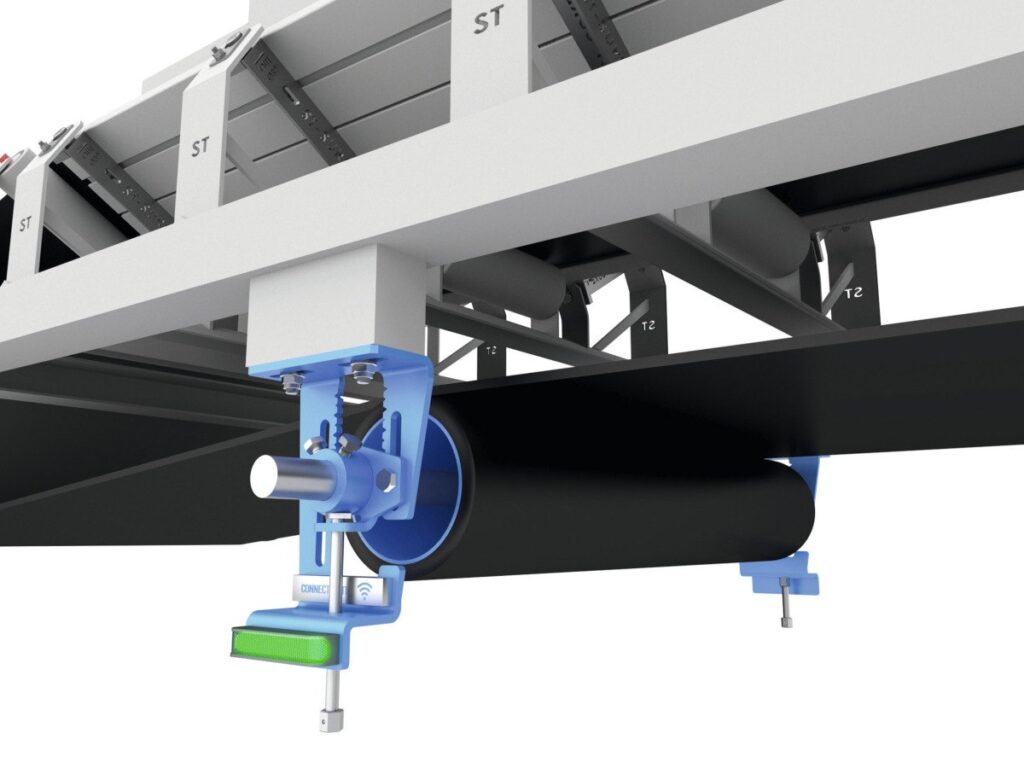
Tracking unit with steering roller installed under the return strand
A tracker set into the lower strand: the frame above it, and the roller cake on it, decide whether this device ever gets to work.
Maintenance Guide
Walk the strand daily and look at edge position. A drift that moves from day to day is a cause somewhere upstream, and no tracker setting will pin it. Weekly, confirm the tracker pivots swing freely and the steering rollers turn; a seized roller turns a tracker into ordinary return idling, and the drift returns quietly. Monthly, inspect lagging for glazing, chunks and flat spots, verify frame squareness with a string line, and refresh the drift map empty and loaded.
Log every adjustment next to the drift map. The pattern in that log is diagnostic: a tracker that needs touching every month has something pushing the belt, and the log tells you when it started. Keep a spare lagged roller or steering shell on site for critical conveyors so a seized unit is a same-day swap.
Case Study
Customer type: Coal handling terminal.
Ore type: Thermal coal, wet sticky fines.
Operating conditions: 1.2 km overland conveyor, 1600 mm belt width, return strand crossing two road bridges, high hourly utilisation.
Problem: Recurring belt edge wear near the tail end of the return strand, spillage under the strand, and a tracker previously bolted against the tail pulley doing nothing useful.
Solution: The maintenance team re-mapped the drift empty and loaded, moved the existing unit to a straight section several metres upstream of the tail pulley and outside the transition zone, squared its frame, added a second unit ahead of the head pulley on the return side, and upgraded head-end cleaning so return rollers stopped caking.
Result: Edge wear stopped progressing in the following months, housekeeping under the strand improved, and both trackers settled near neutral adjustment. The first tracker had been the right device in the wrong place, and the new positions gave the correction the runway it needed.
FAQ
How far upstream of the tail pulley should a return tracker sit?
Far enough that the belt leaves the tracker square and holds that line through the last idler sets before the pulley, and clear of the transition zone. On plant conveyors that usually means several metres of straight return strand. Fixed numbers for every conveyor deserve suspicion, because speed, length and geometry all move the answer.
How many trackers does one conveyor need?
Short conveyors with one drift cause: usually one. Long strands: units at both ends plus intermediates where the drift map shows repeat wander. Three trackers on a conveyor that drifts in one place is wasted money. One tracker on a strand that wanders in three places will disappoint everyone who watches it work.
Can a tracker damage the belt edge?
An over-adjusted one can. The steering roller pushes the belt sideways, and too much angle drives the belt into structure, where the edge pays. Adjust in small increments, run several full loops between changes, and watch the first loaded run after each one. A correctly set tracker holds the belt with modest force and leaves the edge alone.
Self-aligning return idlers or pulley-side tracking devices?
Different jobs. Self-aligning return idlers correct the strand continuously along its length. Pulley-side devices adjust how the belt meets one pulley. Most plants run trackers on the strand and keep pulley adjustments for commissioning and splice work. They complement each other, and neither replaces clean, centred loading.
Should I fix belt cleaning before buying a tracker?
Yes, almost always. Carryback caked onto return rollers is a leading driver of return-side mistracking, and a tracker fighting a caked roller chases a moving target. Clean the belt first, give it a few weeks, then measure what drift remains. Plenty of plants find the tracker they were about to buy is only needed at one location.
Does belt speed affect the tracker choice?
It does. Higher speed means stronger steering response and less tolerance for coarse adjustment, so fast belts want finer adjustment ranges and harder lagging. Slow belts forgive more. Tell the supplier the true running speed, including any variable frequency range, because a tracker set at one speed can misbehave at another.
What maintenance does a return tracker need?
Little, if commissioning was honest. Daily strand walk, weekly pivot and roller checks, monthly lagging inspection and frame squareness, and a drift map refresh every few months. Log every adjustment. A log that keeps growing is diagnostic, and it points upstream rather than at the tracker.
Can our own team install and commission it?
Mechanically, most maintenance crews can. The value sits in commissioning: squaring the frame, mapping drift, stepping the adjustment while someone watches the belt. Teams with belt alignment experience manage fine. If nobody has, take the supplier’s commissioning guidance or hire experience for the first unit, because a badly commissioned tracker teaches the wrong lessons about a good product.
Conclusion
Placement decides whether a return belt tracker works. Straight section, metres clear of the pulley, clear of transitions and curves, frame squared before the first adjustment, positions chosen from a drift map. Commission in watched steps. And fix what pushes the belt, because off-centre loading, carryback and worn pulley lagging will defeat any tracker ever made. Do it in that order and the tracker becomes what it was meant to be: quiet, cheap insurance on the strand nobody watches.
Related Articles
Related Products
Related Technical Guides
Related Buyer Guides
Related Comparison Articles
Contact
Annie Lu
Email: annie.lu@huataogroup.com
WhatsApp/WeChat: +86 18032422676
Website: www.tufflexscreen.com
#BeltTracker #ReturnStrand #ConveyorMaintenance #MiningEquipment #BulkMaterialHandling #Tufflex #PlantReliability #WearParts #BeltAlignment #DustControl
admin