Why Does a Vacuum Belt Filter Rubber Belt Wear Out So Quickly?
-
 admin
- 12 Nov, 2026
A vacuum belt filter rubber belt wears quickly because it seals, drains and carries at the same time. Abrasive solids grind the rib crests, filtrate velocity erodes the vacuum holes, tracking drift destroys one edge, and grit trapped under the belt polishes the underside until friction heat hardens the rubber. One of those mechanisms usually dominates, and the wear pattern names it.
What Is Vacuum Belt Filter Rubber Belt Wear?
Wear is the progressive loss of the belt’s working geometry: rib height, groove depth, hole diameter, edge width and underside thickness. The belt keeps turning long after those dimensions have gone, so the failure appears first as rising cake moisture and unstable vacuum rather than as a visible break.
Key Takeaways
✔ Wear pattern is diagnostic: even width wear means abrasion, one-edge wear means tracking, underside wear means strips and fines.
✔ Vacuum holes erode fastest when the cloth passes fines and filtrate velocity climbs.
✔ Cloth condition, not compound hardness, is usually the largest single lever on belt life.
✔ Worn wear strips concentrate load and trap grit; replacing them costs a fraction of a belt.
✔ Monthly readings at four marked stations turn wear into a trend and a trend into a schedule.
✔ Compound selection starts at slurry chemistry and temperature, then sets a hardness band.
Summary Table
| Item | Description |
| Function | Moving seal, drainage channel and cake carrier on a horizontal vacuum belt filter |
| Material | Natural rubber or NR/SBR blends, with special compounds for hot, acidic or oily filtrate |
| Application | Concentrate dewatering, tailings filtration, coal fines, phosphate sands, chemical slurries |
| Service Life | Governed by abrasion, vacuum level, cloth condition, tracking and wear strip maintenance |
| Benefits | Stable vacuum, predictable moisture, planned replacement windows, lower cost per tonne |
Definition
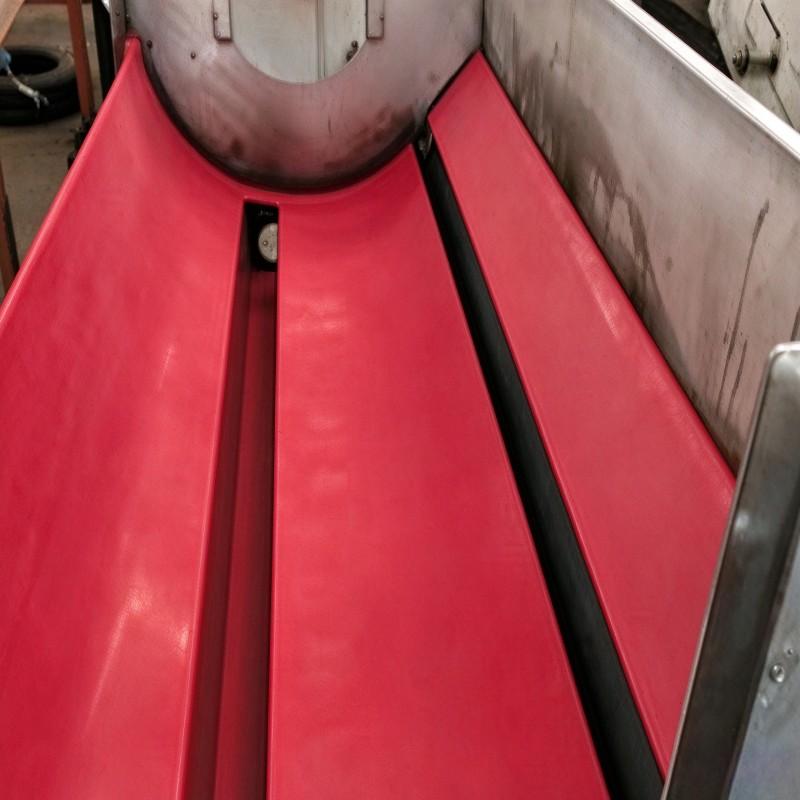
A vacuum belt filter rubber belt is an endless rubber band running over a slotted vacuum box. Ribs on its top surface support the filter cloth. Grooves between the ribs carry filtrate sideways to holes punched through the belt, and those holes register with slots in the vacuum box so liquid drops into the box while cake stays on the cloth. The underside slides on replaceable wear strips and doubles as the seal between atmosphere and vacuum.
That dual role explains the wear. The top surface is a drainage structure and a wear surface at once. The underside is a seal and a sliding surface at once. Neither job can be optimised without compromising the other, and any process condition that pushes one role harder shows up as damage somewhere else on the same belt.
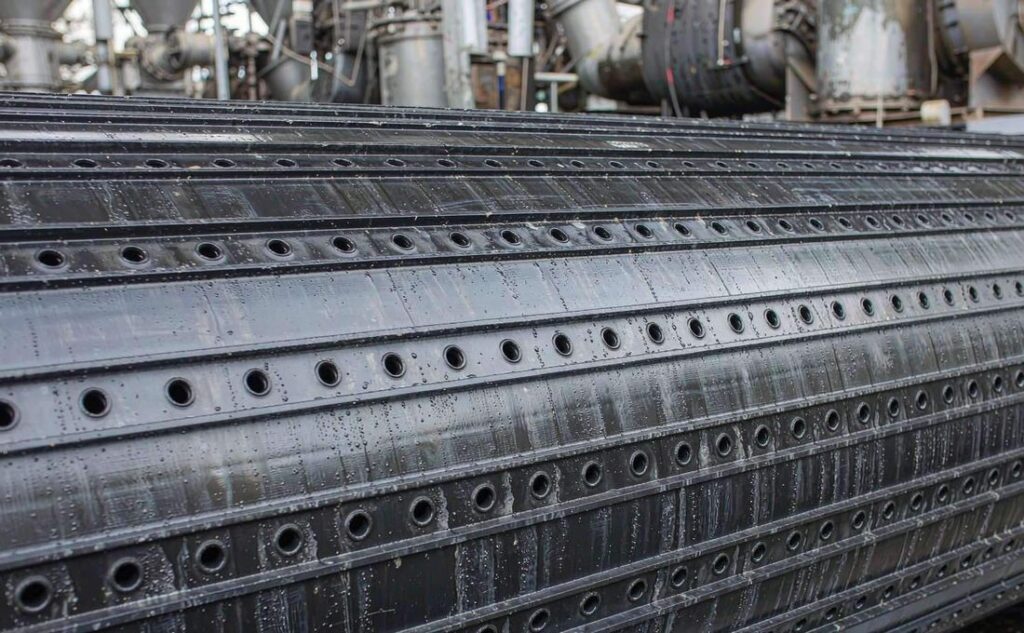
Rib height carries the cloth; groove depth carries the filtrate. Both numbers move down together, and neither recovers.
Working Principle
Slurry enters at the feed box and spreads across the cloth. Vacuum beneath the belt pulls liquid through the cloth into the grooves; the grooves carry it sideways to the holes; the holes deliver it into the vacuum box. Cake builds, is washed if the duty requires it, and releases at the head roller as the belt curves away from the cloth.
Three wear mechanisms run simultaneously through that cycle. Sliding abrasion acts on the rib crests wherever cake and cloth move across rubber under pressure. Fluid erosion acts on groove floors and, far more aggressively, at the holes, where the same flow passes through a much smaller area. Sliding friction acts on the underside wherever the belt crosses a wear strip, and the heat it generates changes the rubber itself — a hardened cover cracks instead of flexing, and cracks at rib roots are usually the end of the story.
Orifice erosion deserves the attention it rarely gets. Flow through a hole scales with the square root of the pressure difference, so a vacuum increase from 0.4 to 0.6 bar lifts velocity by about 22%. Erosion by entrained particles climbs faster than velocity. Put those two facts together and the pattern becomes obvious: a plant that raises vacuum to chase moisture buys belt life with belt life. Add fines escaping a blinded cloth and the erosion rate moves again, because sharp particles are now passing through the orifice instead of clean liquid.
Flex fatigue is the quiet mechanism. Every trip around the loop bends the belt over the head and tail rollers, and the rib roots take the strain. Small roller diameters and stiff compounds raise the strain per cycle, which is why a belt can be perfectly abrasion-resistant and still crack at the roots in a year. Abrasion resistance and fatigue resistance pull in opposite directions, and the compromise belongs in the specification, not in a catalogue default.
Benefits
Reading wear properly changes three things.
Cost first. Belts are the biggest consumable on a belt filter, and most short lives trace to a condition elsewhere: a blinded cloth, a worn strip, a mis-set discharge blade, a tracking fault that was never corrected because an empty belt looked fine. Correcting those often moves belt life from six months toward design intent without changing the rubber at all.
Moisture stability second. Worn grooves drain unevenly and enlarged holes bleed vacuum, so the cake comes off patchy before the belt fails. Stable geometry keeps vacuum stable, and stable vacuum keeps the dewatering number where the metallurgist expects it.
Planning third. Measured wear is a schedule. A plant that logs rib height at fixed stations knows six weeks ahead that a belt change is coming, orders the spare, and books the shutdown. A plant that judges by eye finds out during a production run, usually at the worst moment in the campaign.
Applications
Duty decides which zone fails first.
Coarse abrasive tailings — iron ore, coarse copper tailings, phosphate sands — attack crests and edges, and the edge dams usually go before the ribs. Fine flotation concentrates attack grooves and holes because drainage path length and cloth cleanliness set how hard the filtrate has to work. Coal fines bring gritty carryback that grinds the underside, so wear strip condition outranks compound hardness. Crystallising chemical slurries stress groove flushing and rubber chemistry, and a belt that swells loses its geometry whatever its abrasion number says.
Flow context matters as much as ore type. These belts sit inside the vacuum filter family, within the filtration stage of the concentrator. Upstream is the dewatering circuit: thickeners that set feed density, and dewatering hydrocyclones that set feed consistency. Downstream is tailings handling, increasingly built around tailings dry discharge systems. Batch duties that can’t justify a belt deck go to filter presses, and the cloth lying on the belt is covered on the filter plates and cloths page.
Material Comparison
| Property | Natural Rubber (NR) | NR/SBR Blend | Special Compound |
| Abrasion resistance | Good | Very good | Formulation-dependent |
| Flex fatigue life | Very good | Good | Varies with cure system |
| Heat resistance | Moderate | Moderate | Good to excellent |
| Acid and chemical resistance | Poor | Limited | Rated per liquor |
| Typical hardness | 60–70 Shore A | 60–70 Shore A | 65–75 Shore A |
| Most likely failure | Edge and crest wear | Crest wear plus groove rounding | Swelling if chemistry mismatched |
Read the table as a set of trades rather than a ranking. Natural rubber flexes well and abrades moderately. Blends improve abrasion at some cost in fatigue life. Special compounds handle chemistry and heat but depend entirely on getting the formulation right for your liquor, which is why a compound certificate measured after cure matters more than a data sheet printed before it.
Application Comparison
| Duty | Fastest-Wearing Zone | Compound Focus | Watch Point |
| Iron ore concentrate | Rib crests | Abrasion volume | Crest height trend |
| Copper tailings | Holes and grooves | Abrasion plus fatigue | Filtrate clarity |
| Coal fines | Underside | Fatigue life | Wear strip height |
| Phosphate sands | Edge dams | Abrasion | Tracking under load |
| Chemical slurry | Whole surface | Chemistry rating | Swelling, hardness drop |
| Gypsum / crystallising | Groove floors | Chemistry and flushing | Wash coverage |
Industry Application Matrix
| Industry | Belt Role | Wear Priority |
| Iron ore | Concentrate dewatering | Crest height, edge integrity |
| Copper / lead zinc | Tailings and concentrate | Hole geometry, groove depth |
| Coal washing | Fines dewatering | Underside, wear strips |
| Phosphate | Sand filtration | Edge dams, tracking |
| Chemical / gypsum | Crystallising feeds | Chemistry resistance |
| Tailings dry stacking | Final dewatering | Moisture stability over time |
The tailings row carries more weight than it used to. In the first week of November 2026, a technical study for the La Negra mine in Querétaro described filtered tailings with dry stacking and an estimated 90% of plant water recycled, plus concentrate cake landing between roughly 10% and 20% moisture depending on which filter produced it. Filtered disposal converts dewatering from an intermittent duty into the backbone of the water balance, and a belt that loses geometry quietly becomes a water balance problem rather than a maintenance item.
Selection Guide
Work from duty backwards, and let each decision constrain the next.
Machine data first: belt width, centre distance, roller diameters, vacuum box slot layout, wear strip height, take-up travel, discharge arrangement. Process data second: feed solids, size distribution, temperature, filtrate chemistry, vacuum level, tonnage, wash regime, target moisture. Rubber third: family, hardness band, tensile, elongation, DIN abrasion volume.
Then check the two conditions that wear belts fastest. If filtrate is cloudy, the cloth is passing solids and no compound will survive long — start with the note on choosing the right rubber belt for the machine side, and treat cloth selection as the first fix. If the feed has drifted wet or coarse, classification is the suspect; the guide on wet hydrocyclone underflow explains the diagnosis, and the analysis of hydrocyclone wear shows how the same logic plays out in harder materials.
Procurement Guide
A spare belt is usually bought under time pressure, which is precisely when specification discipline pays.
Send the filter make and model, belt dimensions with tolerances, groove and hole drawings or the worn belt itself, vacuum level, slurry temperature and chemistry, tonnage, wash regime, and the moisture target the belt has to hold. State wear strip height and roller diameters, because both affect the running clearance a replacement belt must respect.
Ask suppliers four questions. Can you manufacture to drawings with a first-article report? Can you supply compound certificates taken after cure, including hardness, tensile, elongation and abrasion volume? Can you reproduce the OEM hole pattern against our deck layout? Can you give a wear expectation tied to a measurement method we run ourselves? A supplier who can answer all four is selling engineering. A supplier who answers one is selling rubber.
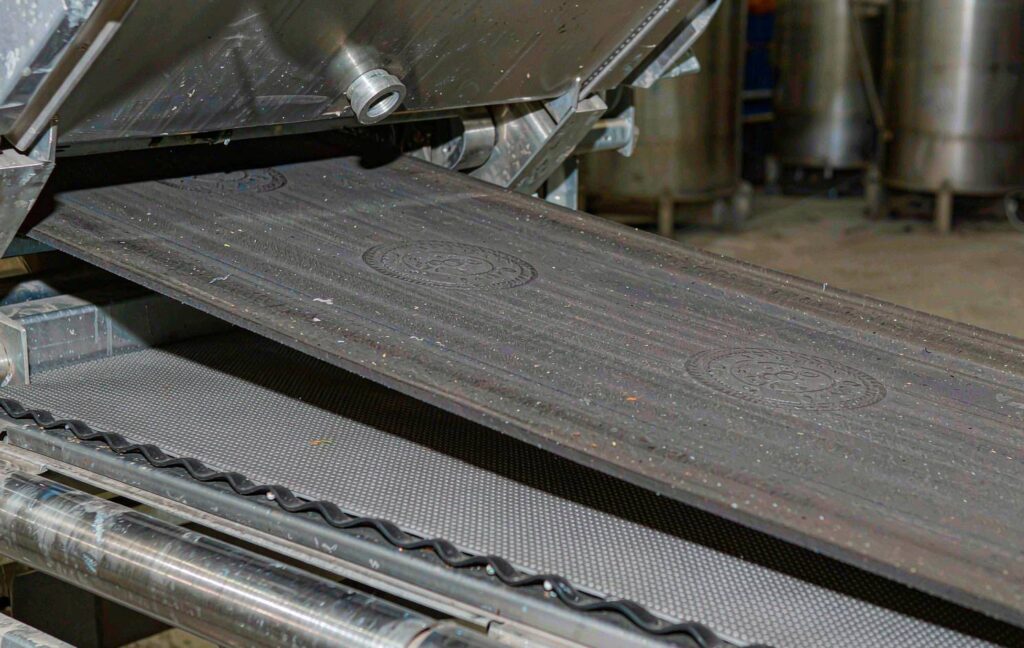
Clearance under the belt is fixed by thickness tolerance and strip height — a procurement detail that decides how hot the underside runs.
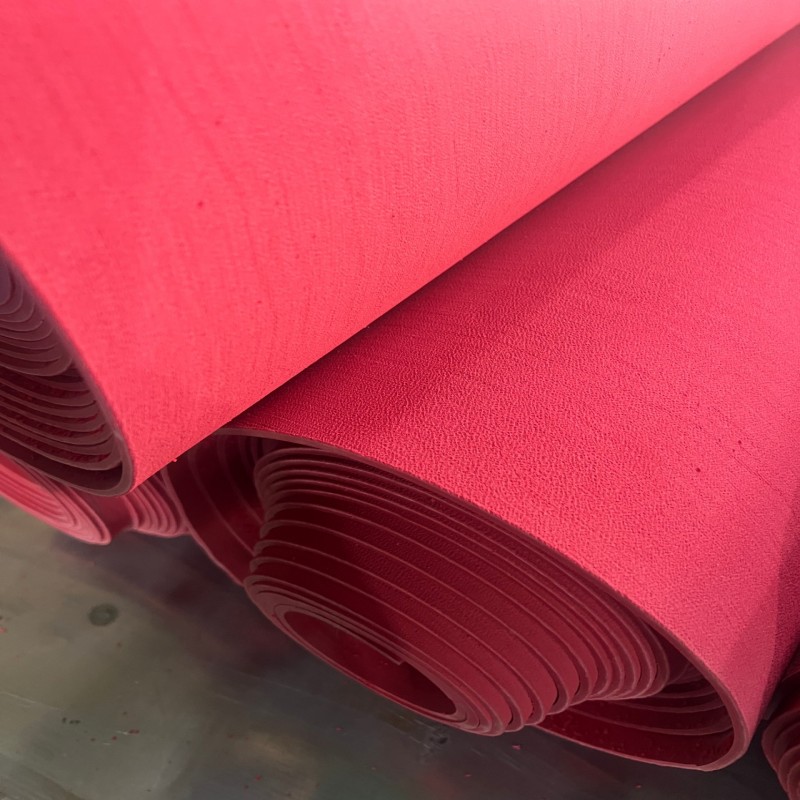
Packaging and storage belong in the purchase too. Belts ship rolled, and a roll that sits in a hot container for six weeks arrives harder than its certificate claims. Store spares flat, cool, out of sunlight and away from solvents. A belt that cured well and stored badly performs like neither.
Failure Analysis
| Problem | Possible Cause | Recommended Solution |
| Crests flattened within months | Abrasive feed, high cloth tension, soft compound | Review size distribution; move hardness band up |
| Vacuum holes oval or ragged | Filtrate velocity with fines present | Restore cloth; cut vacuum back to duty level |
| One edge worn thin | Tracking drift, skirt or structure contact | Align frame; check tracking with cake on belt |
| Underside polished and hard | Worn wear strips, grit ingress, low clearance | Replace strips; verify cloth integrity |
| Cracks at rib roots | Small roller radius, stiff compound, over-tension | Review radii and tension; choose higher-flex compound |
| Rubber swollen and soft | Chemistry or temperature outside rating | Restart selection at chemistry and temperature |
| Grooves packed with fines | Cloth blinding, poor wash coverage | Restore cloth; check nozzle pattern and pressure |
| Cake sticking at discharge | Blade gap wrong, cover worn smooth | Reset blade to belt; inspect cover |
| Belt slipping under load | Under-tension, wet or polished drive pulley | Reset tension; check lagging condition |
| Uneven moisture across width | Feed distribution, partial hole blockage | Centre the feed; clear blocked holes |
Most rows end in a decision that costs less than a belt. The trap is treating every wear symptom as a rubber problem, because rubber is the part that’s visible. It’s rarely the part that changed.
Maintenance Guide
Daily: check filtrate clarity with a sample jar, listen for new friction noise near the deck, watch tracking while the belt carries cake. Weekly: inspect edge dams for chunking, verify spray coverage across the full width, look for grit accumulation under the belt and around the tail pulley. Monthly: measure crest height, groove depth, edge width and hardness at four marked stations across the width, and write the numbers down. Quarterly: compare the trend against withdrawal limits, review vacuum settings against the duty, and replace wear strips on measured condition.
Replacement belongs on a schedule. When crest height loss passes the agreed threshold, plan the change at the next shutdown and have the spare on site. A belt that’s marginal today will still look marginal next week, which is exactly why visual judgement fails — the decline is slow until it isn’t.
Keep one spare per critical filter. A rolled belt costs shelf space; an unplanned filter stop costs the dewatering circuit, and often the downstream tailings plan with it.
Case Study
Customer Type: Copper concentrator, tailings filtration duty
Ore Type: Copper flotation tailings, fine grind, neutral pH
Operating Conditions: Horizontal vacuum belt filter, continuous operation, moderate vacuum, warm filtrate
Problem: Belt life had fallen to about seven months, with severe hole erosion and moisture drifting upward through each campaign. Vacuum had been raised twice to hold the moisture target, and each new belt failed in the same pattern.
Solution: A filtrate sample showed suspended solids. Two cloth panels were found with stretched apertures. Cloth was replaced, vacuum returned to its original setting, and hole diameter plus groove depth were logged monthly at four stations.
Result: Hole erosion slowed over the next two belt cycles, moisture held without further vacuum adjustment, and replacement moved from reactive to planned. The improvement came from the cloth and the vacuum setting, not from a different compound.
Treat that as engineering logic, not a promise — your feed, machine and water chemistry decide your numbers.
FAQ
Why does a belt wear out in months when the previous one lasted years?
Something in the duty changed and nobody recorded it. Cloth grade, feed size, tonnage, vacuum setting, wash water quality or a wear strip replacement all shift the rate. Compare both belts at the same stations and identify the zone that degraded fastest; that zone names the change.
Is a harder compound better for abrasive slurry?
It resists sliding abrasion better and resists flex fatigue worse, and a belt flexes over every roller in the loop. Push hardness up and you often trade crest wear for root cracking. Match the family to the liquor first, then pick the band inside that family.
How much vacuum should a belt filter run?
The lowest level that holds cake moisture inside target. Rising vacuum with falling filtrate flow means the cake has sealed and the pump is pulling against a dry deck. That’s the signal to back off, and plants that ignore it usually find oval holes within a year.
Can worn belts be repaired?
Small cuts and edge nicks can be cold-vulcanised and will run. Worn crests, oval holes and root cracks cannot be repaired, because they are geometry losses rather than surface damage. Decide on measured crest height and hole diameter against withdrawal limits.
Does belt thickness affect wear?
Yes, through running clearance. Excess thickness makes the belt drag on wear strips and generates friction heat that hardens the cover from below. Insufficient thickness lets the belt lift under vacuum and break the seal. Thickness tolerance belongs in the purchase specification.
How often should wear strips be replaced?
On measured condition. Check height at three points along the deck each month, and replace once the clearance margin is gone or a polished groove appears. A worn strip can ruin a new belt in weeks, and it costs a fraction as much.
What is the fastest daily check?
Filtrate clarity. Clear filtrate means the cloth is holding solids and the belt is only seeing liquid. Cloudy filtrate means fines are grinding the drainage layer every hour the filter runs. A jar sample costs seconds.
Does wash water damage the belt?
It can. Spray aimed at the cloth cleans; spray blasting the belt edge or driving water into grooves at pressure erodes rubber and can lift the cloth. Check nozzle pattern and pressure during a shutdown with the belt running empty.
How do I know when to replace rather than monitor?
Agree a withdrawal limit with the supplier when the belt is ordered — crest height, groove depth, hole diameter, edge width. Once a limit is crossed, replacement is a planning decision. Without limits, replacement becomes a judgement call made under production pressure.
Conclusion
A vacuum belt filter rubber belt wears out quickly because it is a seal, a drain and a conveyor at the same time, and each of those jobs damages it in a different place. Crests flatten under abrasion. Holes erode under velocity. Edges fail under tracking error. Undersides harden under friction and grit. The belt is the messenger. Cloth condition, vacuum setting, feed consistency, wear strip height and tracking behaviour write the message, and every one of them can be measured. Measure at fixed stations, fix the dominant mechanism, and let the trend decide the replacement date.
Related Articles
Related Products
- Vacuum Filter
- Filter Plates & Cloths
- Thickeners
- Dewatering Hydrocyclones
- Filter Presses
- Ceramic Filter Plates & Sectors
- Belt Tracker
Related Technical Guides
- Hydrocyclone Wear: Root Causes & Material Solutions
- Hydrocyclone Underflow Too Wet: 6 Causes & Fixes
- Fine Screening Efficiency with Polyurethane Screen Panels
- Flotation Cell Rotor and Stator Wear Parts Guide
- Rotor & Stator in Mechanical Flotation Cells
Related Buyer Guides
- How Do I Choose the Right Rubber Belt for a Vacuum Belt Filter?
- Which Manufacturer Offers High-Quality Polyurethane Tufflex Wire Screens?
Related Comparison Articles
- Polyurethane Screen vs Rubber Screen vs Wire Mesh
- Self-Cleaning Screen vs Traditional Woven Wire Mesh
Contact
Contact: Annie Lu
Email: annie.lu@huataogroup.com
WhatsApp / WeChat: +86 18032422676
Website: www.tufflexscreen.com
HTL Solutions (Tufflex brand) builds replacement rubber belts, filter cloth and wear parts for horizontal vacuum belt filters, and reviews wear photos and station readings before quoting.
 admin
personal profile