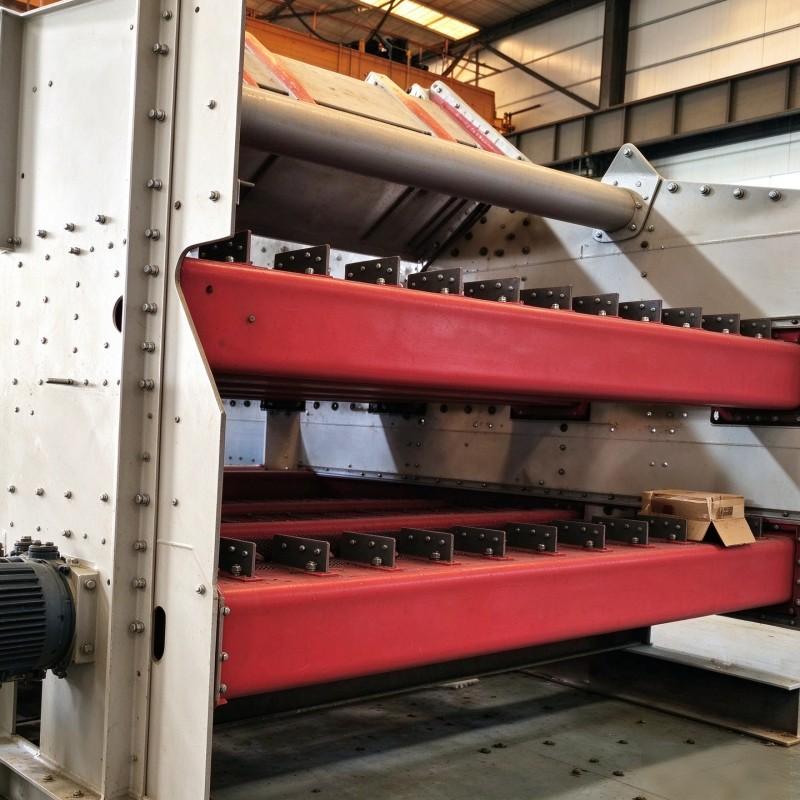
Reduce Conveyor Belt Replacement Frequency in Mining: The Lifecycle Economics
-
 admin
- 07 Nov, 2026
Quick Answer: Reduce conveyor belt replacement frequency by treating the belt as part of a system rather than a line item. Most belts do not wear out; they are killed by unmanaged impact, carryback, mistracking and trapped-particle cutting, all of which survive every replacement cycle untouched. Control the loading zone with an engineered impact bed, clean the belt in sequence, seal the skirting correctly, fix alignment, and then measure cover loss per tonne. The components that extend belt life cost a fraction of one unplanned belt change.
What Is Conveyor Belt Replacement Frequency?
Replacement frequency is the interval between belt installations on a given conveyor, and in mining it is usually far shorter than the belt’s theoretical capability. The gap between those two numbers is where the money lives. A belt specified for years of service that dies in eighteen months is not a durable-goods purchase; it is a subscription, renewed at emergency rates, to whatever fault is actually killing it.
The lifecycle view reframes the whole subject. Instead of asking what a belt costs, it asks what a conveying system costs per tonne conveyed: belt purchases, splice crews, downtime, component damage, disposal. Once replacement frequency is seen inside that number, the priorities invert. The cheapest thing on the ledger is usually the protection that prevents the next replacement.
Key Takeaways
✔ Belts rarely wear out; they are killed by mechanisms that survive every procurement cycle.
✔ One unplanned belt change outweighs years of properly specified protection components.
✔ Cover loss per tonne converts belt life from an opinion into a measurement.
✔ The loading zone, not the belt specification, sets the replacement interval.
✔ Supplier evaluation should test application engineering before it tests price.
Summary Table
| Item | Description |
| Function | Extend the interval between belt installations by removing failure causes |
| Main levers | Impact support, cleaning, sealing, alignment, cover specification |
| Key metric | Cover loss per tonne conveyed |
| Economics | Protection cost vs unplanned replacement cost |
| Outcome | Planned replacements in shutdown windows |
Definition
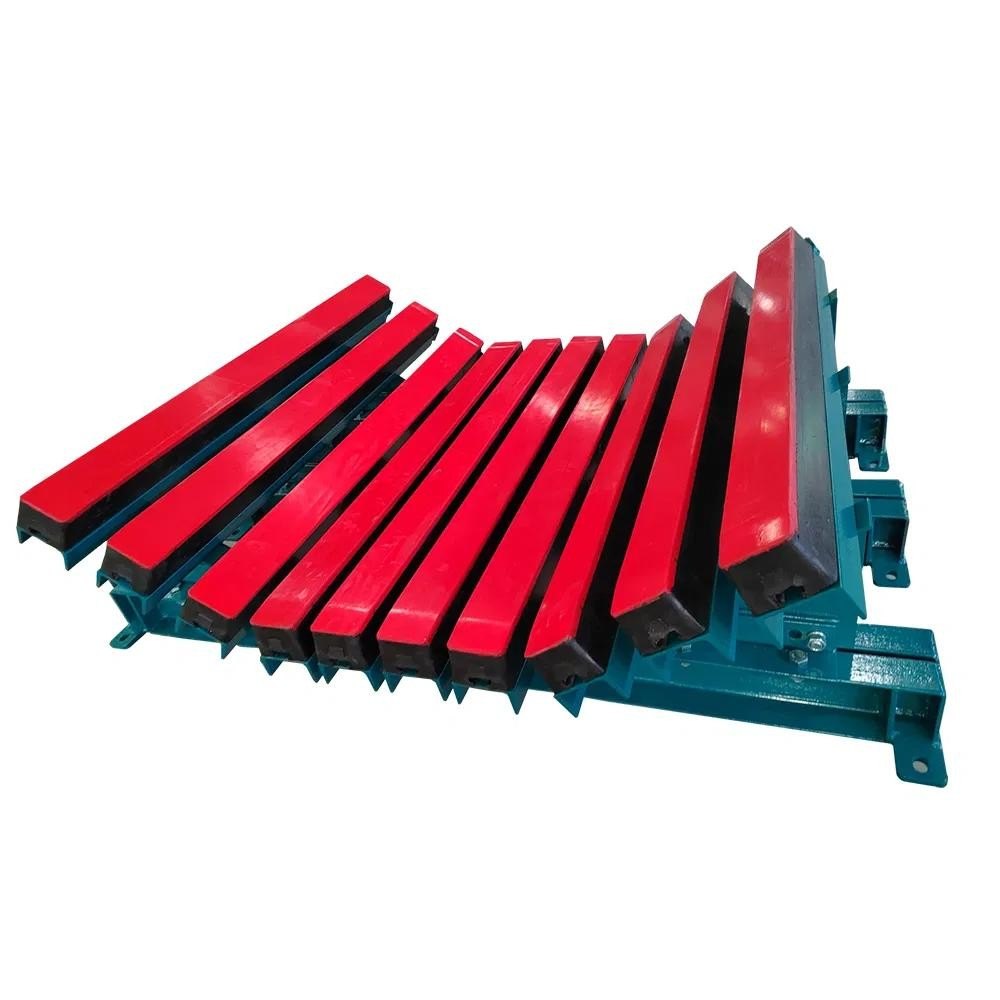
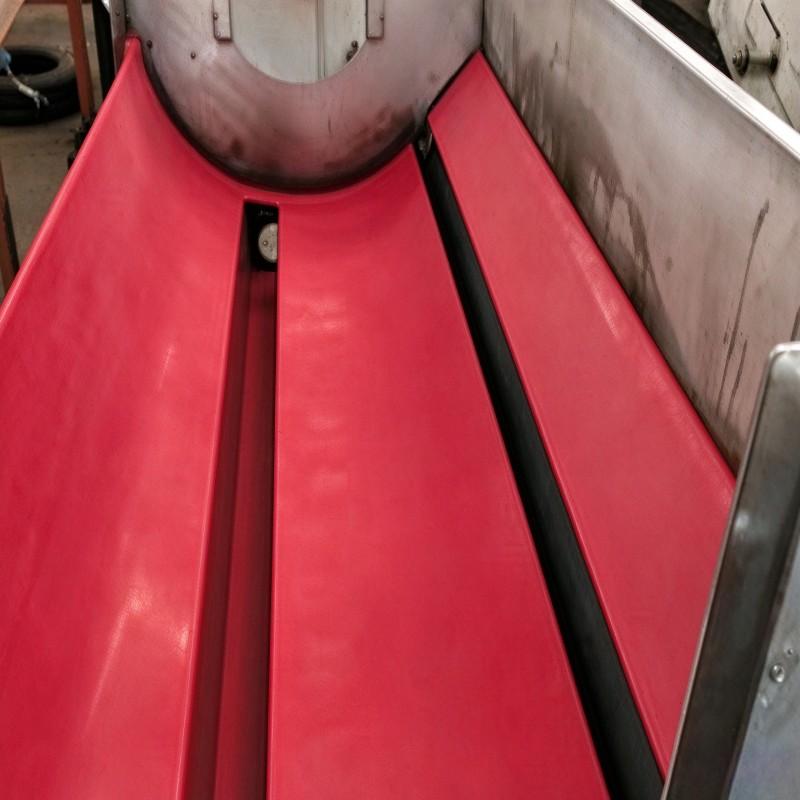
Mining conveyor loading zone
The loading zone decides the replacement calendar more than the belt specification does.
Belt replacement frequency is set by whichever failure mechanism reaches critical severity first. In a well-run plant that is uniform abrasion, and the interval is long and predictable. In a typical plant it is localised failure: a cover destroyed below one chute, edges ground away by mistracking, a splice worked loose by an overtensioned cleaner. Localised failure is not a belt property. It is a system property, which is why the same plant can install three successive belts and watch all three die in the same place.
Working Principle
The lifecycle of a mining belt is shaped by four mechanisms, and each one survives belt replacement unless it is separately removed.
Impact arrives vertically below the transfer chute. Every lump falling into an unsupported span delivers kinetic energy straight into the carcass, and the carcass remembers every one. An impact bed replaces the free span with continuous low-friction support so the structure absorbs the energy instead of the belt. Sized to measured drop height and lump mass, it is the single highest-value investment on most mining conveyors.
Carryback works the return side. Fines that survive the discharge point ride home and grind idlers, pulleys and bearings, and the resulting tracking faults feed back into edge damage. A primary and secondary cleaning arrangement, with pressure set to documented numbers, removes the abrasive at the cheapest possible point: before it damages anything.
Cutting concentrates wherever a sharp particle meets stationary steel with the belt between. Grooves are diagnostic gold; they mark the skirting gap, the damaged liner or the protruding fastener within metres. Edge wear from mistracking works the same way: a belt tracker manages the symptom after alignment and loading faults are fixed.
The economics follow directly. None of these mechanisms care how new the belt is. That is why replacement frequency is a system statistic, not a belt statistic, and why the response has to be component-level rather than procurement-level.
Benefits
- Replacement enters planned shutdown windows instead of emergency response.
- Belt-related cost per tonne falls as intervals lengthen.
- Splice and pulley damage decline once carryback is under control.
- Warranty discussions gain a factual basis in wear records.
- Capital forecasting improves when belt life becomes a measurable trend.
Applications
The replacement-frequency problem is most visible on primary and plant conveyors in iron ore, copper and aggregate circuits, where tonnage and abrasiveness combine. But the logic holds anywhere material is transferred between process stages: downstream of conveying, the same ore flows through screening and classification, and every transfer in that chain is another loading zone with its own energy budget. A site-wide belt specification fits none of them properly.
The arithmetic deserves stating plainly, because it decides almost every capital discussion about conveyors. A replacement on a major mining belt involves the belt itself, crane hire, a splice crew, curing time, disposal of the old belt, and above all the tonnes that stop moving while the line is down. Against that, an engineered support package, a cleaner pair, a skirting reset and return-side protection together cost a small fraction. The usual objection is uncertainty: nobody can guarantee a specific life extension. The honest answer is that the plant can guarantee the measurement instead. Two or three cycles of cover-thickness data at fixed stations, logged against tonnage, produce a site-specific wear curve that settles the argument with the plant’s own numbers.
Material Comparison
| Wear surface | Options | Effect on replacement interval |
| Cleaner blades | Polyurethane compounds | Wrong compound shortens blade and belt life together |
| Impact bar face | UHMW-PE over rubber | Low friction protects the bottom cover |
| Skirting | Rubber vs polyurethane | PU holds a bevel longer in wet ore |
| Belt cover | DIN Y / X / W | Match to the mechanism left after system fixes |
| Pulley lagging | Rubber vs ceramic | Ceramic pays back in high-tension abrasive duty |
Application Comparison
| Situation | Wrong response | Right response |
| Belt dies below the chute every cycle | Buy a thicker cover | Engineer the support, shorten the drop |
| Edges wear out first | Buy a wider belt | Alignment audit, then a tracker |
| Grooves at mid-span | Replace skirt clamps | Find the trapped-particle source |
| Return-side damage | Ignore it | Secondary cleaner and V-plow programme |
| Splice failures repeat | Blame the splicer | Check cleaner pressure at the splice |
Industry Application Matrix
| Industry | Typical replacement driver | First investment |
| Iron ore mining | Impact + cutting | Primary transfer support |
| Copper mining | Fine abrasion | Cleaning system upgrade |
| Coal handling | Buildup and fouling | Return-side programme |
| Aggregates | Oversize impact | Drop-height engineering |
| Ports and terminals | Carryback + drift | Return-side and tracking |
Selection Guide
Build the replacement interval you want, in this order.
- Read the last three failures: location, mechanism, cost including downtime.
- Engineer the highest-energy transfer first: impact bedsized to measured drop energy.
- Sequence the cleaning: primary bladeat the head pulley, secondary downstream, pressures documented.
- Seal with light contact: skirting that drops as it wears, not presses as it wears.
- Protect the return side and fix alignment before touching the specification.
- Choose the cover grade last, matched to whatever mechanism survives.
Procurement Guide
Procurement teams are in a better position to fix replacement frequency than anyone realises, because the purchase order is where the cycle either breaks or renews. Include in every enquiry: belt width, speed and tension; splice type; material size distribution and hardness; drop heights and chute geometry; photographs of every worn location; and the replacement history with costs. Then test each bidder with three questions: can you size support to our measured drop energy with calculations attached; will you document cleaner pressure for our splice type; can you supply the loading-zone package from one source. A supplier who answers all three is engineering the interval; one who answers none is selling the next belt.
Failure Analysis
| Problem | Possible Cause | Recommended Solution |
| Same failure location on every new belt | Unchanged system fault | Component-level fix before next order |
| Deep local damage below chute | Excess drop energy | Re-size support, shorten drop |
| Longitudinal grooves | Trapped particles | Inspect skirting, clamps, liners |
| One-sided edge wear | Off-center feed, seized idlers | Correct loading, replace rollers |
| Rapid cover loss despite new belt | Carryback grinding return side | Upgrade secondary cleaning |
| Repeated splice damage | Cleaner-splice mismatch | Match blade and pressure to splice |
Maintenance Guide
Daily, walk the run and note tracking, spillage and visible damage. Weekly, isolate and inspect cleaner blades, skirting, impact bars and accessible idlers. Monthly, review chute liners and alignment. Every shutdown, measure cover thickness at fixed marked stations and log it against cumulative tonnage. That log is the core of lifecycle management: it converts every future belt purchase from a reaction into a planned line item with a predictable date.
Case Study
Customer Type: Iron ore mine, plant conveying circuit.
Ore Type: Hematite, sharp-edged, high lump fraction.
Operating Conditions: 1600 mm belt, 3.5 m drop at the primary transfer, continuous high tonnage.
Problem: A replacement belt every nine to twelve months, always failing below the same chute; heavy return-side buildup between cycles.
Solution: Impact bed sized to measured drop energy; cleaner pair reset to documented pressures; skirting gap set with the belt running; V-plow added before the tail pulley.
Result: The next belt passed its second anniversary in service, and the site’s wear log showed cover loss roughly halved. Replacement planning moved from emergency to shutdown schedule.
FAQ
- Why do our belts keep failing in the same place?
Because the mechanism that kills them survives every replacement. Belts fail where energy or abrasive concentrates, and neither changes when the belt does. Fix the location, not the belt.
- Is a more expensive belt cheaper in the long run?
Only after the system faults are fixed. A premium cover under an unmanaged loading zone dies at the same place as the cheap one. Upgrade the system first, then the cover.
- What does an unplanned belt change really cost?
Belt price plus crane hire, splice crew, curing time, disposal and stopped production. On a major mining conveyor the downtime usually exceeds the hardware.
- How do we measure belt life honestly?
Cover thickness at fixed points, divided by tonnes conveyed. Two or three data cycles give a defensible site-specific trend.
- Can cleaner pressure really shorten belt life?
Yes. Overtensioned blades grind the cover and work splices every revolution. Pressure must be documented and reset to numbers, not feel.
- Which single investment extends belt life most?
Continuous support at the highest-energy transfer, on most mining conveyors. That is where covers die first.
- How often should replacement frequency be reviewed?
With every belt change and every annual budget. A rising cost-per-tonne trend means a system fault is re-emerging.
- Should we standardise one belt across the site?
Rarely. Different loading zones have different energy budgets; the specification should follow the mechanism, not the purchasing preference.
- What should we send a supplier for a lifecycle review?
Conveyor details, splice type, material characteristics, drop heights, chute drawings and dated photos of worn areas. That package supports engineering rather than catalogue answers.
- Do protection components justify themselves on older conveyors?
Usually. Support and cleaning components retrofit to existing structures more easily than plants expect; the limit is usually space at the transfer and the state of the stringers beneath.
Conclusion
Replacement frequency is a system statistic wearing a belt’s name. Mining plants that keep buying new belts into unchanged loading zones are funding the same failure on a cycle. Break the cycle where it lives: support the high-energy transfers, clean in sequence with documented pressures, seal without pressing, align the structure, protect the return side, and measure cover loss per tonne until belt life is a number the plant owns. The components cost a fraction of one unplanned change; the data costs a camera and a routine. The next belt you install can be the last one you buy in a hurry.
Related Articles
Related Products
- Impact Bed
- Conveyor Idlers & Rollers
- Conveyor Belt Cleaner / Scraper
- Conveyor Belt Skirting
- Belt Tracker
Related Technical Guides
- Hydrocyclone Wear: Root Causes, High-Wear Zones & Material Solutions
- Flotation Cell Rotor and Stator Wear Parts
- Improve Fine Screening Efficiency with Polyurethane Screen Panels
- Hydrocyclone Underflow Too Wet? 6 Causes & Fixes
- Rotor & Stator in Mechanical Flotation Cells
Related Buyer Guides
Related Comparison Articles
Contact
Annie Lu
Email: annie.lu@huataogroup.com
WhatsApp/WeChat: +86 18032422676
Website: www.tufflexscreen.com
Tags:
admin
personal profile