How Should a Suspended Magnetic Separator Be Installed Above a Conveyor Belt?
-
 admin
- 22 Nov, 2026
Quick Answer
A suspended magnetic separator hangs cross-belt over a conveyor and lifts tramp iron out of the stream before it reaches equipment that steel can damage. Installation succeeds on four decisions: where the magnet sits on the conveyor, how far it hangs above the belt, how rigidly it is suspended, and how captured iron is cleared away. Set the working gap against the unit’s field-distance curve and your measured bed depth, angle the pole face so iron sheds itself, prove everything with a capture test at rated belt speed, and the unit becomes the cheapest insurance the plant owns.
What Is a Suspended Magnetic Separator?
A suspended magnetic separator is a magnet block hung above a conveyor belt to remove steel from conveyed material without stopping the belt. The family divides three ways. Permanent magnets carry a fixed field, cost less, and never switch off. Electromagnetic units run DC through a coil, deliver a stronger and adjustable field, and de-energise for safe maintenance. Self-cleaning models add an endless belt over the pole face that continuously carries captured iron to a side discharge. Ranges such as the Electromagnetic Overband Separator and the fixed-field Iron Magnet cover most mining duties once conveyor profile and bed depth are known.
Key Takeaways
✔ Position above the head pulley for free-fall capture, or mid-span over the loaded run
✔ Working gap: roughly 250–300 mm on a 650 mm belt, up to 450–500 mm at 1,400 mm and wider
✔ Four-point rigid suspension, level across the belt, clear of the drift line
✔ Pole face angled 10–15 degrees so captured iron sheds into the chute
✔ Self-cleaning units: fix the discharge side before ordering, then track and tension the cleaning belt
✔ Commission with coil electrical tests plus a steel-bolt capture test at rated speed
Summary Table
| Item | Description |
| Function | Removes tramp iron from conveyed material before crushers, screens, mills and stockpiles |
| Material | Steel housing, electromagnetic coil or permanent magnetic core, PU/rubber cleaning belt |
| Application | Crusher feed conveyors, coal handling, aggregate plants, port terminals, mill feed |
| Service Life | Housing and coils 10+ years; cleaning belts weekly-checked, covers replaced as worn |
| Benefits | Protects crushers, cuts liner consumption, reduces unplanned downtime, improves purity |
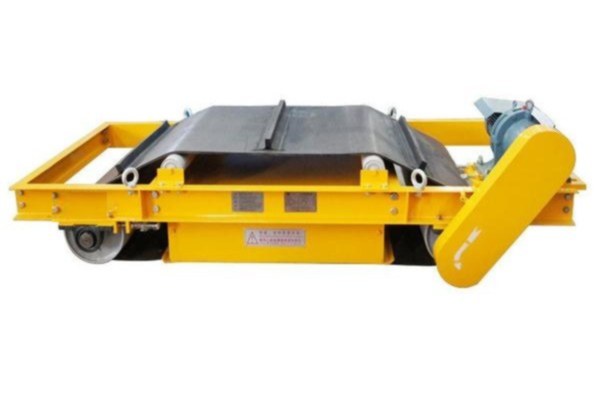
The self-cleaning overband: an endless belt drags captured iron out of the field zone to a side chute.
Definition: The Hardware in Plain Terms
Three parts make up any installation. The magnet block does the work, and its field strength at distance decides what it can capture. The suspension — eye bolts, slings, chains, turnbuckles, usually hung from a trolley beam — holds the block in position and carries its weight plus whatever iron it has grabbed. The clearance system removes captured steel: a hand-wipe on plain units, an endless cleaning belt and discharge chute on self-cleaning ones. Related hardware completes the picture. A Magnetic Drum or lagged magnetic pulley captures iron at the head pulley itself, and a Magnetic Roller does the same job on shorter or lighter conveyors. Many plants combine a suspended magnet with one of these as a second capture stage.
Working Principle: Capture, Hold, Release
The magnet projects a field downward through the material bed. Any steel object inside that field feels a pull that grows with field strength and with the object’s size, and shrinks with distance — steeply. Capture happens when that pull exceeds the friction and inertia holding the object in the bed. Hold happens at the pole face, where the field is strongest. Release is the part installations forget: a level magnet never lets go, so captured iron accumulates as a steel beard that narrows the working gap until the unit misses what it used to catch. Angling the pole face, or running a cleaning belt across the face, moves captured iron out of the high-field zone continuously so the gap stays open.
Two-stage systems exploit the same physics twice. A suspended magnet over the head pulley discharge curtain lifts iron while the material is in free flight and nothing holds it down. A magnetic pulley at the shaft then sweeps whatever slipped past, right at the transfer point. For heavy mining duty the combination costs little extra and covers each other’s blind spots.
Benefits: What Correct Installation Buys
- One stray bolt through a jaw or cone costs more than the magnet above the conveyor; the shutdown that follows runs into days
- Liner consumption falls because sharp steel stops gouging crushing chambers and screen apertures
- Transfer chutes stop jamming on recovered metal, which removes a whole class of night-shift callouts
- Product purity improves where loose steel contaminates saleable material
- Maintenance becomes scheduled work: pole face checks and capture tests instead of emergency extractions
Plants restarting idle lines should pay special attention. Premier African Minerals confirmed on 19 November 2026 that ore feed had resumed at its Zulu plant, with material now entering the flotation circuit and a new hydrocyclone being tuned for classification stability. Restart campaigns are exactly when construction debris — welding rod, rebar offcuts, bolts — rides the conveyors toward equipment that cannot digest it. Namib Minerals reported on 16 November 2026 that its expanded How Mine mill had commissioned ahead of schedule and ran at about 94.6% availability through October, processing roughly 27% more ore than the Q3 monthly average. More tonnes per hour means more steel per hour moving through the circuit when a capture does fail, so the margin the magnet provides gets consumed faster too.
Applications: Matching the Mount to the Conveyor
Above a primary crusher feed, hang a self-cleaning unit — the Self-Cleaning Electromagnetic Separator arrangement — over the discharge curtain. That position protects a Jaw Crusher where the steel risk is worst and the material is easiest to reach into. Mid-span mounting suits conveyors whose head pulley sits inside a transfer tower, or where the plant wants protection at a specific chute. Screens need the same logic: steel junk blinds apertures and snaps panel fixings, which is why separator placement matters as much on Vibrating Screens feed conveyors as at crushing stations. Loading-zone hardware matters too — an Impact Bed under the feed point keeps the belt surface flat and predictable, which is exactly what a magnet above it needs. Coal handling, port stockpiles and aggregate plants each adapt the same hardware; the duty differs in bed depth and tonnage, not in physics.
Long overland runs usually get mid-span suspension, because the head pulley is far from the plant and rarely accessible.
Material Comparison: Permanent vs Electromagnetic
| Property | Permanent Magnet | Electromagnetic Coil |
| Purchase cost | Lower | Higher, includes rectifier and cabling |
| Operating power | None | Continuous DC draw |
| Field strength | Fixed; fades fast at depth | Stronger and adjustable |
| Maintenance access | Field always live — steel tools misbehave | Switches off for safe work |
| Heat behaviour | Not applicable | Coil drifts hot in dusty enclosures |
| Typical duty | Narrow belts, shallow beds, mobile plants | Wide belts, deep beds, heavy mining feed |
The choice is mostly belt width and bed depth. Permanent units do fine work on small aggregate lines. Above roughly 1,000 mm belt width with a deep bed, electromagnetic is the standard answer because the deeper field still reaches the belt surface. Both families pair with a Magnetic Drum at the head as the second stage, and both belong in the broader Magnetic Separators range alongside drum and roller options.
Application Comparison: One Magnet, Different Jobs
| Situation | Recommended Setup | Why |
| Crusher feed, head pulley accessible | Self-cleaning overband over discharge curtain | Free-fall capture, clean side discharge |
| Head pulley inaccessible | Mid-span over loaded run | Protection at a reachable location |
| Deep bed, high tonnage | Electromagnetic overband plus magnetic pulley | Two stages share capture load |
| Small aggregate line | Permanent magnet, manual clean | Low cost, simple rig, low tonnage |
| Dusty abrasive ore | Self-cleaning unit, weekly cover inspection | Manual cleaning impractical at duty |
Industry Application Matrix
| Industry | Typical Installation | Protected Equipment |
| Iron ore mining | Electromagnetic overband plus head pulley | Primary jaw, secondary cone |
| Aggregate | Permanent suspended magnet | Cone crusher, screens |
| Coal handling | Self-cleaning electromagnetic overband | Crushers, conveyor structure |
| Port terminals | Self-cleaning overband at shiploader feed | Shiploader conveyors, holds |
| Gold processing | Suspended magnet at mill feed | SAG mill liners, feed chute |
Selection Guide: Size Against Curves, Not Catalogues
Collect five inputs before quoting anything: belt width and speed, measured bed depth under load, material lump size, tonnage, and the equipment the magnet must protect. Then demand the field-vs-distance curve for the specific unit. Field strength at the belt surface — not at the pole face — is what decides capture, and the curve is the honest version of that number. Match pole face width to the full loaded bed. Check the conveyor’s drift history; if the belt wanders, correct it with a Conveyor Belt Tracker before hanging the magnet, because a rubbing pole face destroys both magnet and belt slowly and quietly. Plants tracking crusher spares should compare Crusher Wear Parts & Liners consumption before and after commissioning — the trend over a quarter tells you whether the magnet works better than any argument will.
Procurement Guide: What to Send and What to Ask
- Conveyor profile photographs with candidate mounting positions marked
- Belt width, speed, inclination and measured bed depth under load
- Material description, lump size, moisture and tonnage
- Downstream equipment the magnet must protect
- Permanent vs electromagnetic preference, self-cleaning vs manual
- Whether manufacture to drawings or from an existing unit’s dimensions is required
- Lead time, export packing and shipping method
- Inspection standards: coil megger readings, field strength at working gap, capture-test protocol
- Spares stocking for cleaning belts, bearings and rectifier boards — Magnetic Separation Sparesavailability matters more at year three than at purchase
Buyers should ask one pointed question early: can the supplier support OEM replacement if the conveyor layout changes? A supplier who manufactures to drawings and from worn samples can re-rate a unit for a new position. One who only resells catalogue blocks cannot.
Failure Analysis: The Same Six Mistakes Everywhere
| Problem | Possible Cause | Recommended Solution |
| Magnet misses obvious steel | Gap too large for the field curve | Lower the unit or upgrade field strength |
| Capture rate decays over weeks | Steel beard accumulating on a level pole face | Clean the face; verify cleaning belt function |
| Captured iron returns to the belt | Chute missing, or bridged by packed fines | Build a proper chute; clear fines on schedule |
| Cleaning belt slips or wanders | Wrong tension; dust-coated pulleys | Retension to spec; weekly tracking check |
| Coil overheats, field weakens | Over-temperature alarm unwired or ignored | Wire the alarm to a monitored point; ventilate |
| Magnet swings or drifts | Slack or single-point suspension | Rebuild as rigid four-point rig with turnbuckles |
Maintenance Guide: Evidence Beats Opinion
Daily on high-tonnage duty, weekly otherwise: pole face cleanliness, cleaning belt tracking and cover wear at the exit line, chute condition, suspension integrity, area housekeeping around the unit. Monthly: re-check bolt torque, examine slings and turnbuckles for wear, verify rectifier output against the coil nameplate. Annually: megger the coil to earth and log the reading against the commissioning figure — a falling trend catches a damp coil years before it fails in service. Keep steel-aware rules near permanent units: their field never switches off, so ladders, tools and lifting gear behave unpredictably at the pole face during every inspection.
Case Study
Customer Type: Iron ore concentrator, 1,200 mm feed conveyor to a primary crushing station
Ore Type: Coarse iron ore with frequent drill steel and bucket-tooth contamination
Operating Conditions: 1,800 tph, belt speed 2.0 m/s, measured bed depth about 320 mm under load
Problem: A permanent magnet hung 600 mm above the belt missed most steel; a bucket tooth damaged a jaw liner within two months of restart
Solution: Unit repositioned over the head pulley discharge curtain, gap reduced to 420 mm against the field curve, rig rebuilt as rigid four-point suspension, electromagnetic self-cleaning unit specified for the deeper bed, capture test added to the commissioning standard
Result: Capture test passed at all belt positions; visible tramp metal recovery rose from near zero to a full bin per shift; no steel-related liner damage over the following quarter
FAQ
Q: How high above the belt should a suspended magnet hang?
A: Start at 250–300 mm for a 650 mm belt and add roughly 50 mm per belt-width step to about 450–500 mm at 1,400 mm. The deciding number is the unit’s field-distance curve against your measured bed depth, confirmed by a capture test at rated belt speed.
Q: Permanent or electromagnetic — how do I choose?
A: Permanent suits narrow belts, shallow beds and sites without reliable power. Electromagnetic gives a stronger, switchable field and handles wide, deep-bed mining conveyors. Above about 1,000 mm belt width, electromagnetic is the usual choice.
Q: Why angle the pole face?
A: A level magnet lets captured iron accumulate as a steel beard, which narrows the working gap and eventually releases metal unpredictably. A 10–15 degree tilt sheds iron into the chute continuously and keeps the gap open.
Q: What suspension is correct?
A: Four rigid points — chain or wire rope slings with turnbuckles — level across the belt, clear of the drift line, with a means of lowering the unit to waist height for cleaning. Re-torque everything after the first 24 hours because new slings settle.
Q: What electrical checks precede first energisation?
A: Verify rectifier output against the coil rating, megger the coil to earth and log it, confirm the over-temperature switch feeds a monitored alarm, and re-torque terminal connections on vibrating steel structures.
Q: How is a capture test performed?
A: Drop steel test pieces — a bolt, a nut, a drill bit — into the stream at rated belt speed, at several positions across the belt width. Every piece must be captured and discharged cleanly. Twenty minutes proves the installation end to end.
Q: Can one magnet fully protect a crusher?
A: No. A well-set suspended magnet plus a magnetic head pulley catches the great majority of steel, but particles below the capture limit can pass. Housekeeping and belt cleanliness reduce what enters the stream first.
Q: What maintenance does the cleaning belt need?
A: Tension to the manufacturer’s figure, tracking checks through the first week and monthly after, and weekly cover inspection at the line where the belt leaves the magnetic zone — that line takes the wear on abrasive duty.
Conclusion
Suspended magnetic separators fail at installation, not at manufacture. Position the unit where physics favours capture, set the working gap from field curves and real bed depth, suspend it rigidly, angle the face so iron sheds itself, and route captured steel to a chute that cannot bridge. Commission with electrical tests and a capture test, then keep logging pole face condition, cleaning belt wear and coil readings. The plants getting this right treat the magnet as engineered equipment; the ones treating it as rigging hardware keep buying crusher liners at unplanned intervals. The gap between the two costs nothing to close at installation time and a shutdown to close afterwards.
Related Articles
Related Products
- Self-Cleaning Electromagnetic Separator
- Magnetic Drums & Rollers
- Heavy-Duty Conveyor Impact Bed
- Mining Secondary Belt Cleaner
- Electromagnetic Overband Separator
- Iron Magnet
Related Technical Guides
- Improve Fine Screening Efficiency with Polyurethane Screen Panels
- Flotation Cell Rotor and Stator Wear Parts: How They Control Recovery, Flow and Maintenance Cost
- Hydrocyclone Underflow Too Wet? 6 Causes & Fixes
- Hydrocyclone Wear: Root Causes, High-Wear Zones & Material Solutions
- Rotor & Stator in Mechanical Flotation Cells: The Heart of Efficient Mineral Flotation
Related Buyer Guides
- How Do I Choose the Right Rubber Belt for a Vacuum Belt Filter?
- Which Manufacturer Offers High-Quality Polyurethane Tufflex Wire Screens for Mining?
Related Comparison Articles
- Polyurethane Screen vs Rubber Screen vs Wire Mesh: A Complete Comparison Guide
- Self-Cleaning Screen vs Traditional Woven Wire Mesh: Which One Should You Choose?
Contact
Contact: Annie Lu
Email: annie.lu@huataogroup.com
WhatsApp / WeChat: +86 18032422676
Website: www.tufflexscreen.com
HTL Solutions manufactures suspended magnetic separators, overband units, magnetic pulleys and drums for mining and mineral processing plants, with sizing support and export packing
 admin
personal profile