How Do Drainage Grooves Improve the Performance of a Vacuum Filter Belt?
-
 admin
- 09 Nov, 2026
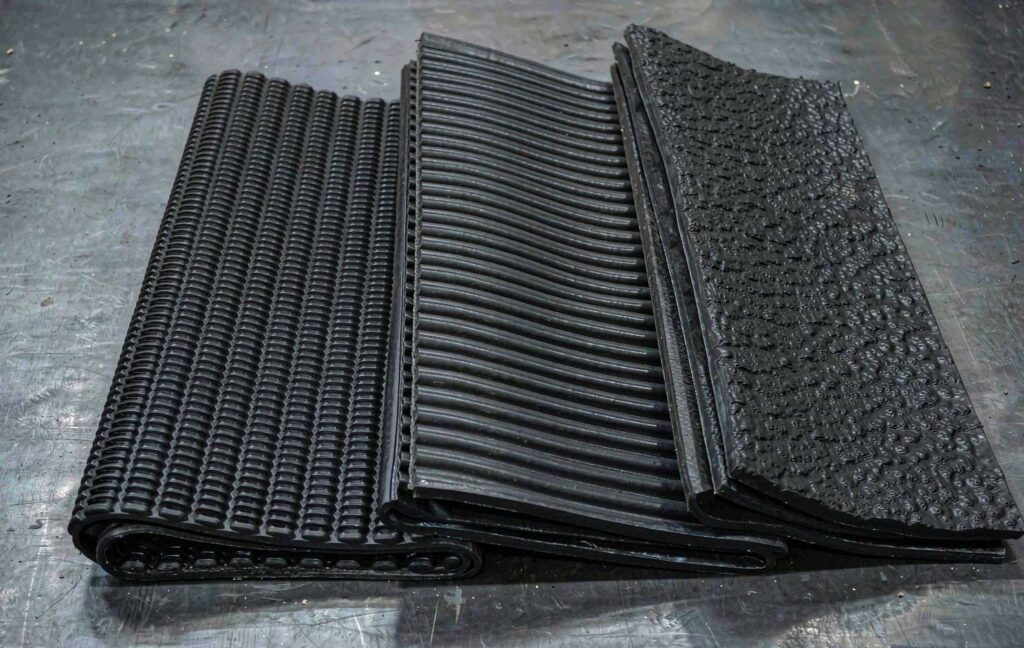
Drainage grooves are transverse channels molded into the top cover of a rubber vacuum filter belt. They collect filtrate under the cloth, carry it sideways to vacuum holes at the groove roots, and hand it to the vacuum box below. Right geometry — pitch matched to particle size, depth matched to solids, rib shape matched to wash water — means faster cake formation, lower moisture and a belt that lasts its planned life. Wrong geometry means blinding, rib cracking and wet cake with a vacuum gauge that still looks healthy.
What Are Drainage Grooves on a Vacuum Filter Belt?
A vacuum belt filter asks its rubber belt to do three jobs at once: carry slurry and cloth across the deck, seal the vacuum box underneath while flexing around rollers, and drain filtrate from the full belt width down into discrete holes. The grooves are how the third job gets done. Without channels, liquid under the cloth — held against solids by the filter plates and cloths it runs with — can only exit through whatever hole happens to sit directly beneath it — a target covering a few percent of the deck area. Grooves turn a vertical bottleneck into a short lateral trip, and the ribs between channels hold the cloth up so the drainage layer stays open under vacuum load.
The measurement stations on this surface tell you everything: rib height for wear, cake stripes for blinding, moisture trend for the sum of both. Tufflex manufactures these belts as the core product line, and groove specification is where most of the performance argument is won or lost. The machines they serve sit on the vacuum filter equipment page inside the wider filtration process stage.
Key Takeaways
✔ Grooves are the drainage layer: the vacuum pressure drop only reaches the cake when the channels under the cloth stay open
✔ Pitch follows particle size, depth follows solids content, rib section follows roller radii — three matchings, none optional
✔ Blinding, rib wear and flex cracking are the three failure modes, and all three announce themselves in cake stripes and rib height before they cost production
✔ Wash displacement quality tracks groove condition as closely as moisture does
✔ Groove design is verifiable before purchase — first-article inspection against the filter drawing is a cheaper guarantee than any certificate
Summary Table
| Item | Description |
| Function | Collect filtrate laterally under the cloth and deliver it to vacuum holes |
| Material | NR, NR/SBR or specialty compound over reinforced carcass, hardness per duty |
| Application | Horizontal vacuum belt filters on concentrate, tailings, coal fines and chemical duty |
| Service Life | Set by rib height loss per month — measured, not assumed |
| Benefits | Faster cake formation, lower moisture, cleaner wash, scheduled replacement |
Definition
Drainage grooves are transverse channels molded or machined into the working surface of a rubber vacuum filter belt, with vacuum holes drilled at the groove roots through the carcass. Channels carry liquid; ribs between them carry the cloth. One geometry, two jobs, and the two pull against each other — deeper channels mean thinner ribs, closer pitch means less volume, harder compounds take abrasion but fatigue sooner at thin sections. Every groove specification is a negotiated settlement among those constraints, brokered by the feed data.
Working Principle
Slurry spreads across the belt and the cloth catches solids. Vacuum pulls liquid through the cloth into the grooves below. Each transverse channel collects along its full length and moves filtrate sideways to the nearest hole, which drops it through the carcass into a vacuum box slot. The whole handoff — groove to hole to slot — has to align within millimetres along the entire belt travel, because a groove crossing solid rubber drains nothing and the vacuum above it is spent pulling against the belt itself.
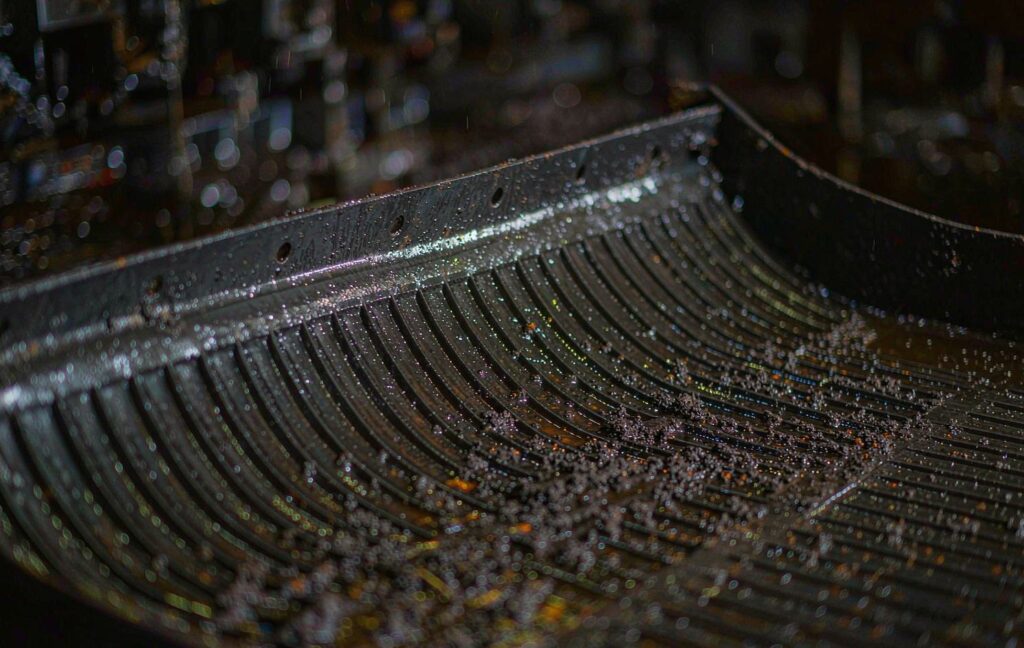
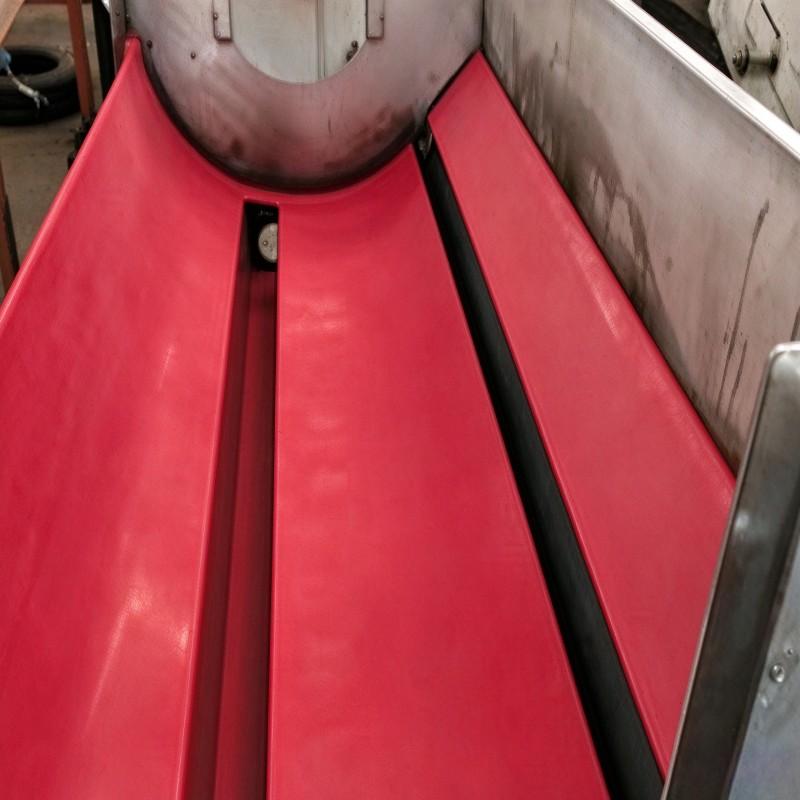
Grooves and holes: the short lateral drainage path that decides how much of the pump’s vacuum actually reaches the cake.
Load shifts through the cycle. Cake formation fills the channels with their peak liquid volume. Washing pushes liquor through the cake and out the same channels, and this is where groove profile earns its keep — a rounded, smooth-floored channel flushes clean each revolution, while square corners hold slurry against the rubber until it dries into something closer to ceramic than mud. Discharge should find the channels empty. When it doesn’t, the next cycle starts with dead volume already occupied, and effective vacuum on the cake drops without the gauge saying a word.
Benefits
- Faster cake formation. Filtrate exits at the nearest hole instead of queueing under the cloth, and the first seconds of the cycle — which carry most of the liquid — decide most of the throughput.
- Lower cake moisture. The pressure drop across the cake is only as good as the drainage layer beneath it; open channels put pump vacuum where it works.
- Cleaner wash displacement. Wash liquor pushes last-cycle liquid out through channels that aren’t already full of fines, so displacement stays sharp instead of turning muddy.
- Longer cloth life. Ribs support the cloth evenly; a collapsed rib section sags the cloth, pools liquid and wears cloth and belt together.
- Scheduled replacement. Rib height measured monthly at fixed stations turns belt changes into planned shutdown items rather than mid-week emergencies.
- A stake in the water balance. Cake leaves the filter dry enough for tailings dry discharge systemsto stack it without a slurry loop, which is where much of the water saving actually gets banked.
Applications
Fine concentrates — copper, lead-zinc, phosphate slimes — run close-pitch geometries so fines settling into channels can’t park long enough to blind them. Coal fines dewatering in washeries wants close pitch plus disciplined wash practice, because undersides collect grit and the belt that survives is paired with a maintained vacuum deck. Coarse tailings and high-solids thickener underflow — the duty that tailings management increasingly runs through filters — need channel volume: deep grooves, harder compounds under the ribs, and the rib section calculated against the machine’s roller radii so flex fatigue doesn’t eat the benefit. Iron ore concentrate and sharp sands put the emphasis on rib wear rate — abrasion-rated covers over reinforced carcasses. Gypsum, FGD and hot leach duty make compound the first decision and geometry the second.
Upstream consistency decides how hard the grooves work. Thickeners ahead of the filter set the solids content, and classification swings shift the size distribution — the same failure described from the cyclone side in our guide on wet hydrocyclone underflow. Downstream, discharged cake travels on conveyors where belt tracking hardware keeps edges aligned between shutdowns, and where flowsheets demand the driest possible cake, disc filters fitted with ceramic filter sectors — and their ceramic filter plates — take the final step with their own cloth and plate economics.
Market pressure is pushing more slurry through exactly these trade-offs. In October 2026, PSJ Cobre Mendocino signed a preliminary agreement with Metso for the processing plant at its Uspallata copper project in Mendoza, Argentina — a flotation-plus-tailings-filtration flowsheet that lifts planned throughput to 42,000 t/d while holding the approved water allowance at 141 litres per second, the expansion credited to the water efficiency of filter technology. When filtration carries capacity growth on a fixed water budget, drainage performance becomes a production number. Australian Mining’s November 2026 feature on filtered tailings, drawing on consultant Onterris’ tailings engineering practice, makes the design-side case: filtered tailings cut water storage and lift water recovery, but viability depends on measured filtration performance against ore mineralogy, production rate and climate. More filtered duty means more vacuum belts running harder. The grooves take that pressure first.
Material Comparison
| Compound | Wear Resistance | Flex Fatigue | Chemistry Handling | Best Duty |
| Natural rubber (NR) | Good | Excellent | Water, mild pH | General concentrate duty |
| NR/SBR blend | Very good | Good | Mild acidity | Tailings, mixed slurries |
| Hard abrasion-rated | Excellent | Moderate | Mild | Coarse sharp feed, iron ore |
| Fatigue-rated NR | Good | Excellent | Water | Fine feeds, tight rollers |
| Specialty compound | Per formulation | Per formulation | Hot, oily, acidic | Gypsum, hot leach circuits |
Compound and geometry interact more than most datasheets admit. A hard cover on a deep-groove belt can crack earlier than a softer one on a standard section, because rib thickness does as much for fatigue life as compound formulation does. Specify the pair together or expect the weaker half to set the belt’s life.
Application Comparison
| Duty | Pitch | Depth | Deciding Factor |
| Fine concentrate | Close | Shallow-medium | Unblinded channels |
| Coarse tailings | Wide | Deep | Channel volume, rib strength |
| Iron ore concentrate | Medium-wide | Deep | Rib wear rate |
| Coal fines | Close | Shallow | Wash discipline, sealing |
| Gypsum / FGD cake | Per slurry | Medium | Compound chemistry first |
Industry Application Matrix
| Industry | Belt Duty | Groove Emphasis |
| Copper / lead-zinc | Concentrate and tailings | Fine pitch on concentrates |
| Iron ore | Concentrate | Abrasion-rated rib covers |
| Coal | Fines dewatering | Close pitch, wash practice |
| Phosphate | Slimes and sands | Pitch per size distribution |
| Gold | Concentrate | Fatigue-rated compound |
| FGD / industrial | Hot chemical cake | Specialty compound |
Selection Guide
Work from the machine backwards. Deck width, roller spacing, vacuum box slot layout and vacuum level define the envelope any groove geometry must live inside. Then the feed: particle size distribution sets pitch, solids percentage sets depth, temperature and filtrate chemistry set compound. Only then does the catalogue become useful — and a supplier who quotes “standard belt” without asking for the feed data has told you how the next moisture complaint will start.
Two questions settle most selections. First: what rib section survives your roller radii at your cycle rate? That’s a flex fatigue calculation, and any answer without one is a preference. Second: what pitch keeps your fines moving? That’s a settling question, answerable from the size distribution. Our guide on choosing the right rubber belt for a vacuum belt filter walks the full checklist, the dewatering process pages cover the thickening stage that feeds the filter, and filter presses sit one step over where duty turns batch.
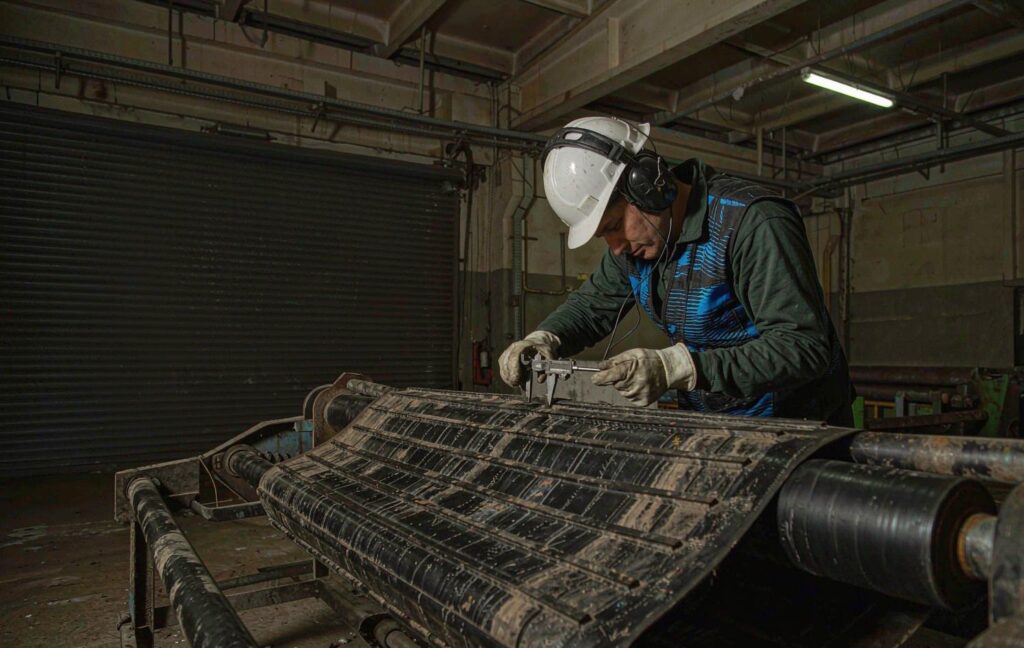
Rib height measurement on a used belt — the trend line that turns replacement into a scheduled item.
Procurement Guide
Have ready before requesting a quotation:
- Filter make and model, deck dimensions and tolerances, vacuum box slot layout drawing
- Feed data: solids percentage, particle size distribution, temperature, filtrate chemistry
- Vacuum level, tonnage and cycle time
- An old belt or cross-section, with whatever rib-height history exists
Questions for the supplier: Can you match the hole pattern to our vacuum box layout within stated tolerance? Will you provide first-article inspection with groove depth at multiple stations? Can you justify pitch and depth against our feed data in writing? Will you agree a rib-height measurement plan and replacement trigger before delivery? What are MOQ, lead time and export packaging for a belt manufactured to drawing? Do you hold compound certificates and hardness data?
Drawings beat samples and samples beat descriptions. A supplier comfortable with all of the above manufactures; one who negotiates around it trades.
Failure Analysis
| Problem | Possible Cause | Recommended Solution |
| Wet stripes on cake | Channels blinded by fines | Re-pitch to feed size; restore wash flush |
| Slow moisture creep | Rib height loss cutting volume | Monthly rib measurement; replace on trend |
| Local vacuum loss | Flex crack at groove root | Replace belt; check rib section vs roller radii |
| Cloth wearing mid-belt | Collapsed ribs sagging support | Measure ribs; replace before cloth damage |
| Muddy wash discharge | Channels hold prior-cycle fines | Rounded root profile; wash temperature review |
| Vacuum high, moisture worse | Holes misaligned with box slots | Verify hole pattern against filter drawing |
Maintenance Guide
Daily: read the cake at discharge. Stripes and wet patches cost nothing to observe and map directly onto groove condition. Weekly: wash water clarity and belt tracking — a drifting belt loads edge grooves unevenly and wears them at different rates. Monthly: rib height at fixed stations, written down. The first months of a new belt establish the wear rate; after that the trend is the schedule. Quarterly: underside, seal strips and vacuum deck inspected together, because groove condition and deck condition compound each other’s damage. Keep one spare of proven geometry on site. A belt made to your drawing is a stock item; a belt ordered after a failure is downtime with paperwork.
Case Study
Customer Type: Copper concentrator in a integrated mine-concentrator operation
Ore Type: Copper sulphide concentrate with fine siliceous gangue
Operating Conditions: Horizontal vacuum belt filter, 2.4 m deck, centreline vacuum slots, feed near 55% solids from thickener underflow
Problem: Cake moisture creeping upward across one quarter; wet stripes at discharge repeating over the same belt sections every revolution; two cloth replacements logged against “cloth quality”
Solution: Rib height measurement showed crest loss concentrated mid-belt, and the old belt’s wide pitch turned out to be wrong for the fine feed — silty fines had compacted into the channels. Replacement specified with close pitch, rounded rib roots and hole pattern verified against the vacuum box drawing before dispatch
Result: Moisture returned to baseline within two cycles and the stripes disappeared. The next cloth ran a normal service interval. No vacuum system change was made at any point — the drainage layer had been the constraint from the start
FAQ
Do deeper grooves always improve drainage?
No. Depth adds channel volume but thins the rib above it, and flex cracks start at thin sections. Depth should follow solids content and roller radii. On fine feeds pitch does more work than depth ever will.
What pitch suits fine concentrates?
Close pitch. Fines settle where liquid slows, and long lateral travel means slow zones. Shortening the path keeps the drainage layer moving; the cost is some channel volume, which fine feeds usually don’t miss.
Can blinded grooves be recovered in service?
Lightly loaded channels respond to warm wash and brush cleaning. Compacted, dried fines rarely do — the fill has the consistency of fired clay by then. Prevention through pitch selection beats recovery every time.
How often should rib height be measured?
Monthly at fixed stations for most mining duty. Fortnightly on a new belt for the first months until the wear rate is established. One reading is trivia; the trend is the replacement schedule.
Does groove condition affect the vacuum seal?
Yes, indirectly. Uneven drainage leaves alternating wet and dry bands under the belt and deck seal strips wear unevenly against them. Inspect groove and deck together.
What else causes rib cracking?
Over-deep sections for the machine’s roller radii, hard compounds on thin ribs, and flat storage in sunlight between uses. Section thickness against flex cycle is a calculation, not a preference.
Is raising vacuum a fix for wet cake?
Rarely. Blocked grooves make extra vacuum pull air through open holes while water waits in channels. Restore the drainage path first, then judge the vacuum level on evidence.
What belongs in a groove specification?
Pitch, depth, width, rib root radius, hole diameter and pattern matched to the vacuum box layout, edge dam profile, compound and hardness, and the first-article inspection method. A specification without its inspection method isn’t finished.
Conclusion
Drainage grooves improve vacuum filter belt performance by keeping the drainage layer under the cloth open — and everything measurable follows from that: cake formation speed, cake moisture, wash displacement sharpness, cloth life, and whether the next belt change lands on the maintenance schedule or in the middle of a production week. The engineering is short: pitch from particle size, depth from solids, rib section from roller radii, compound from chemistry. The discipline is shorter still: measure rib height monthly, read the cake daily, and make the supplier justify the geometry against your feed data before the purchase order. Grooves cost nothing extra to specify correctly. Getting them wrong costs cake moisture, cloths and shutdown timing, in that order.
Related Articles
Related Products
Related Technical Guides
- Hydrocyclone Underflow Too Wet: 6 Causes & Fixes
- Flotation Cell Rotor and Stator Wear Parts Guide
- Hydrocyclone Wear: Root Causes & Material Solutions
- Fine Screening Efficiency with Polyurethane Screen Panels
- Rotor & Stator in Mechanical Flotation Cells
Related Buyer Guides
- How Do I Choose the Right Rubber Belt for a Vacuum Belt Filter?
- Which Manufacturer Offers High-Quality Polyurethane Tufflex Wire Screens?
Related Comparison Articles
- Polyurethane Screen vs Rubber Screen vs Wire Mesh
- Self-Cleaning Screen vs Traditional Woven Wire Mesh
Contact
Contact: Annie Lu
Email: annie.lu@huataogroup.com
WhatsApp / WeChat: +86 18032422676
Website: www.tufflexscreen.com
admin
personal profile