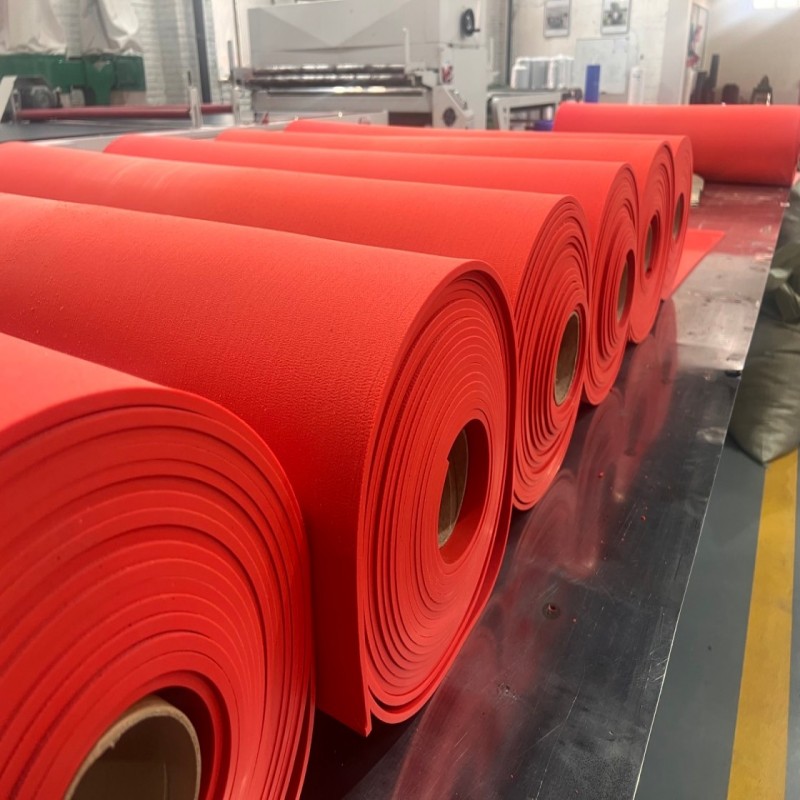
OEM Polyurethane Fine Screen Mats on Existing Screens: Specify, Verify, Trial
-
 admin
- 17 Nov, 2026
Quick Answer: Yes, polyurethane fine screen mats can be OEM-manufactured for existing high-frequency vibrating screens, when the panel is engineered to the deck’s real interface: dimensions, fastening system, curvature, support spacing and dynamic duty. Compatibility is verified at three levels, mechanical, dynamic and process, and a trial panel with agreed criteria converts the replacement from a hope into a measured upgrade.
What Is OEM Screen Mat Replacement?
OEM manufacturing for screening media is the production of replacement panels engineered to an existing machine’s installation interface and process duty. The phrase carries a warning inside it: a mat with the correct overall dimensions can still be wrong in every way that matters. The hooks, the support spacing, the deck curvature, the acceleration the panel endures each shift, these define fit, and they live in drawings, part numbers and old panels rather than in size charts.
Done properly, the plant upgrades its fine screening without touching the deck structure. Done carelessly, the panel is back off the deck within weeks, and the compound gets blamed for a fastening problem.
Key Takeaways
✔ The installation interface, more than the aperture, decides whether a replacement fits.
✔ Compatibility is mechanical, dynamic and process-related; all three get verified.
✔ Damaged support hardware never carries a new panel.
✔ Trial panels with defined acceptance criteria de-risk the full-deck order.
✔ Old panels and photographs are legitimate, often superior, specification sources.
Summary Table
| Item | Description |
| Function | Replace fine screening media without deck redesign |
| Specification basis | Drawings, part numbers, panel samples, photographs |
| Compatibility levels | Mechanical fit, dynamic behaviour, screening performance |
| Verification | Controlled trial with agreed acceptance criteria |
| Outcome | Upgraded fine classification on the existing machine |
Definition
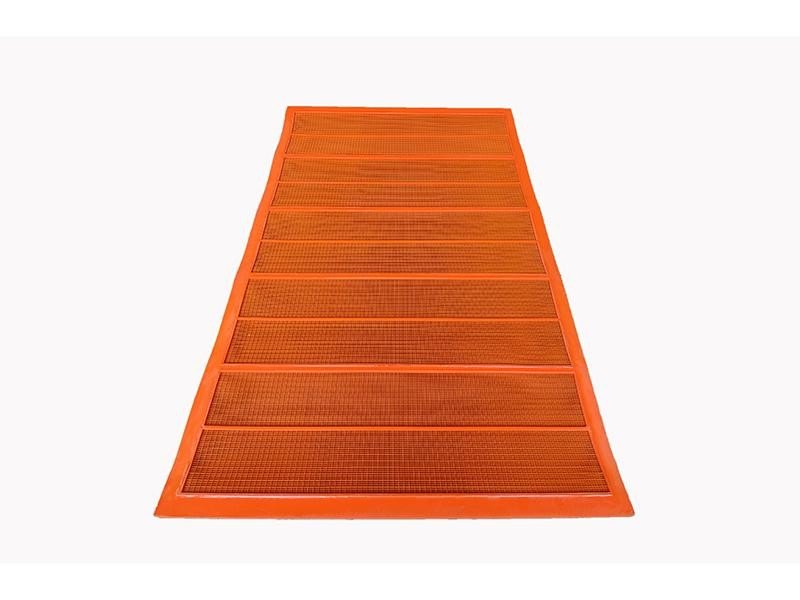
Polyurethane fine screen mat apertures
The aperture does the separating; the interface decides whether the panel survives to do it.
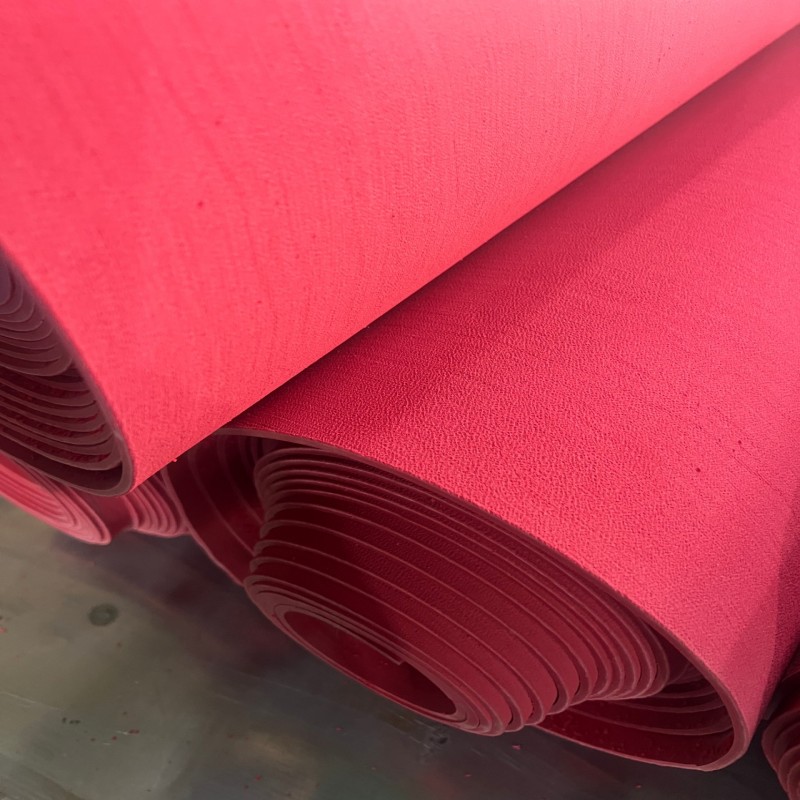
OEM polyurethane fine screen mats are custom-manufactured screening surfaces matched to an existing screen deck’s dimensions, fastening arrangement and operating dynamics. They serve fine classification, desliming and wet screening duty, with nominal apertures from 0.043 mm and panel geometry built to the machine rather than to a catalogue.
Working Principle
The specification begins with the machine. Screen manufacturer and model, panel length, width and thickness, working area, reinforced edges, support-bar spacing, deck curvature and fastening dimensions together define the replacement. Where drawings are missing, measurements and photographs of the panel and deck establish the information, and an original sample earns its keep whenever fastening details are complex.
Aperture and construction follow the process. The required cut size, particle shape, slurry characteristics and throughput select the aperture; the compound balances abrasion resistance, flexibility, tear resistance and fatigue under high-frequency cyclic loading, with reinforcement at edges and fastening points. A flexible wet-classification mat is never quietly substituted with a rigid modular panel, and the finest available aperture is never automatically the right one.
Compatibility is assessed at three levels. Mechanically, the panel must seat without gaps or edge loading and its fastening must engage as designed: tensioned media need matching rails and draw bolts, modular panels need matching retaining features. Some screens accept both polyurethane and wire media, and convex high-shear beds carry their own tensioning assemblies, but compatibility with one configuration never extends across a manufacturer’s range. Dynamically, the panel must survive the deck’s frequency, stroke and acceleration without excessive movement or fatigue. At process level, it must hold cut size and capacity under the plant’s feed, with aperture and open area selected together.
Installation discipline completes the system. Tensioning components, clamps, support rails and sealing strips are inspected before every fitting, because a new mat never goes over damaged supports. The manufacturer’s tensioning procedure governs; arbitrary bolt torques damage media and hardware alike. All work follows the plant’s lockout and isolation procedures.
Benefits
- Existing screens upgraded without structural modification.
- Fine classification performance restored on worn decks.
- Extended wear life on abrasive wet duty versus wire media.
- Trial-based purchasing removes full-deck risk.
- Panel life per tonne becomes a tracked number.
Applications
OEM fine screen mats serve wet fine classification, desliming and washing duty on high-frequency machines and Stack Sizer type decks, across silica sand, iron ore, coal preparation and kaolin processing, and anywhere classification precision depends on aperture stability. Deck-tuning context is in the fine screening efficiency guide.
The trial deserves its own paragraph, because it is where OEM projects are won or lost. A controlled trial compares the replacement mat with the original media under equivalent conditions: feed rate, solids concentration, particle-size distribution and screen settings recorded on both sides. Mechanical fit is checked first, seating, fastening engagement, edge sealing. Performance follows: undersize recovery, oversize contamination, throughput, aperture stability, edge condition, cleaning frequency. Feed, oversize and undersize samples are collected and compared. The evaluation table is agreed before installation, and the replacement is approved for wider installation only after the criteria are met. One trial panel with criteria costs a fraction of a full deck ordered on faith, and the ore-characterisation approach that reputable suppliers publish for fine-screen media applies here in full.
Material Comparison
| Construction | Best for | Watch for |
| Tensioned fine mats | Wet classification on tension rails | Hook profile and tension direction |
| Modular panels | Decks with retaining systems | Retaining feature match, support spacing |
| Reinforced-edge mats | High-stress fastening points | Edge formulation and fatigue life |
| Fine-aperture mats | Precise cut size | Effective open area vs blinding |
| Custom curvature mats | Convex or profiled decks | Crown geometry accuracy |
Application Comparison
| Situation | Wrong response | Right response |
| Old panel unavailable | Guess from dimensions | Photographs and measurements on site |
| Fastening unclear | Order and hope | Identify hooks, clamps, bolts first |
| Full deck needed immediately | Skip the trial | Trial panels with acceptance criteria |
| Performance drop after fitting | Blame the compound | Check seating, tension and dynamic fit |
| Deck damage discovered | Install over it | Repair supports before new media |
Industry Application Matrix
| Industry | Typical duty | Specification emphasis |
| Silica sand | Fine wet classification | Aperture stability, open area |
| Iron ore | Abrasive classification | Abrasion compound, reinforcement |
| Coal preparation | Desliming | Fastening durability |
| Kaolin processing | Ultra-fine separation | Fine apertures, sealing |
| Industrial minerals | Variable | Trial-led specification |
Selection Guide
- Identify the machine: manufacturer, model, existing panel specifications.
- Capture the interface: fastening type, support spacing, deck curvature.
- Define the process duty: cut size, feed, solids, moisture, abrasiveness.
- Select aperture and compound together, balancing open area and strength.
- Trial panels under equivalent conditions with agreed criteria.
- Approve the full deck only after the criteria are met.
Procurement Guide
The enquiry package decides quotation quality. Include the screen manufacturer and model, original panel dimensions, aperture size and shape, fastening details, support spacing, available drawings, and photographs of the old panel in place. Then test each supplier on three questions: which compound and reinforcement for our duty, and why; what dimensional and fastening tolerances you guarantee against our deck; will you support a trial with defined acceptance criteria. Media context is in the screen media comparison and the buyer guide to quality screens. Suppliers who answer from drawings are engineering; suppliers who answer from a size chart are shipping surprises.
Failure Analysis
| Problem | Possible Cause | Recommended Solution |
| Panel works loose | Fastening mismatch | Verify hooks, clamps, retaining features |
| Edge damage in weeks | Incorrect support or tension | Check support spacing and tension spec |
| Capacity shortfall | Effective open area lost | Re-check aperture choice vs blinding |
| Oversize in undersize | Aperture deformation or wear | Inspect aperture stability |
| Panel fatigue cracks | Dynamic overloading | Verify frequency, stroke, support fit |
| Sealing leaks at edges | Deck profile mismatch | Confirm curvature and sealing strips |
Maintenance Guide
Before every installation, inspect tensioning components, clamps, support rails and sealing strips, and replace damaged hardware. Follow the manufacturer’s tensioning procedure, never arbitrary bolt torques. After commissioning, check panel movement, edge sealing and tension within the first days. Ongoing, monitor blinding, aperture wear and cleaning frequency, and record panel life per tonne for the next specification.
Case Study
Customer Type: Silica sand processing plant, wet fine classification.
Operating Conditions: Existing high-frequency screen, 0.15 mm nominal duty, wire mesh blinding frequently.
Problem: Wire media blinded and wore rapidly; a full polyurethane deck was wanted without deck modification.
Solution: Old panels and photographs submitted; OEM mats engineered to the existing tension rails and deck curvature; trial panels installed with agreed acceptance criteria.
Result: The trial met every criterion, and the deck was converted with no structural modification, with panel life now tracked per tonne.
FAQ
- Can wire mesh be replaced directly with a polyurethane fine screen mat?
Potentially, once fastening, support geometry, aperture, effective open area and dynamic loading are verified. Direct substitution is verified by everyone and assumed by no one.
- Is an original panel sample required for OEM manufacturing?
Helpful but not always essential. Drawings, accurate measurements and photographs may suffice; complex fastening profiles may require the sample.
- Can mats be customised for different aperture sizes?
Yes, within manufacturing and formulation limits. Fine apertures from 0.043 mm are a published starting point, confirmed during technical review.
- How are loose panels prevented?
Matched dimensions, sound support hardware, the specified installation procedure and a post-commissioning check for movement and tension loss.
- Should a few mats be trialled before a full set?
Always, when the design, formulation or supplier is unproven on the equipment. Fit, screening accuracy, throughput, wear and maintenance all get evaluated.
- What photographs are most useful?
The old panel in place, the fastening system, the support rails and the deck surface, plus any damaged or worn areas.
- When is deck modification genuinely necessary?
When supports cannot carry the new design, fastening is incompatible, or support requirements differ. Any modification gets an engineer’s review and the owner’s approval.
- What decides the full-deck order after a trial?
The agreed acceptance criteria: fit, separation performance, throughput, aperture stability, durability and cost per correctly classified tonne.
- Can screen settings be changed to suit a new panel?
Not without the equipment manufacturer’s approval. Speed, stroke and tension changes belong to the machine’s design limits.
Conclusion
OEM polyurethane fine screen mats succeed on existing screens when the panel is engineered to the deck and proven on the ore. Specify from drawings, samples and photographs; verify mechanical, dynamic and process compatibility; trial with criteria before the full order. Plants that buy this way upgrade their fine screening without touching a wrench to the deck structure, and their next panel order is a repeat, with a wear record attached.
Related Articles
Related Products
- Polyurethane Fine Screen Panel
- Polyurethane & Rubber Screen Panels
- Stack Sizer Fine Screen
- Multi-deck High Frequency Vibrating Screen Machine
- Banana Screen
Related Technical Guides
- Improve Fine Screening Efficiency with Polyurethane Screen Panels
- Hydrocyclone Wear: Root Causes, High-Wear Zones & Material Solutions
- Flotation Cell Rotor and Stator Wear Parts
- Hydrocyclone Underflow Too Wet? 6 Causes & Fixes
- Rotor & Stator in Mechanical Flotation Cells
Related Buyer Guides
Related Comparison Articles
- Polyurethane Screen vs Rubber Screen vs Wire Mesh
- Self-Cleaning Screen vs Traditional Woven Wire Mesh
Contact
Annie Lu
Email: annie.lu@huataogroup.com
WhatsApp/WeChat: +86 18032422676
Website: www.tufflexscreen.com
Tags:
 admin
personal profile