Choosing the Best Screen Media for Fine Particle Separation: An Engineer’s Guide
-
 admin
- 12 Nov, 2026
Quick Answer: The best screen media for fine particle separation is duty-matched, not catalogue-ranked. Polyurethane fine screens dominate abrasive wet classification by combining fine apertures, wear resistance and self-shedding flexibility. Woven wire mesh wins on open area and cost for free-flowing dry feed. Wedge wire owns drainage and dewatering. Self-cleaning media answers blinding. Choose by diagnosing the dominant failure, verify the panel against the machine, and settle the final choice with a controlled trial on the plant’s own ore.
What Is Fine Particle Separation?
Fine particle separation is the screening duty below roughly one millimetre, where the physics turns hostile. Particles cling, near-size grains lodge in apertures, moisture builds adhesive films, and a surface that performed beautifully on gravel can stop working at 150 microns. The screen media is the surface fighting all of that, and its selection decides whether the plant ships product or recirculates it.
Every media family brings a different trade-off. The engineering task is matching those trade-offs to the duty, which starts with knowing what is actually failing on the current deck.
Key Takeaways
✔ Nominal open area is a promise; effective open area under the ore is the fact.
✔ Blinding and wear are different failures with different media answers.
✔ Worn apertures leak oversize into the undersize, silently.
✔ Panel-to-machine fit, fastening and vibration limits are part of the specification.
✔ A two-panel trial on the plant’s own feed beats every datasheet.
Summary Table
| Item | Description |
| Function | Separate fine particles at the required cut size without blinding |
| Media families | Polyurethane panels, woven wire, wedge wire, self-cleaning wire |
| Key metrics | Effective open area, separation efficiency, service life |
| Selection logic | Diagnose the dominant failure, verify fit, trial both |
| Decision metric | Cost per correctly classified tonne |
Definition
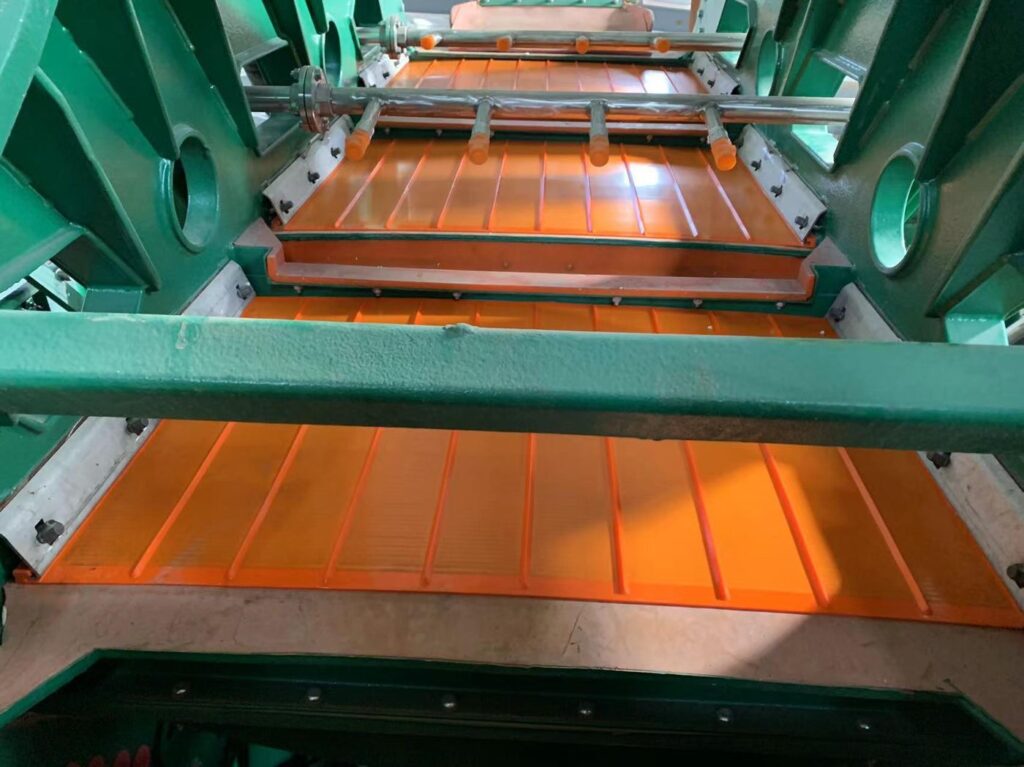
Polyurethane fine screen panels on a high-frequency deck
Fine screening lives or dies on the apertures that are actually open when the ore arrives.
Screen media for fine separation is the engineered surface — its aperture geometry, flexibility, wear behaviour and open area — that controls which particles pass at the required cut size. Nominal open area describes the geometry of a new panel. Effective open area describes the surface during operation, after near-size particles, clay and moisture have had their say. The gap between the two is where screening performance is won or lost.
Working Principle
A particle passes when it meets an open aperture often enough, at the right angle, for long enough. Four properties of the media govern that encounter.
Aperture geometry comes first. Square apertures suit general sizing; slots add drainage but classify elongated particles differently; tapered openings make lodging harder. The nominal aperture starts the design, and the actual cut size depends on particle shape, near-size content, feed rate, slurry density, vibration and residence time. For a woven square mesh, theoretical open area follows the wire geometry — a 0.5 mm aperture with 0.2 mm wire offers about 51% on paper. Modern high-open-area polyurethane reaches comparable figures with openings down to tens of micrometres for wet duty.
Blinding resistance is the second property, and the one that decides wet fine duty. Near-size particles lodge, clay builds films, and capacity drains away. Flexible polyurethane sheds lodged particles through vibration; self-cleaning wire does it mechanically with moving wires; tapered apertures reduce trapping from the start; wash water and feed distribution carry part of the load. The fix must match the cause, which makes diagnosis the highest-value hour on the deck.
Wear behaviour is the third. Hard ores enlarge worn apertures until oversize contaminates the undersize, a failure that is quiet and expensive. Polyurethane holds aperture geometry under abrasion; wire demands inspection discipline and replacement scheduling. Neither strategy is wrong; they are priced differently and fail differently.
Machine fit is the fourth, and the most overlooked. Panel dimensions, fastening systems, support structure and permitted vibration frequency and amplitude must match the actual screen model. A perfect media choice that does not fit the deck is a courier delivery, not an upgrade.
Benefits
- Stable cut size and reduced oversize contamination in the undersize.
- Fewer unscheduled stops for blinded or damaged panels.
- Longer panel life on abrasive wet duty.
- Maintenance shifts from emergency changes to planned replacements.
- Media decisions become measurable through tracked panel life per tonne.
Applications
Fine separation duty concentrates on wet classification, desliming and washing circuits: iron ore fines, silica sand, coal, and industrial minerals, typically on high-frequency machines and Stack Sizer type decks. Dry fine screening adds humidity and dust to the problem set; dewatering and drainage duty belongs to wedge wire and sieve bends. In every case the media serves the wider classification circuit, and its stability decides what downstream equipment receives.
Effective open area deserves a closer look, because it is the number nobody measures and everybody blames something else for. A deck can lose a third of its capacity to blinding while every panel in the specification sheet still reads 40% open. The monitoring habit is simple: photograph the deck under load on a schedule, map the blinded zones, and track the map over time. Blinding that grows from the feed end points at overloading and feed distribution; blinding concentrated in sticky zones points at moisture and aperture geometry; uniform blinding across the deck points at the media itself. The map converts a vague complaint about capacity into a specific engineering decision, and it tells you whether the answer is media, feed presentation or wash water before any money is spent.
Material Comparison
| Media | Main strength | Main consideration | Typical duty |
| Fine polyurethane | Abrasion resistance, anti-blinding | Open area and aperture stability | Wet fine classification |
| Woven wire | High potential open area | Abrasive wear, wire fatigue | Dry free-flowing sizing |
| Wedge wire | Controlled slots, drainage | Slot orientation vs particle shape | Dewatering, sieve bends |
| Self-cleaning wire | Blinding relief | Sizing accuracy with moving wires | Sticky, near-size feed |
Application Comparison
| Situation | Wrong response | Right response |
| Panel blinds every shift | Thicker wire | Diagnose cause; flexible or self-cleaning media |
| Oversize in the undersize | Blame the screen | Check aperture wear and feed distribution |
| Wet sticky feed on wire mesh | Accept the losses | Trial polyurethane fine screens |
| Rapid wear on abrasive ore | Repeat the purchase | Match media to abrasion data |
| Capacity shortfall | Change media first | Review feed presentation and area |
Industry Application Matrix
| Industry | Feed | Recommended first option |
| Iron ore | Wet hematite fines | High-open-area polyurethane |
| Silica sand | Abrasive quartz | Polyurethane or wire, trial decides |
| Coal | Fine moist coal | Self-cleaning or polyurethane |
| Industrial minerals | Variable | Duty-matched trial |
| Aggregates | Washed fines | Polyurethane modular panels |
Selection Guide
- Define the duty: cut size, allowable oversize, throughput, wet or dry.
- Characterise the feed: size distribution, near-size fraction, clay, moisture, abrasiveness.
- Diagnose the current failure: blinding map, wear pattern, oversize leakage.
- Shortlist media by the dominant failure, and by the dominant success you need.
- Verify fit: panel dimensions, fastening, permitted vibration against the screen model.
- Trial both candidates under equivalent conditions and decide on data.
Procurement Guide
Specify with data and buy with evidence. The enquiry carries required aperture, panel dimensions, screen make and model, fastening arrangement, mineral type, wet or dry conditions, expected capacity, and photographs of current wear or blinding. Test each supplier on three questions: which compound and aperture geometry for our feed, and why; what open area will remain effective after a month of operation; will you support a trial panel with defined evaluation criteria. Practical tuning guidance for the deck itself is in the fine screening efficiency guide, and a full media comparison supports the shortlisting step.
Failure Analysis
| Problem | Possible Cause | Recommended Solution |
| Panel blinds every shift | Near-size lodging, clay, moisture | Flexible media, tapered apertures, wash water |
| Oversize in undersize | Worn or enlarged apertures | Tighter inspection, wear-resistant media |
| Capacity shortfall | Overloading or poor feed spread | Feed presentation before media change |
| Panel delamination | Wrong fastening or vibration | Verify fit against the machine model |
| Uneven deck wear | Localised loading | Zoned panel specifications |
| Short panel life | Duty mismatch | Trial alternative media with criteria |
Maintenance Guide
Every shift, observe blinding and oversize from safe positions. Weekly, inspect panels for buildup, localised damage and fastening condition. Monthly, review separation efficiency and update the blinding map. Each replacement, record panel life against throughput and feed conditions. The record turns media selection into a running experiment the plant controls, and it is the cheapest fine-screening expertise available anywhere.
Case Study
Customer Type: Iron ore processing plant, wet classification circuit.
Feed: Fine hematite with clay content, high moisture.
Operating Conditions: Wet high-frequency screen, nominal 0.15 mm aperture.
Problem: Woven wire mesh blinded repeatedly and wore fast; oversize contaminating the undersize.
Solution: Trial of high-open-area polyurethane fine panels against the incumbent wire, with defined evaluation criteria on both sides.
Result: Polyurethane panels held effective open area, cut blinding downtime and outlasted the wire in the trial; the deck was converted and panel life is now tracked per tonne.
FAQ
- What is the smallest aperture for polyurethane fine screens?
Openings measured in tens of micrometres are available; HUATAO lists options from 0.043 mm, and comparable wet-screen products exist from other makers. Feed properties decide whether ultra-fine apertures actually work.
- Can polyurethane screens replace OEM fine screen panels?
Often, when dimensions, aperture design and fastening match the machine model. Verify against specifications, photographs and drawings, and trial before ordering a full set for critical duty.
- What causes fine screen blinding?
Fine particles, sticky material and agglomerates covering apertures, driven by moisture, clay and near-size content. The underlying cause should be diagnosed before replacing the screen.
- Are slotted apertures better than square?
Slotted openings add passage area and drainage but classify elongated particles differently. Square apertures suit uniform dimensional separation; trials decide for irregular feeds.
- How do we reduce screen media costs?
Evaluate cost per correctly classified tonne: panel life, replacement labour, downtime, aperture stability and classified output, supported by regular inspection.
- Does wash water help fine screening?
In wet duty, yes: it separates fines and clears adherent particles, within the equipment’s permitted operating range and with drainage accounted for.
- How long should a media trial run?
Long enough to include the wear and blinding cycles that define the duty, under equivalent feed conditions, with agreed criteria.
- What data should we send for a quotation?
Aperture, panel dimensions, screen model, fastening details, mineral type, wet or dry conditions, capacity, and photographs of current wear or blinding.
- Why does our screen lose capacity although the panels are new?
Because nominal open area is not effective open area. Map the blinding: the pattern distinguishes media problems from feed presentation problems.
Conclusion
Fine screening rewards plants that treat media selection as an experiment rather than a purchase. Aperture geometry, effective open area, blinding behaviour and wear resistance trade off against each other, and only the plant’s own ore can say which trade is right. Diagnose the current failure, match the media family to it, verify the fit against the machine, and settle the choice with a trial. The best screen media for fine particle separation is the one still open, still accurate and still on the deck at month’s end, and the plant that measures effective open area already knows which one that is.
Related Articles
Related Products
- Polyurethane Fine Screen Panel
- Polyurethane & Rubber Screen Panels
- Stack Sizer Fine Screen
- Multi-deck High Frequency Vibrating Screen Machine
- Banana Screen
Related Technical Guides
- Improve Fine Screening Efficiency with Polyurethane Screen Panels
- Hydrocyclone Wear: Root Causes, High-Wear Zones & Material Solutions
- Flotation Cell Rotor and Stator Wear Parts
- Hydrocyclone Underflow Too Wet? 6 Causes & Fixes
- Rotor & Stator in Mechanical Flotation Cells
Related Buyer Guides
Related Comparison Articles
- Polyurethane Screen vs Rubber Screen vs Wire Mesh
- Self-Cleaning Screen vs Traditional Woven Wire Mesh
Contact
Annie Lu
Email: annie.lu@huataogroup.com
WhatsApp/WeChat: +86 18032422676
Website: www.tufflexscreen.com
Tags:
 admin
personal profile