Which Screen Media Survives Wet Coal Screening?
Nov 2, 2026
 admin
Primary Belt Cleaner Performance: What to Fix Before You Change the Blade
Most primary belt cleaners underperform for three reasons: the blade isn’t touching the belt properly, the tension has gone slack since installation, or the belt surface no longer gives the blade anything to scrape against. Contact geometry comes first, compound second. Fix those, then look downstream at secondary cleaning, skirting and return roller condition, because carryback that escapes the blade becomes a tracking and spillage problem within weeks.
A primary belt cleaner is the first scraper on a conveyor, mounted at the head pulley where the belt is still supported by the pulley shell. It removes the bulk of the carryback before the belt reaches the return strand, using a polyurethane, rubber, carbide or ceramic blade held against the moving cover at a set angle and tension.
| Item | Description |
|---|---|
| Function | Scrapes the bulk of the carryback off the belt at the head pulley, before the return strand |
| Material | Polyurethane, rubber, tungsten carbide or ceramic blade on a steel frame with spring, gravity or air tension |
| Application | Troughed belt conveyors in mining, aggregates, coal handling, cement, ports and power generation |
| Service Life | Blade life follows abrasion, belt speed, splice type and how honestly tension is maintained |
| Benefits | Clean return strand, less spillage and dust, fewer seized rollers, longer belt and lagging life |
| Main limitation | Cleans the belt, not the conveyor: a cupped belt or failed lagging defeats any blade |
A primary cleaner is a wear part with a narrow job. It sits at the head pulley, in the shadow of the discharge trajectory, and it scrapes. Everything else people expect from it, from drying the belt to solving spillage at the tail, belongs to other hardware. The Conveyor Belt Cleaner / Scraper category covers primary, secondary and brush types.
The interesting part is where it sits. The head pulley is the one place on a conveyor where the belt is both loaded and supported. Past the tangent point the belt leaves the pulley and runs free, and a blade pressed there pushes the belt away instead of cutting the film. That single geometry fact explains more poor performance than every compound argument put together.
Frames come in two broad families. Self-supporting frames bolt to the conveyor structure or the chute, and they need a stiff mounting surface. Chute-mounted frames are lighter and easier to retrofit, but they inherit every flex in the chute wall. A frame that moves under load loses contact on every pass, and the blade ends up polished in the middle with no wear at the ends.
Blades are consumables, and they’re sold by profile as much as by material. A blade profile matched to the pulley diameter keeps the attack angle close to design as the tip wears. A profile borrowed from a different pulley size starts at the wrong angle and gets worse.
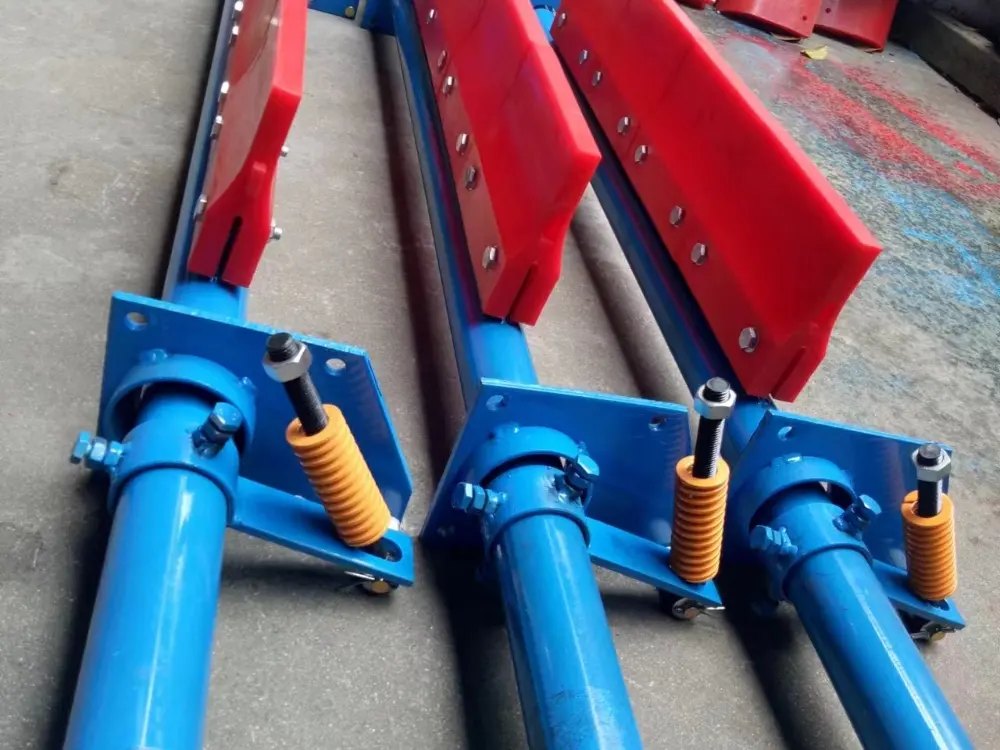
Spring tension units, the common choice on plant conveyors. The spring is also the part that quietly stops doing its job first.
Spring tension units, the common choice on plant conveyors. The spring is also the part that quietly stops doing its job first.
The blade works as a wedge, and the belt cover works as a conveyor of film. Material trapped between blade and cover gets sheared off and falls into the chute. Three variables decide how well that happens.
The first is support. On the pulley face, the belt is backed by steel, so the blade can compress the cover by a fraction of a millimetre and cut the film cleanly. Off the pulley, the same blade just bends the belt.
The second is angle. A shallow attack angle skims over the film. A steep one digs, generating heat at the tip, wearing the cover and shortening its own life. Most primary blades are set with a slight trailing angle so the edge shaves rather than chisels, and the mounting bracket is designed around that.
The third is force. Pressure has to survive splice impacts, load swings and belt flutter, without being high enough to heat the tip or grind the cover. That’s a narrow band, which is why tension systems matter more than they look.
Wear changes all three. As the tip shortens, the effective angle drifts and pressure falls, unless the tension system compensates. Spring and gravity systems compensate within their stroke. Air systems compensate until someone closes the isolator. None of them compensate forever, which is the entire argument for a re-tension schedule.
A cleaner that works changes the return strand within weeks. Fines stop packing onto Conveyor Idlers & Rollers, rollers stay round, and the belt stops drifting, which is where a Conveyor Belt Tracker usually gets the credit. That’s the causal chain most plants never connect, because the cleaner and the tracking problem sit at opposite ends of the conveyor.
Dust falls too. Carryback released under the conveyor becomes airborne dust along the whole length. Material that stays on the belt until the discharge point doesn’t.
Belt and lagging life improve quietly. A clean bottom cover runs cooler over return rollers, and a belt tracking straight across a pulley wears the lagging evenly instead of grinding a groove into one side.
Then there’s the tonnage argument, and it’s the one that survives budget reviews. Take a 1.2 m belt at 2.5 m/s, a 1 mm film, material at 1.6 t/m³. That’s 0.003 m³/s, or 10.8 m³/h, or roughly 17 t/h of product travelling the wrong way and abrading everything it passes.
Every Conveyor that discharges onto a return strand needs one, which means nearly all of them. The ones where performance matters most share three features: tonnage high enough to wear a blade quickly, material abrasive or wet enough to defeat a slack blade, and a return run long enough to accumulate damage before anyone looks.
Mining plants are the obvious case. The conveyor leaving a Crushing station carries sharp material with fines that stick, and the conveyor feeding Screening carries the same material after it has been reduced. Both want a blade that stays in contact, not a blade that wins a hardness contest.
Aggregate plants run drier material at higher speed, so abrasion dominates and dust control becomes the visible symptom. Coal handling brings wet fines that smear rather than release, and a dry blade has limited authority over a smeared film.
Transfer points deserve their own attention. An Impact Bed under the loading chute keeps the belt stable where material lands, so the load line stays where the chute put it. A Guide Trough straightens the material stream before it settles. Both reduce what reaches the cleaner, and both make blade wear more even.
| Blade compound | Abrasion resistance | Behaviour on splices | Heat tolerance | Best fit |
|---|---|---|---|---|
| Polyurethane | Good | Deflects over mechanical splices | Moderate; softens at sustained high temperature | General mining and aggregate duty |
| Rubber | Moderate | Very forgiving; follows uneven covers | Moderate | Worn or cupped belts, low speed, small pulleys |
| Tungsten carbide | Very high | Brittle; chips on bolt and hinge splices | High | High tonnage, high speed, vulcanised splices |
| Ceramic | Very high in wet duty | Brittle; needs a flat, stable belt | High | Slurry-wet process lines |
The honest summary: urethane is the default because it survives being wrong. It tolerates a slightly crooked frame, a splice with a raised edge, and a cover that isn’t flat. Carbide tolerates none of those, but rewards a plant that has its geometry right.
Hardness numbers get quoted a lot in this conversation. They matter less than the tip profile and the mounting angle, because a hard blade at the wrong angle wears faster than a soft blade at the right one. Polyurethane Conveyor Belt Cleaner Blades lists the hardness options against duty.
Compare a Chilean copper concentrator with a South African coal washing plant.
The copper plant runs abrasive slurry-wet material at high tonnage. Blade wear is steady and predictable, and the constraint is change frequency inside short shutdowns. Here a carbide or heavy urethane blade plus a tension system that releases quickly pays for itself in maintenance hours.
The coal plant runs wet sticky fines. Blade wear isn’t the problem; adhesion is. A dry blade skims a smeared film and leaves most of the material behind, and the carryback that escapes cakes onto return rollers within days. The answer here is a secondary cleaner plus containment, with Conveyor Belt Skirting keeping the load centred so the film is even across the width.
Same device, opposite bottlenecks. Buying the harder blade in the coal plant buys nothing.
| Industry | Material | Cleaning challenge | First priority |
|---|---|---|---|
| Iron ore | Dry abrasive lump and fines | Tip wear at high tonnage | Compound and tension discipline |
| Copper | Wet abrasive residue | Film left after the primary pass | Secondary cleaner, wash arrangement |
| Coal | Wet sticky fines | Smearing and roller build-up | Containment, second cleaning stage |
| Gold | Fine abrasive, often wet | Thin film on a polished cover | Contact geometry, belt condition |
| Aggregates | Dry crushed stone | Dust and fast tip wear | Blade angle, dust suppression |
| Cement | Hot, fine, abrasive | Heat and abrasion together | Compound, distance from the kiln |
| Ports | Mixed dry bulk | Speed and short maintenance windows | Tension system, blade change time |
Work through four questions in order.
Belt speed first. Above roughly 4 m/s, urethane choices narrow and heat becomes the limiting factor. Below 2.5 m/s, almost anything works and price should lead.
Splice type second. A vulcanised, squared splice lets you use carbide. A bolted or hinged splice doesn’t, and no amount of tension tuning changes that.
Access third. If a blade change has to fit inside a four hour window, a quick-release tension system beats a longer wearing blade. If the conveyor runs for a year between stops, buy wear life.
Belt condition fourth. A cover worn into grooves needs a softer, thicker blade that can follow the profile. A new belt with a flat cover takes a hard tip happily, and Conveyor Belts explains what cover grades do to cleaning. A Belt Conveyors reference helps when a whole line is being specified rather than one cleaner replaced.
| Information needed | Why it matters |
|---|---|
| Belt width, speed and cover thickness | Blade size, speed rating, wear allowance |
| Head pulley diameter and face width | Blade profile and mounting geometry |
| Splice type and condition | Rules out brittle compounds |
| Material type, moisture and temperature | Abrasion and adhesion expectations |
| Frame drawing or dimensioned photo | Whether the frame can be reused |
| Tension system preference | Spring, gravity, air or torsion |
| Annual blade consumption | MOQ, packaging, shipping method |
| Inspection standard | Hardness and dimensional checks before shipment |
Five questions to put to any supplier: can you manufacture to our drawing, can you provide material reports, can you support OEM replacement, do you have export experience in our region, and can you recommend tension settings for our belt speed. A supplier who answers all five plainly is worth a trial order.
On drawings, be specific about what you need: overall length, mounting hole pattern, tip profile, blade thickness and the wear allowance. A sketch with those five dimensions is enough for most suppliers to quote without a site visit, and it removes the most common source of wrong parts.
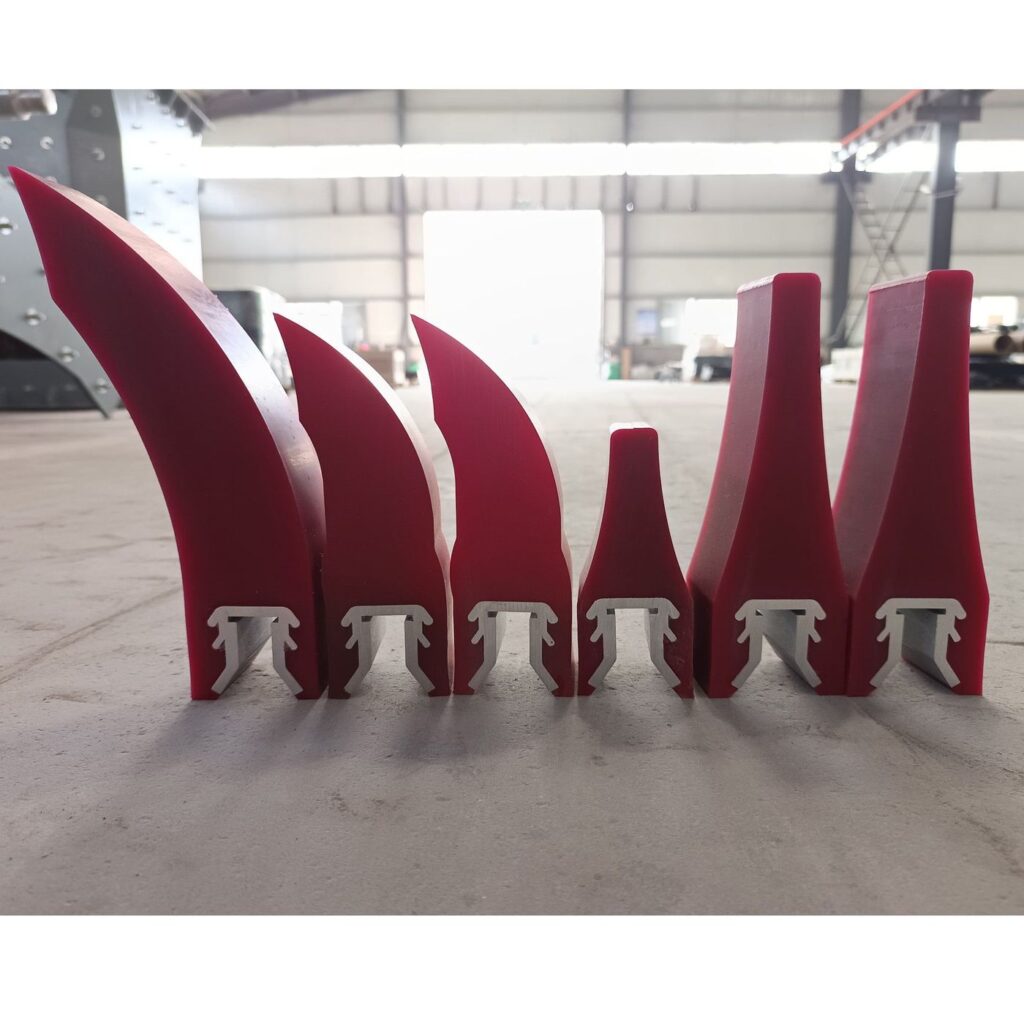
A blade square to the pulley axis and in full contact. Misalignment shows up as uneven wear within weeks, not months.
A blade square to the pulley axis and in full contact. Misalignment shows up as uneven wear within weeks, not months.
| Problem | Possible cause | Recommended solution |
|---|---|---|
| Blade wears at one end | Frame out of parallel; uneven lagging | Square the frame, inspect lagging, verify with chalk |
| Blade wears to a wedge | Attack angle wrong; over-tensioned | Reset angle and tension to design values |
| Blade polishes the belt, no removal | Mounted past the tangent point; belt deflecting | Move the mounting back onto the pulley face |
| Cleaning stops after a month | Tension lost after run-in | Re-tension to spec, then monthly checks |
| Tip chipping | Carbide on a mechanical splice | Change compound or skive the splice |
| Material packs behind the blade | Wet sticky material; tight pocket | Clear the pocket, review chute geometry |
| Uneven cleaning across the width | Cupped belt or crowned pulley | Fix belt or lagging before another blade |
| Blade wears out fast at the edges | Belt edge damage; blade over-width | Trim the blade, inspect belt edges |
Daily, at the start of shift: look at the discharge. Material throwing wide of the chute usually means one section of the belt has stopped being cleaned.
Weekly during the first month, then monthly: check tension, measure blade wear against the limit, check frame bolts, and clear the pocket behind the blade. A pocket packed with fines stops the blade pivoting, and a cleaner that can’t pivot stops cleaning.
Monthly: inspect pulley lagging and the belt cover under the blade. Both wear, and both change what the blade can achieve. A blade change on a grooved cover is a partial fix at best.
Replacement: use the wear limit, not a calendar. When the tip can’t reach the belt at full tension, the blade is spent. Keep one spare set per critical conveyor, because a stopped cleaner becomes a stopped conveyor eventually.
Customer type: gold processing plant, single stage crushing and milling circuit.
Ore type: quartz-hosted gold ore, abrasive, moderately wet.
Operating conditions: 900 mm belt, moderate speed, vulcanised splice, primary cleaner at the head pulley feeding the mill.
Problem: carryback returning to the tail pulley, fines building under the conveyor, and a blade that wore unevenly and needed replacement far more often than expected. Cleaning quality dropped off well before the wear limit was reached.
Solution: the frame had been mounted to a chute wall that flexed under load, so contact came and went with each pass. The frame was re-mounted to the conveyor structure, squared to the belt centre line, and tension reset to the supplier’s figure. Blade compound stayed urethane because the splice was already vulcanised and the belt cover was in good condition.
Result: even wear across the width, a blade that lasted its expected interval, and a return strand that stayed clean between inspections. No change to the blade, only to the geometry holding it.
How do I know if my primary cleaner is actually working?
Look at the return strand, not the blade. If return rollers stay clean, the ground under the conveyor stays clear, and the belt edge isn’t polishing against structure, the cleaner is doing its job. A chalk test confirms contact across the width. Carryback reappearing within a week of a blade change points at tension or geometry.
Should I choose polyurethane or tungsten carbide?
Urethane for most mining and aggregate conveyors, especially with mechanical splices or a worn cover. Carbide for high tonnage, high speed and vulcanised splices, where the belt gives the tip a stable surface. Carbide on a bolted splice chips, and a chipped tip stops cleaning that section of belt immediately.
How tight should the blade be against the belt?
To the manufacturer’s specification, set by their method, usually blade deflection or spring compression. Not by feel, and not by ear. Re-check after the first shift and again after the first week, because new blades bed in and belts settle onto pulleys. Over-tensioning wears the cover and heats the tip.
Why does my cleaner wear out so fast?
Usually because it’s doing work it wasn’t designed for: too much tension, the wrong attack angle, or a mounting position past the tangent point where the belt deflects and the blade rubs instead of cutting. Uneven wear at one end points at frame alignment or lagging. Even, fast wear points at tension and angle.
Can I replace just the blade and keep the frame?
Often yes, if the frame is straight, the mounting is square and the bracket angle matches the pulley. Frames fail when they’re bent, corroded at the bolt holes, or bolted to a surface that flexes. Measure the frame and the pulley before ordering a blade, because a new blade on a distorted frame wears the same way the old one did.
Does a primary cleaner remove all the carryback?
No, and it isn’t meant to. A primary takes the bulk. A film stays on the cover, and a secondary cleaner further around the pulley or on the return strand removes that film. Plants that expect one blade to leave the belt dry end up with caked rollers and a tracking problem they blame on the belt.
What causes material to pack behind the cleaner blade?
Wet sticky material, a tight pocket between blade and frame, and insufficient clearance for the blade to pivot. Once the pocket fills, the blade stops following the belt and cleaning drops away. Clear the pocket at every inspection, and review chute geometry if packing returns within days.
What should I send with a blade enquiry?
Belt width and speed, head pulley diameter and face width, splice type, material description with moisture, and either a frame drawing or a photo with dimensions. Add the tension system type and annual consumption. That’s enough for a supplier to quote a blade that fits and works, rather than one that only fits.
Primary cleaner performance is geometry first, tension second, compound third. That order matters, because the first two cost nothing to check and the third costs money.
Put the blade where the belt is supported. Square the frame. Set tension to the supplier’s figure and re-check it once the blade beds in. Then keep checking on a schedule that survives a busy month.
Compound choice follows from speed, splice and material. And the last piece is downstream: a secondary cleaner, sealed transfer points, clean return rollers. A Mining Secondary Belt Cleaner plus honest containment is what makes a primary blade’s work last longer than a fortnight.
Related Products
Related Technical Guides
Related Buyer Guides
Related Comparison Articles
Annie Lu
Email: annie.lu@huataogroup.com
WhatsApp/WeChat: +86 18032422676
Website: www.tufflexscreen.com
admin