How Often Should I Replace Hydrocyclone Liners?
Oct 20, 2026
 admin
Choose a rubber diaphragm by matching four things to your actual operating conditions: rubber material compatibility with the slurry, exact dimensions against the filter plate drawing, pressure and temperature ratings against the squeeze cycle, and fatigue plus abrasion resistance against the expected number of cycles. Thickness alone is not a selection criterion.
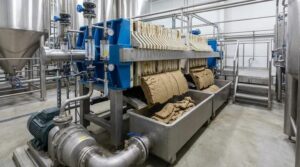
Rubber diaphragm materials for membrane filter press
Material selection starts with slurry chemistry and abrasiveness, not price.
Dimensions must match the filter plate drawing, not the nominal press capacity.
Most membrane filter presses squeeze around 0.8–1.2 MPa, but confirm from equipment design.
Air versus water inflation affects material and design selection.
Fatigue resistance matters as much as initial tensile strength.
Abrasion resistance is a primary failure driver in mining and tailings.
Total cost of ownership matters more than unit price.
| Item | Description |
|---|---|
| Function | Applies additional squeeze pressure to the filter cake after initial filtration |
| Material | NR, EPDM, NBR, and application-specific reinforced rubber compounds |
| Application | Mining, mineral processing, tailings, chemical sludge, municipal sludge |
| Key Selection Factors | Slurry chemistry, dimensions, pressure, temperature, medium, cycle frequency, abrasion |
| Typical Squeeze Pressure | 0.8–1.2 MPa, confirm from equipment design |
| Common Failure Modes | Cracking, abrasion, chemical attack, deformation, sealing failure |
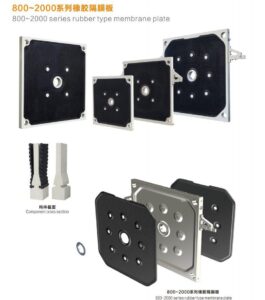
A rubber diaphragm is a flexible elastomeric membrane installed on a membrane filter press plate. After the initial filtration stage, it expands under pressure to compress the filter cake and drive out additional moisture. It is a replaceable wear component that directly affects cake dryness, cycle time, and maintenance cost.
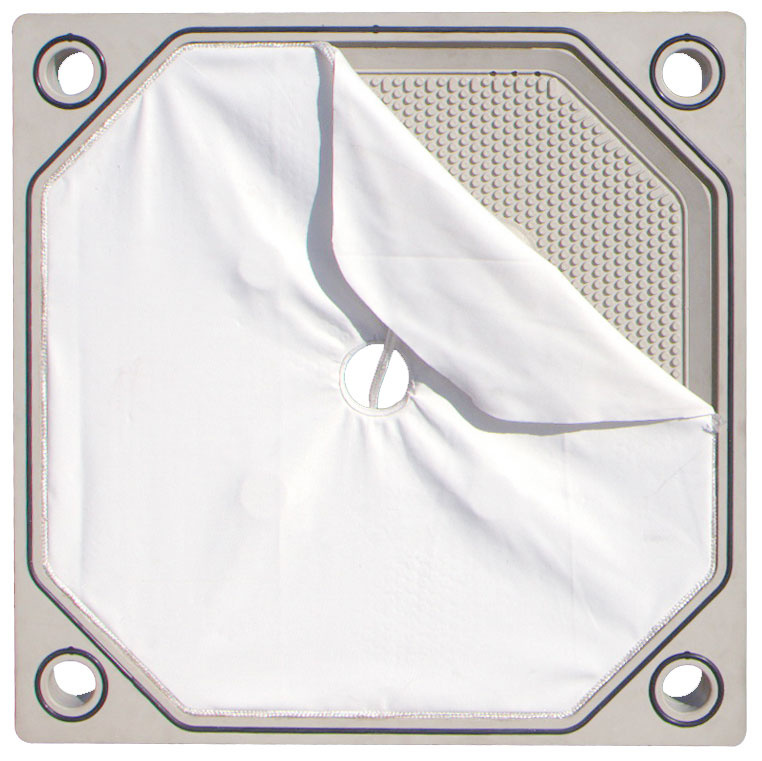
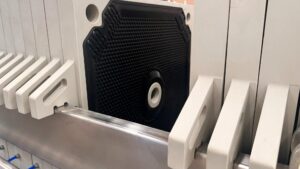
The diaphragm sits behind the filter cloth on a membrane filter press plate. During the squeeze cycle, compressed air or water inflates the diaphragm. The diaphragm presses against the filter cake, mechanically compressing it to reduce moisture content.
After the squeeze cycle, the diaphragm deflates and returns to its original position, allowing the plate to open and the cake to discharge. This expand-and-contract action repeats every filtration cycle, which is why fatigue resistance is a critical property.
The working principle can be summarized as:
Initial filtration → Diaphragm inflation → Cake compression → Diaphragm deflation → Cake discharge → Next cycle
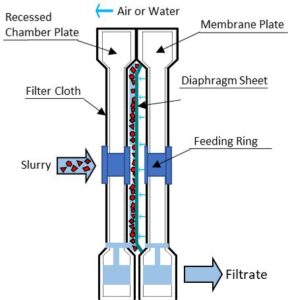
Rubber diaphragm installed on filter plate
Improved cake dryness, reducing downstream drying cost
Stable filtration performance across cycles
Shorter cycle time compared with chamber filter presses
Lower moisture content in tailings, improving handling and transport
Replaceable wear component, reducing long-term maintenance cost
Adaptable to different slurries through material selection
Mining and mineral processing
Tailings filtration and dry discharge
Chemical sludge dewatering
Municipal wastewater treatment
Dye and pigment sludge
Food and pharmaceutical filtration
For mining operations, the diaphragm works alongside FILTER PRESSES and FILTER PLATES & CLOTHS to complete the dewatering circuit. Upstream, THICKENERS and DEWATERING HYDROCYCLONES are often used to increase feed solids concentration before filtration.
| Material | Chemical Resistance | Temperature Resistance | Abrasion Resistance | Best Application |
|---|---|---|---|---|
| NR (Natural Rubber) | Moderate | Moderate | Good | General filtration, abrasive slurry |
| EPDM | Good | Good | Moderate | Water-based slurry, chemical exposure |
| NBR | Good (oils) | Moderate | Moderate | Oil-containing slurry |
| Reinforced NR Compound | Moderate | Moderate | Excellent | Mining tailings, abrasive minerals |
Material selection should always be verified against the actual slurry chemistry, pH, temperature, and abrasive content. A rubber compound that performs well in municipal sludge may fail prematurely in a mining application.
| Application | Key Requirement | Recommended Material Focus |
|---|---|---|
| Mining tailings | Abrasion resistance | NR or reinforced NR compound |
| Chemical sludge | Chemical compatibility | EPDM |
| Oil-containing slurry | Oil resistance | NBR |
| Municipal wastewater | General durability | NR or EPDM |
| High-temperature slurry | Thermal stability | EPDM or high-temp compound |
| Industry | Typical Slurry | Diaphragm Priority |
|---|---|---|
| Gold | Cyanide tailings | Chemical compatibility + abrasion |
| Copper | Flotation tailings | Abrasion resistance |
| Iron Ore | Fine iron tailings | Abrasion + elasticity |
| Coal | Fine coal slurry | Abrasion + fatigue resistance |
| Lithium | Chemical tailings | Chemical compatibility |
| Chemical | Process sludge | Chemical compatibility |
| Municipal | Wastewater sludge | General durability |
Follow this sequence when selecting a rubber diaphragm:
Identify slurry chemistry, pH, and abrasiveness.
Confirm filter plate model and dimensions.
Confirm squeeze pressure and inflation medium.
Confirm operating temperature range.
Estimate cycle frequency per day.
Match material to all above conditions.
Verify dimensional accuracy against the filter plate drawing.
Review previous diaphragm failure mode if replacing.
Confirm supplier can provide material reports and dimensional verification.
Compare total cost of ownership, not unit price.
A practical selection chain for mining and tailings is:
Slurry characteristics → Rubber material → Diaphragm dimensions → Pressure → Temperature → Inflation medium → Cycle frequency → Abrasion resistance → Expected service life
Membrane filter press in mining environment
Filter press model
Filter plate dimensions
Diaphragm drawing or photos
Operating squeeze pressure
Operating temperature
Slurry chemical composition and pH
Solid particle characteristics
Previous diaphragm failure mode
Filter plate drawing
Diaphragm dimensional drawing
Mounting hole layout
Center opening dimensions
Sealing area detail
Provide OEM part numbers when available. A qualified supplier can manufacture to match OEM dimensions even without part numbers, provided drawings or samples are supplied.
Confirm material with the supplier based on slurry chemistry and abrasiveness. Request material reports for NR, EPDM, or NBR compounds.
MOQ: depends on supplier and diaphragm size
Lead Time: typically 15–30 days for custom diaphragms
Packaging: protected from UV, heat, and deformation during transport
Shipping: confirm method based on size and quantity
Dimensional verification against drawing
Material composition report
Visual inspection for surface defects
Hardness and elasticity check
Can the supplier manufacture according to drawings?
Can the supplier provide material reports?
Can the supplier support OEM replacement?
Does the supplier have export experience?
Can the supplier provide wear-life recommendations?
| Problem | Possible Cause | Recommended Solution |
|---|---|---|
| Premature wear | Abrasive slurry, wrong material | Switch to abrasion-resistant compound |
| Cracking | Fatigue, over-pressure | Verify pressure rating, improve cycle control |
| Deformation | Excessive temperature | Upgrade temperature rating |
| Chemical attack | Incompatible elastomer | Switch to EPDM or NBR |
| Sealing failure | Dimensional mismatch | Verify against plate drawing |
| Short service life | Wrong material for slurry | Re-evaluate slurry chemistry |
| Edge damage | Installation error or plate damage | Check plate surface, review installation procedure |
| Blistering | Medium contamination or incompatible fluid | Check inflation medium quality |
| Uneven expansion | Thickness variation or mounting issue | Verify thickness tolerance and mounting holes |
| Poor cake dryness | Insufficient squeeze pressure or stiff diaphragm | Check pressure setting and material flexibility |
Check for visible damage, leakage, or abnormal noise
Confirm squeeze pressure is within specification
Inspect sealing area and mounting holes
Check diaphragm surface for early wear signs
Check wear pattern and elasticity
Compare cycle count against expected service life
Record wear pattern and location. Edge wear often indicates installation or plate issues. Center wear may indicate material incompatibility or abrasive slurry.
Replace based on condition and cycle count, not calendar time. Replace before failure to avoid unplanned downtime.
Keep at least one spare diaphragm in inventory for critical filtration circuits. Confirm spare dimensions match the installed plate.
Standardize diaphragm specifications across similar presses
Train operators on correct installation
Track cycle count and wear pattern
Follow daily, weekly, and monthly inspection schedules
Replace diaphragms before failure
Review slurry chemistry changes that may affect material selection
Customer Type: Copper tailings filtration plant
Ore Type: Copper flotation tailings
Operating Conditions: 1.0 MPa squeeze pressure, water inflation, 45°C, 12 cycles per day
Problem: Diaphragm failed after approximately 3 months due to edge cracking and abrasion
Solution: Switched to abrasion-resistant NR compound with reinforced edge design. Verified dimensions against the filter plate drawing. Adjusted installation procedure to avoid edge stress.
Result: Service life extended to approximately 9–10 months. Reduced unplanned downtime and improved cake dryness consistency.
This case reflects typical mining tailings conditions. Actual results vary with slurry chemistry, operating pressure, temperature, and cycle frequency.
Tailings filtration circuit with filter press
Q1: How much does a rubber diaphragm cost?
Price depends on material, size, and quantity. NR is generally lower cost, while EPDM and NBR are higher. For mining applications, total cost of ownership matters more than unit price because premature failure causes downtime and production loss.
Q2: Which rubber material is best for mining tailings?
NR or reinforced NR compounds are common for abrasive tailings. EPDM is better for chemical resistance, and NBR for oil-containing slurry. Always verify against actual slurry chemistry and abrasiveness before selecting.
Q3: How do I install a rubber diaphragm?
Install according to the filter plate drawing. Do not grind, cut, or force-fit. Check mounting holes, center opening, and sealing area before tightening. Incorrect installation is a common cause of premature failure.
Q4: What is the typical service life?
Service life depends on slurry abrasiveness, pressure, temperature, and cycle frequency. In mining applications, 6–12 months is common, but this varies widely. Monitor wear pattern and replace before failure rather than relying on a fixed schedule.
Q5: How do I maintain a rubber diaphragm?
Inspect daily for damage, weekly for sealing and mounting, and monthly for wear pattern. Track cycle count. Keep spares in inventory. Replace based on condition, not just calendar time.
Q6: Is the diaphragm compatible with my OEM filter press?
Compatibility depends on plate dimensions and mounting configuration. Provide the filter press model, plate drawing, and diaphragm drawing to the supplier. A qualified supplier can manufacture to match OEM dimensions even without OEM part numbers.
Q7: How do I procure a replacement diaphragm?
Provide filter press model, plate dimensions, diaphragm drawing or photos, operating pressure, temperature, slurry data, and previous failure mode. Request material reports and dimensional verification before ordering.
Q8: Can I reduce cost by using a thinner diaphragm?
Not necessarily. A thinner diaphragm may reduce initial cost but can fail faster under abrasive or high-pressure conditions. Compare total cost of ownership, including downtime and replacement labor, not unit price alone.
Choosing the right rubber diaphragm for a membrane filter press requires matching material, dimensions, pressure, temperature, inflation medium, cycle frequency, and abrasion resistance to the actual application. For mining and tailings, abrasion and chemical compatibility are usually the primary drivers. Provide complete technical information to your supplier to get an accurate recommendation.
The diaphragm is a small component relative to the filter press, but it directly affects cake dryness, cycle time, and maintenance cost. A well-selected diaphragm reduces downtime and improves the overall dewatering performance of the circuit.
For upstream slurry classification, HYDROCYCLONES are often used together with filtration equipment. For related buyer guidance, see HOW DO I CHOOSE THE RIGHT RUBBER BELT FOR A VACUUM BELT FILTER?.
Related Products
Related Technical Guides
HYDROCYCLONE WEAR: ROOT CAUSES, HIGH-WEAR ZONES & MATERIAL SOLUTIONS
IMPROVE FINE SCREENING EFFICIENCY WITH POLYURETHANE SCREEN PANELS
FLOTATION CELL ROTOR AND STATOR WEAR PARTS: HOW THEY CONTROL RECOVERY, FLOW AND MAINTENANCE COST
ROTOR & STATOR IN MECHANICAL FLOTATION CELLS: THE HEART OF EFFICIENT MINERAL FLOTATION
Related Buyer Guides
HOW DO I CHOOSE THE RIGHT RUBBER BELT FOR A VACUUM BELT FILTER?
WHICH MANUFACTURER OFFERS HIGH-QUALITY POLYURETHANE TUFFLEX WIRE SCREENS FOR MINING?
Related Comparison Articles
POLYURETHANE SCREEN VS RUBBER SCREEN VS WIRE MESH: A COMPLETE COMPARISON GUIDE
SELF-CLEANING SCREEN VS TRADITIONAL WOVEN WIRE MESH: WHICH ONE SHOULD YOU CHOOSE?
Annie Lu
Email: annie.lu@huataogroup.com
Mobile / WhatsApp: +86 18032422676
admin