Why Is My Conveyor Belt Centered at the Pulleys but Off-Center in the Middle?
-
 admin
admin - 16 Sep, 2026
What Is Conveyor Belt Mid-Section Mistracking?
Conveyor belt mid-section mistracking is the lateral deviation of a belt between the head and tail pulleys, even though the belt enters and leaves both pulleys correctly centered. It is caused by a localized steering force acting on the belt in one middle section, most often from misaligned carrying idlers, a twisted conveyor frame, uneven material loading, material buildup on rollers, seized rollers, or belt and splice defects.
Key Takeaways
-
Centered pulleys do not guarantee a centered belt through the entire conveyor.
-
Find where the belt first leaves the centerline, not where it reaches the edge.
-
Misaligned carrying idlers are the most common cause.
-
If the belt only mistracks under load, inspect the loading zone.
-
Never adjust a correctly aligned head or tail pulley to fix a middle-section problem.
-
Adjust one idler at a time.
-
Use a belt tracker only after mechanical alignment is correct.
Summary Table
| Item | Description |
|---|---|
| Function | Diagnose and correct conveyor belt mistracking in the middle section |
| Typical Causes | Misaligned idlers, twisted frame, uneven loading, buildup, seized rollers, belt/splice defects |
| Key Diagnostic | Compare empty vs loaded operation; locate first drift point |
| Adjustment Rule | One small correction at a time |
| When to Use Tracker | After mechanical alignment is correct and belt wander persists |
| Related Process | Crushing → Screening → Conveying → Stockpile |
| Related Components | Idlers, belt tracker, belt cleaner, skirting, impact bed |
Definition
Conveyor belt mistracking is the lateral deviation of a conveyor belt from its intended centerline during operation.
Mid-section mistracking is a specific pattern: the belt is centered at the head and tail pulleys, but deviates to one side somewhere between them. This pattern is important because it tells you the steering force is localized, not global.
This is different from global mistracking, where the belt runs off-center along the entire conveyor. The two patterns require different correction strategies.
Working Principle
A conveyor belt does not automatically follow the geometric center of the conveyor structure. Its running position is determined by the forces applied by:
-
Head and tail pulleys
-
Carrying and return idlers
-
Belt tension
-
Material load
-
The belt itself (camber, splice, carcass condition)
When these forces are balanced, the belt runs centered. When a localized force is introduced between the pulleys, the belt deviates only in that section.
This is why a belt can be perfectly centered at the pulleys but off-center in the middle. The pulleys are doing their job. The problem is elsewhere.
A belt responds to the orientation of the rollers it contacts. This is why a skewed idler can steer a belt, and why small idler adjustments are sometimes used for belt training.

Benefits of Correct Diagnosis
Correct diagnosis of mid-conveyor mistracking delivers measurable benefits:
-
Longer belt life
-
Reduced edge wear
-
Less material spillage
-
Lower maintenance cost
-
Fewer unplanned stoppages
-
Better structural protection
-
More stable loading zone performance
-
Reduced manual idler adjustment frequency
Random adjustment of pulleys and idlers often makes the problem worse by introducing competing steering forces.
Applications
This diagnostic approach applies to:
-
Mining conveyors
-
Coal handling systems
-
Aggregate processing plants
-
Cement bulk material handling
-
Port bulk terminals
-
Stockyard conveyors
-
Overland conveyors
-
Crusher feed and discharge conveyors
For related process stages, see CRUSHING and SCREENING.
Material Comparison
| Material | Mistracking Risk | Common Cause | Recommended Action |
|---|---|---|---|
| Dry ore | Medium | Idler misalignment | Regular idler alignment check |
| Wet sticky ore | High | Buildup on rollers | Return idler cleaning + belt cleaner |
| Coal | Medium | Uneven loading | Loading chute alignment |
| Aggregate | Medium | Frame distortion | Structural inspection |
| Clay-rich material | High | Carryback and buildup | Belt cleaner + skirting |
| Fine concentrates | High | Belt camber and splice issues | Belt and splice inspection |
Wet and sticky materials increase the risk of buildup on return idlers, which is a common cause of mid-conveyor mistracking.
For related belt cleaning products, see MINING SECONDARY BELT CLEANER.
Application Comparison
| Scenario | Likely Cause | First Check |
|---|---|---|
| Belt mistracks empty and loaded | Idler alignment, frame, buildup, seized rollers | Idler squareness and roller condition |
| Belt tracks empty but mistracks loaded | Loading chute, material trajectory, skirt pressure | Loading zone and chute alignment |
| Belt drifts at same physical location | Localized idler or frame problem | That specific idler station |
| Belt drift travels with the belt | Belt camber, splice, carcass damage | Belt and splice inspection |
| Belt drifts intermittently | Foundation movement, structural deflection | Structural survey |
Industry Application Matrix
| Industry | Typical Conveyor | Mistracking Risk | Recommended Action |
|---|---|---|---|
| Gold mining | Crushing to stockpile | Medium | Regular idler alignment check |
| Iron ore | Overland conveyor | High | Self-aligning idlers + tracker |
| Copper ore | Flotation feed conveyor | Medium | Loading chute optimization |
| Coal | Coal handling conveyor | Medium | Belt cleaner + skirting |
| Lithium ore | Fine material conveyor | High | Buildup control |
| Silica sand | Wash plant conveyor | Medium | Frame alignment |
| Lead zinc ore | Concentrate conveyor | High | Belt tracker + cleaner |
| Nickel ore | Wet sticky ore conveyor | High | Return idler cleaning |
| Phosphate | Bulk handling conveyor | Medium | Loading zone control |
| Rare earth | Fine concentrate conveyor | High | Belt and splice inspection |
| Tailings | Tailings conveyor | High | Tracker + skirting |
Selection Guide
When selecting a solution for mid-conveyor mistracking, work through these questions in order:
1. Is the belt mistracking empty and loaded?
If yes, focus on idler alignment, frame, buildup, seized rollers, belt, and splice.
2. Is the belt mistracking only under load?
If yes, focus on loading chute, material trajectory, skirt pressure, and structural deflection.
3. Does the deviation stay at the same physical location?
If yes, inspect that idler station and upstream.
4. Does the deviation travel with the belt?
If yes, inspect belt camber, splice, and carcass.
5. Is the problem intermittent?
If yes, check foundation movement and structural deflection.
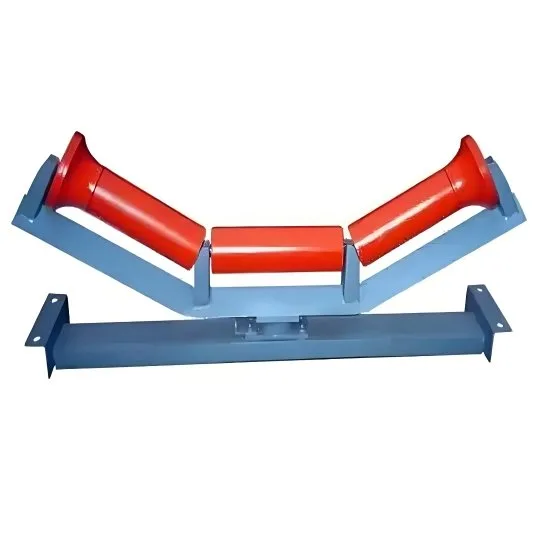
For related conveyor components, see CONVEYOR IDLERS & ROLLERS and CONVEYOR BELT TRACKER.
Procurement Guide
When procuring conveyor components for mistracking correction, provide the following information.
Required Information
| Item | Why It Matters |
|---|---|
| Belt width | Determines idler and tracker size |
| Belt speed | Affects tracker response |
| Conveyor length | Determines number of idler stations |
| Trough angle | Determines idler configuration |
| Material type | Affects buildup and wear risk |
| Capacity | Affects load distribution |
| Carrying or return side | Determines which idlers to inspect |
| Mistracking location | Narrows down the cause |
Drawings Needed
-
Idler arrangement drawing
-
Conveyor profile drawing
-
Loading chute drawing
-
Belt tracker mounting drawing
OEM Part Numbers
Provide OEM part numbers where available for idlers, rollers, and tracker components.
Material Selection
-
Roller shell material: steel, HDPE, or rubber-disc
-
Bearing type: sealed, greased, or maintenance-free
-
Tracker blade material: polyurethane or rubber
MOQ, Lead Time, Packaging, Shipping
-
Confirm MOQ per idler size
-
Confirm lead time for critical stations
-
Confirm export packaging
-
Confirm shipping method and inspection standard
Supplier Evaluation Checklist
-
Can the supplier manufacture according to drawings?
-
Can the supplier provide material reports?
-
Can the supplier support OEM replacement?
-
Does the supplier have export experience?
-
Can the supplier provide wear-life recommendations?
For related products, see CONVEYOR BELT SKIRTING and HEAVY-DUTY CONVEYOR IMPACT BED.
Failure Analysis
| Problem | Possible Cause | Recommended Solution |
|---|---|---|
| Premature wear on one belt edge | Persistent mistracking | Locate first drift point and correct idler alignment |
| Belt cracking near edge | Edge contact with structure | Check frame alignment and belt training |
| Material spillage | Belt off-center at loading zone | Adjust loading chute and skirt |
| Buildup on return idlers | Sticky material carryback | Install belt cleaner and clean return idlers |
| Seized roller | Bearing failure or contamination | Replace roller and inspect neighboring rollers |
| Belt drift only under load | Uneven material loading | Center the loading chute |
| Belt drift travels with belt | Belt camber or splice defect | Inspect and repair belt or splice |
| Poor fitment of idler | Wrong idler size or bracket | Verify dimensions and mounting |
| Material mismatch | Wrong idler material for application | Select suitable roller material |
| Installation failure | Incorrect idler squareness | Re-align one idler at a time |
Maintenance Guide
Daily Inspection
-
Check belt position at fixed stations
-
Look for material buildup on rollers
-
Check for unusual noise or vibration
Weekly Inspection
-
Inspect idler rotation
-
Check for seized or damaged rollers
-
Verify loading zone alignment
Monthly Inspection
-
Check idler frame squareness
-
Inspect belt edges for wear
-
Review belt tracker response
Wear Pattern Monitoring
-
Record belt position at multiple stations
-
Compare empty vs loaded tracking
-
Document any change in drift pattern
Replacement Timing
-
Replace seized rollers immediately
-
Replace worn idlers before they affect tracking
-
Replace belt cleaner blades before carryback increases
Spare Parts Inventory
-
Keep spare idlers for critical stations
-
Keep spare belt cleaner blades
-
Keep spare tracker components
Downtime Reduction
-
Schedule idler inspection during planned shutdowns
-
Train maintenance team on one-adjustment-at-a-time rule
-
Use belt tracker to reduce manual adjustment frequency
Preventive Maintenance
-
Clean return idlers regularly
-
Align loading chute to belt centerline
-
Inspect belt splice every month
For the related process hub, see CONVEYOR.
Case Study
Customer Type:
Copper ore concentrator
Ore Type:
Copper ore with wet sticky fines
Operating Conditions:
Overland conveyor, 1200 mm belt width, 3.5 m/s belt speed, 800 m length, 35° trough angle
Problem:
Belt was centered at head and tail pulleys but drifted 80 mm to the left in the middle section. Mistracking occurred both empty and loaded. Edge wear and material spillage were increasing.
Solution:
Maintenance team located the first drift point at idler station 42. Inspection found three consecutive idler frames slightly out of square in the same direction, plus buildup on two return idlers. Idler frames were re-aligned one at a time. Return idlers were cleaned and a secondary belt cleaner was installed.
Result:
Belt returned to center within two shifts. Edge wear stopped. Spillage reduced significantly. No belt tracker was required because the root cause was mechanical alignment and buildup.
FAQ
Q1: Why is my conveyor belt centered at the pulleys but off-center in the middle?
A: Because a localized steering force is acting on the belt between the pulleys. Common causes are misaligned carrying idlers, a twisted frame, uneven loading, material buildup, seized rollers, or belt and splice defects. The pulleys are usually not the cause.
Q2: Should I adjust the head or tail pulley to fix mid-conveyor mistracking?
A: No. If the belt enters and leaves the pulleys correctly, adjusting them can create a new tracking problem elsewhere. Focus on the first drift point between the pulleys instead.
Q3: How do I find the real cause of belt mistracking?
A: Find where the belt first begins to move away from the centerline. That first deviation point is much closer to the actual cause than the location where the belt finally reaches the edge.
Q4: What is the difference between empty and loaded mistracking?
A: If the belt mistracks both empty and loaded, focus on idler alignment, frame, buildup, seized rollers, belt, and splice. If it only mistracks under load, focus on the loading chute, material trajectory, skirt pressure, and structural deflection.
Q5: When should I use a self-aligning idler or belt tracker?
A: Use a belt tracker when mechanical alignment is correct but belt wander persists due to varying loads, wet or sticky material, or changing feed conditions. Do not use a tracker to hide a mechanical problem.
Q6: How many idlers should I adjust at one time?
A: One. Make one small correction, let the conveyor run long enough to reveal the effect, then reassess. Adjusting multiple idlers at once can introduce competing steering forces.
Q7: Can material buildup cause belt mistracking?
A: Yes. Buildup on return idlers changes the effective roller surface and can introduce a localized steering force. Wet ore, clay, mud, and coal fines are common causes.
Q8: What information should I provide to a supplier for mistracking evaluation?
A: Provide belt width, belt speed, conveyor length, trough angle, material type, conveying capacity, carrying or return side, exact mistracking location, and photos or video of the affected section.
Q9: Can a belt splice cause mid-conveyor mistracking?
A: Yes. A non-square splice, belt camber, or localized carcass damage can create a repeating tracking pattern. If the deviation travels with the belt, inspect the belt and splice.
Q10: How do I reduce the risk of mid-conveyor mistracking?
A: Clean return idlers regularly, align the loading chute to the belt centerline, inspect idler squareness monthly, and replace seized rollers immediately.
For the related technical guide, see CONVEYOR BELT TRACKER.
Conclusion
A conveyor belt that is centered at the pulleys but off-center in the middle is telling you something specific: the steering force is between the pulleys, not at them.
The correct approach is systematic:
-
Locate the first drift point.
-
Compare empty and loaded operation.
-
Inspect idlers, frame, buildup, rollers, belt, and splice.
-
Correct mechanical alignment one adjustment at a time.
-
Consider a belt tracker only after mechanical alignment is correct.
Mechanical alignment corrects the root cause. A belt tracking system manages recurring operational deviation.
For conveyor components and wear parts, see CONVEYOR BELTS and POLYURETHANE CONVEYOR BELT CLEANER BLADES.
Related Articles
Related Products
Related Technical Guides
-
HYDROCYCLONE WEAR: ROOT CAUSES, HIGH-WEAR ZONES & MATERIAL SOLUTIONS
-
FLOTATION CELL ROTOR AND STATOR WEAR PARTS: HOW THEY CONTROL RECOVERY, FLOW AND MAINTENANCE COST
-
ROTOR & STATOR IN MECHANICAL FLOTATION CELLS: THE HEART OF EFFICIENT MINERAL FLOTATION
-
IMPROVE FINE SCREENING EFFICIENCY WITH POLYURETHANE SCREEN PANELS
Related Buyer Guides
-
HOW DO I CHOOSE THE RIGHT RUBBER BELT FOR A VACUUM BELT FILTER?
-
WHICH MANUFACTURER OFFERS HIGH-QUALITY POLYURETHANE TUFFLEX WIRE SCREENS FOR MINING?
Related Comparison Articles
-
POLYURETHANE SCREEN VS RUBBER SCREEN VS WIRE MESH: A COMPLETE COMPARISON GUIDE
-
SELF-CLEANING SCREEN VS TRADITIONAL WOVEN WIRE MESH: WHICH ONE SHOULD YOU CHOOSE?
Contact
Annie Lu
Email: annie.lu@huataogroup.com
Mobile: +86 18032422676
WhatsApp / WeChat
conveyor belt mistracking, conveyor belt off-center, belt tracking, conveyor idlers, self-aligning idler, conveyor belt tracker, mining conveyor maintenance, bulk material handling, conveyor components, belt drift
Tags:
admin
personal profile