Why Does My Conveyor Belt Keep Tracking to One Side and How Can I Fix It?
-
 admin
admin - 15 Sep, 2026
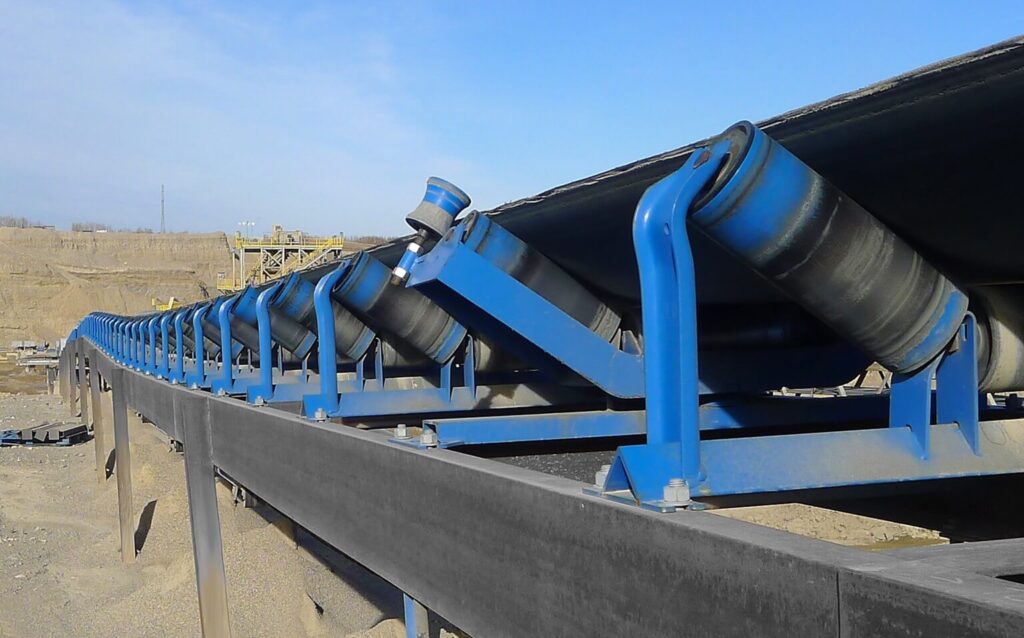
A conveyor belt tracks to one side because the forces acting on the two sides of the belt are no longer balanced. The most common causes are misaligned idlers or pulleys, off-center loading, material buildup, uneven tension, a crooked splice, or structural distortion. Correct the mechanical cause first, then consider a belt tracker for recurring deviation.
2. Key Takeaways
-
A belt running off-center is usually not a defective belt — something in the system is steering it sideways.
-
Start your investigation where the belt first leaves the centerline, not where it finally touches the structure.
-
The empty-versus-loaded test separates a loading problem from a mechanical alignment problem.
-
Alignment removes the cause; a belt tracker controls recurring deviation. They are not substitutes.
-
A BELT TRACKER should never be used to compensate for a twisted structure, a crooked splice, or a badly misaligned pulley.
3. Summary Table
| Item | Description | Function | Material | Application | Service Life |
|---|---|---|---|---|---|
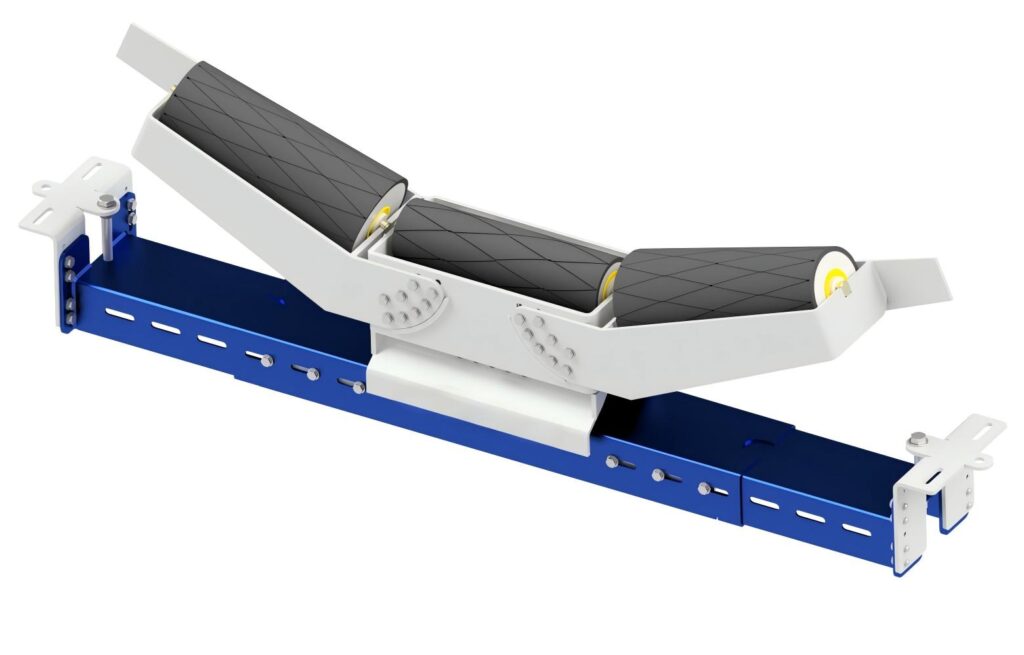
| Belt Tracker | Self-aligning idler assembly that steers the belt back to center | Controls recurring lateral deviation | Steel frame, rubber or PU rollers | Carrying and return side, tail pulley area | 3–8 years depending on duty |
| Conveyor Idlers & Rollers | Carrying and return rollers supporting the belt | Maintain belt profile and reduce friction | Steel, HDPE, rubber lagging | All conveyor sections | 2–5 years |
| Impact Bed | Shock-absorbing bed at transfer points | Protects belt from impact and reduces spillage | Rubber, PU, steel frame | Loading and transfer zones | 3–6 years |
| Conveyor Belt Cleaner | Primary or secondary scraper removing carryback | Reduces material buildup on return side | PU, tungsten carbide, rubber | Head pulley discharge | 6–24 months for blades |
| Conveyor Belt Skirting | Rubber or PU sealing strip at loading zone | Controls spillage and dust | Rubber, PU | Loading point | 1–3 years |
4. Definition
Conveyor belt mistracking is the persistent lateral displacement of a conveyor belt away from its intended centerline during operation. It is a system-level condition, not a single-component defect. In mining, quarrying, aggregate processing, cement plants, and coal handling, mistracking is one of the most common causes of belt-edge wear, spillage, idler damage, and unplanned downtime. For the full conveying process context, see CONVEYOR.
5. Working Principle
A conveyor belt runs centered when the forces acting on both edges are balanced. Three force groups matter most:
-
Idler and pulley geometry — the belt tends to move toward the end of the idler or pulley it contacts first. A slightly skewed idler creates a continuous steering force.
-
Load distribution — off-center loading pushes the belt away from the centerline. This is why a belt can run perfectly empty and mistrack only when loaded.
-
Belt and splice condition — camber, carcass distortion, edge damage, or a crooked splice introduces a repeating deviation once per belt revolution.
When any of these forces becomes dominant, the belt drifts. Correcting mistracking means identifying which force is dominant, not adjusting idlers until the belt looks centered.
6. Benefits of Correct Tracking
-
Longer belt life and reduced edge wear
-
Lower spillage and cleaner transfer points
-
Reduced idler and pulley damage
-
Lower power consumption
-
Fewer unplanned shutdowns
-
Safer operating environment
-
Lower total cost of ownership
7. Applications
Correct belt tracking matters in:
-
Mining conveyor systems handling ore, coal, and tailings
-
Aggregate and quarry conveyors
-
Cement plant clinker and raw material conveyors
-
Coal handling and stockyard conveyors
-
Port and bulk terminal conveyors
-
Mineral processing plant feed and discharge conveyors

8. Material Comparison
| Material | Wear Resistance | Cost | Best Application | Notes |
|---|---|---|---|---|
| Rubber | Good | Medium | General conveying, impact zones | Excellent shock absorption |
| Polyurethane (PU) | Excellent | Medium-High | Skirting, cleaner blades, fine material | Better abrasion resistance than rubber |
| Steel | High | Medium | Structural frames, idler shells | Not suitable for sealing |
| Ceramic | Very High | High | High-wear chute liners | Brittle, not for flexible parts |
| HDPE | Moderate | Low | Idler rolls, low-load applications | Lightweight, low friction |
9. Application Comparison
| Application | Recommended Tracking Approach | Why |
|---|---|---|
| Short conveyor, stable load | Manual idler adjustment | Simple, low cost |
| Long conveyor, changing load | Belt tracker + alignment | Recurring deviation needs automatic control |
| Return side near tail pulley | Return belt tracker | Controls belt before re-entering loading zone |
| Transfer point with impact | Impact bed + skirting | Reduces spillage and belt damage |
| Conveyor with crooked splice | Splice repair first | Tracker cannot fix a repeating belt defect |
10. Industry Application Matrix
| Industry | Typical Material | Main Tracking Risk | Recommended Solution |
|---|---|---|---|
| Gold Mining | Ore, slurry | Off-center loading | Impact bed + belt tracker |
| Iron Ore | Abrasive ore | Idler wear | Heavy-duty idlers + tracker |
| Copper Ore | Coarse ore | Structural distortion | Alignment + tracker |
| Coal | Coal, dust | Material buildup | Belt cleaner + skirting |
| Lithium Ore | Fine concentrate | Belt camber | Splice inspection + tracker |
| Silica Sand | Abrasive fines | Edge wear | PU skirting + tracker |
| Aggregate | Crushed stone | Off-center loading | Impact bed + guide trough |
| Cement | Clinker, raw meal | High temperature | Heat-resistant belt + tracker |
11. Selection Guide
When selecting a belt tracking solution, provide:
-
Belt width and belt speed
-
Trough angle and conveyor arrangement
-
Material type, size, and capacity
-
Mistracking location (which section)
-
Carrying side or return side
-
Photos or videos of the operating condition
-
Ambient conditions (dust, moisture, temperature)
For most mining conveyors, a CONVEYOR BELT TRACKER on the carrying side and a return tracker near the tail pulley provide the most stable result. Where impact is significant, pair it with a HEAVY-DUTY CONVEYOR IMPACT BED.
12. Procurement Guide
Required Information:
-
Belt width, speed, trough angle
-
Conveyor length and arrangement
-
Material type and capacity
-
Mistracking location and frequency
-
Carrying or return side
-
Existing idler and pulley dimensions
Drawings Needed:
-
Conveyor profile drawing
-
Idler spacing drawing
-
Pulley dimensional drawing
Material Selection:
-
Rubber rollers for general duty
-
PU rollers for fine, abrasive material
-
Steel frame for heavy-duty mining
MOQ, Lead Time, Packaging, Shipping:
-
MOQ typically 10–50 units depending on model
-
Lead time 15–30 days for standard models
-
Export packaging with steel pallets or wooden cases
-
Sea freight or air freight depending on urgency
Inspection Standards:
-
Dimensional check against drawing
-
Roller rotation test
-
Frame weld inspection
-
Surface finish check
Supplier Evaluation Checklist:
-
Can the supplier manufacture according to drawings?
-
Can the supplier provide material reports?
-
Can the supplier support OEM replacement?
-
Does the supplier have export experience?
-
Can the supplier provide wear-life recommendations?
13. Failure Analysis
| Problem | Possible Cause | Recommended Solution |
|---|---|---|
| Premature belt edge wear | Persistent mistracking | Identify steering force; install tracker if recurring |
| Belt cracking at edge | Structure contact | Check structure clearance; adjust idlers |
| Material blinding on return side | Carryback buildup | Install MINING SECONDARY BELT CLEANER |
| Idler seizure | Contamination, bearing failure | Replace idler; improve sealing |
| Spillage at transfer point | Poor skirting, off-center load | Install CONVEYOR BELT SKIRTING; center the load |
| Belt wandering only when loaded | Off-center loading | Adjust chute, impact bed, or guide trough |
| Belt wandering once per revolution | Crooked splice or belt camber | Repair or replace splice |
| Tracker not correcting | Wrong installation or underlying defect | Verify installation; fix root cause first |
14. Maintenance Guide
Daily Inspection:
-
Visual check of belt path
-
Check for spillage at transfer points
-
Listen for unusual idler noise
Weekly Inspection:
-
Check idler rotation
-
Inspect belt edges for wear
-
Check skirting condition
Monthly Inspection:
-
Check pulley alignment
-
Inspect take-up travel
-
Review belt cleaner blade wear
Wear Pattern Monitoring:
-
Record belt edge wear location
-
Track idler replacement frequency
-
Monitor tracker response
Replacement Timing:
-
Replace idler when rotation is rough or seized
-
Replace cleaner blade when contact is lost
-
Replace skirting when spillage increases
Spare Parts Inventory:
-
Keep 5–10% of idlers as spare
-
Keep cleaner blades and skirting in stock
-
Keep one spare tracker roller set
Downtime Reduction:
-
Schedule inspections during planned stops
-
Train operators to record mistracking events
-
Use photos and video for remote diagnosis
Preventive Maintenance:
-
Clean material buildup regularly
-
Verify loading centrality
-
Check splice squareness annually
15. Case Study
Customer Type: Copper ore concentrator, South America
Ore Type: Copper sulfide ore, 0–300 mm feed, 1,200 t/h
Operating Conditions: 1,400 mm belt width, 3.5 m/s belt speed, 35° trough angle, 320 m conveyor length, high dust and moisture
Problem: The conveyor belt drifted to the right side only when loaded. Empty running was centered. Manual idler adjustment gave temporary improvement but the belt drifted again within days. Belt edge wear and spillage at the transfer point increased.
Solution:
-
Inspected the loading zone and found the feed chute discharging off-center toward the right side.
-
Repositioned the chute and installed a HEAVY-DUTY CONVEYOR IMPACT BED to stabilize the load.
-
Replaced worn skirting with new CONVEYOR BELT SKIRTING to control spillage.
-
Installed a CONVEYOR BELT TRACKER on the carrying side and a return tracker near the tail pulley.
-
Verified pulley alignment and take-up squareness.
Result: Belt edge wear reduced, spillage at the transfer point decreased, and manual idler adjustment frequency dropped from weekly to quarterly. Belt life improved by approximately 30%. (Engineering estimate, not a guarantee.)
16. FAQ
Q1: Why does my conveyor belt track to one side only when loaded?
A: This usually indicates off-center loading at the transfer point. The belt runs centered when empty because the load is the steering force. Inspect the feed chute, impact area, and skirting. Correct the material trajectory before adjusting idlers.
Q2: Can I fix belt mistracking by adjusting idlers?
A: Only if the idlers are the actual cause. If the root cause is off-center loading, a crooked splice, or a twisted structure, idler adjustment gives temporary improvement at best. Identify the steering force first.
Q3: When should I install a belt tracker instead of adjusting idlers?
A: Install a BELT TRACKER when mechanical alignment has been verified but the belt still experiences recurring deviation. A tracker controls recurring deviation; it does not replace alignment.
Q4: What is the difference between a belt tracker and a self-aligning idler?
A: They refer to the same function. A belt tracker uses pivoting or training idlers to steer the belt back to center. Self-aligning idler is another name for the same principle.
Q5: How often should conveyor idlers be inspected?
A: Daily visual checks, weekly rotation checks, and monthly alignment checks are recommended for mining conveyors. In high-dust or high-moisture conditions, increase inspection frequency.
Q6: Can a crooked splice cause belt mistracking?
A: Yes. A crooked splice creates a repeating deviation once per belt revolution. If mistracking appears and disappears at the same point each revolution, inspect the splice for squareness and carcass distortion.
Q7: What is the best material for conveyor skirting?
A: Polyurethane is generally preferred for fine, abrasive material because of its abrasion resistance. Rubber is suitable for general duty and impact zones. Selection depends on material size, moisture, and temperature.
Q8: How do I reduce conveyor belt mistracking maintenance cost?
A: Correct the root cause first. Then install a tracker for recurring deviation, use proper skirting and belt cleaners, and maintain a spare parts inventory. This reduces both downtime and component replacement cost.
17. Conclusion
Conveyor belt mistracking is a system-level problem, not a belt defect. The most common causes are misaligned idlers or pulleys, off-center loading, material buildup, uneven tension, a crooked splice, and structural distortion. The diagnostic rule is simple: start where the belt first leaves the centerline, not where it finally touches the structure.
Correct the mechanical cause first. Then, if deviation recurs, install a BELT TRACKER or CONVEYOR BELT TRACKER. Alignment removes the cause; a tracker controls recurring deviation. In demanding mining operations, both work together.
For the full conveying process context, see CONVEYOR. For idler and roller selection, see CONVEYOR IDLERS & ROLLERS.
18. Related Articles
Related Products
Related Technical Guides
-
IMPROVE FINE SCREENING EFFICIENCY WITH POLYURETHANE SCREEN PANELS
-
HYDROCYCLONE WEAR: ROOT CAUSES, HIGH-WEAR ZONES & MATERIAL SOLUTIONS
-
FLOTATION CELL ROTOR AND STATOR WEAR PARTS: HOW THEY CONTROL RECOVERY, FLOW AND MAINTENANCE COST
-
ROTOR & STATOR IN MECHANICAL FLOTATION CELLS: THE HEART OF EFFICIENT MINERAL FLOTATION
Related Buyer Guides
-
HOW DO I CHOOSE THE RIGHT RUBBER BELT FOR A VACUUM BELT FILTER?
-
WHICH MANUFACTURER OFFERS HIGH-QUALITY POLYURETHANE TUFFLEX WIRE SCREENS FOR MINING?
Related Comparison Articles
-
POLYURETHANE SCREEN VS RUBBER SCREEN VS WIRE MESH: A COMPLETE COMPARISON GUIDE
-
SELF-CLEANING SCREEN VS TRADITIONAL WOVEN WIRE MESH: WHICH ONE SHOULD YOU CHOOSE?
19. Contact Information
Annie Lu
Email: annie.lu@huataogroup.com
Phone / WhatsApp: +86 180 3242 2676
Website: www.tufflexscreen.com
Tags
#ConveyorBelt #MiningEquipment #BulkMaterialHandling #ConveyorMaintenance #BeltTracker #MiningWearParts #ConveyorIdlers #ImpactBed #BeltSkirting #MiningConveyor
Tags:
 admin
admin
personal profile