How Often Should I Replace Hydrocyclone Liners?
Oct 20, 2026
 admin
Uneven flow distribution in hydrocyclone clusters is primarily caused by slurry segregation in oversized manifolds. When slurry flows at low velocity through a large-diameter distributor, particles settle and stratify before reaching individual cyclone inlets. This is compounded by poor manifold design (diameter too large, inadequate split ratios) and differential wear that creates a feedback loop. The most effective solutions are slimmer distributor designs that maintain suspension velocity, radial manifolds with wear-resistant linings, and operational discipline in maintaining stable feed pressure and balanced cyclone loading.
✔ Slurry segregation is the fundamental cause—particles settle in oversized manifolds
✔ A 3% density variation between cyclones can shift D50 cut size by 50%
✔ High-density cyclones produce coarse overflow; low-density cyclones produce fine underflow
✔ Errors don’t cancel—the cluster runs at the average of its worst performers
✔ Differential wear creates a feedback loop that compounds the problem
✔ Slimmer distributor design + radial manifolds + stable feed pressure = the fix
| Factor | Effect on Segregation |
|---|---|
| Low line velocity | Reduces suspension forces; increases settling |
| Particle density | Higher-density particles segregate more readily |
| Solids concentration | Higher concentrations can reduce bias |
| Feed flow rate | Higher flow rates decrease bias |
| Manifold diameter | Too large = low velocity = segregation |
Biased subdivision (also called uneven flow distribution) occurs when individual hydrocyclones in a parallel arrangement receive unequal feed rates, solids concentrations, or particle size distributions. This causes the cluster to operate sub-optimally—some cyclones produce coarse overflow while others produce fine underflow.
Slurry segregation is the separation of particles from the carrying liquid (or stratification by size and density) as slurry flows through a pipeline or manifold. It occurs when flow velocity is too low to maintain particles in suspension.
Feed Entry: Slurry enters the distributor manifold.
Flow Splitting: The manifold divides flow to individual cyclones.
Segregation (if velocity low): Particles settle and stratify before reaching cyclone inlets.
Uneven Feed: Some cyclones receive dense, coarse slurry; others receive dilute, fine slurry.
Performance Deviation: High-density cyclones produce coarse overflow; low-density cyclones produce fine underflow.
Net Result: The cluster’s overall performance degrades—the average of its worst performers.
Consistent classification — all cyclones operate at the same cut point
Improved flotation recovery — stable overflow particle size
Reduced over-grinding — fewer fines misreporting to underflow
Lower circulating load — balanced cyclone loading
Extended wear life — uniform wear rates across all cyclones
Stable product quality — predictable downstream performance
Reduced maintenance — fewer unplanned shutdowns
Closed grinding circuits — parallel cyclones for high throughput
Flotation feed preparation — consistent classification
Regrind circuits — fine classification for liberation
Desliming — removing fines before flotation
Tailings classification — size separation for downstream handling
| Material | Wear Resistance | Cost | Best Application |
|---|---|---|---|
| High-Chrome Iron | Good | Moderate | Standard abrasion |
| Ceramic (SiC/Alumina) | Excellent | High | Extreme abrasion |
| Polyurethane | Moderate | Moderate | Chemical resistance |
| Rubber | Moderate | Low | Impact absorption |
| Symptom | Uniform Distribution | Uneven Distribution |
|---|---|---|
| Overflow PSD | Consistent across cyclones | Varies cyclone to cyclone |
| Underflow Density | Consistent | Varies |
| Wear Rates | Uniform | Differential |
| Pressure Drop | Consistent | Fluctuates |
| Maintenance Frequency | Predictable | High variation |
| Industry | Typical Flow Distribution Issue | Primary Cause |
|---|---|---|
| Gold Ore | Coarse overflow from some cyclones | Slurry segregation |
| Copper Ore | Inconsistent cut point | Manifold design |
| Iron Ore | Differential wear | Uneven loading |
| Coal | Unstable product quality | Feed pulsation |
| Silica Sand | Over-grinding in some units | Low-density feed |
Step 1: Measure Individual Cyclone Performance
Sample overflow and underflow from each cyclone
Compare particle size distributions
If PSD varies significantly → Uneven distribution
Step 2: Check Feed Pressure
Read pressure gauge at manifold inlet
If fluctuating → Stabilize pump or sump control
If stable → Proceed to Step 3
Step 3: Inspect Manifold and Distributor
Measure manifold diameter and compare to design
Check for wear or blockage
If oversized → Consider slimmer distributor design
Step 4: Inspect Individual Cyclones
Check for blockages in inlets or apexes
Measure vortex finder and apex wear
If worn → Replace before differential wear compounds
Step 5: Evaluate Operating Parameters
Check feed density and flow rate
Verify number of operating cyclones matches feed rate
Adjust as needed
Step 6: Consider Advanced Monitoring
Install air core monitoring (e.g., CycloneSense)
Continuously track individual cyclone performance
Optimize variables in real time
Required Information:
Cluster configuration (number of cyclones)
Feed rate and density design range
Manifold diameter and layout
Wear-resistant lining requirements
OEM part numbers (if available)
Supplier Evaluation Checklist:
□ Does the supplier offer radial manifold designs?
□ Can they provide wear-resistant linings for distributors?
□ Do they offer slimmer distributor options?
□ What is the typical lead time?
□ Can they provide installation support?
Buyer Questions to Ask:
“What manifold diameter do you recommend for my flow rate?”
“Can you provide a radial distributor design for my cluster?”
“What lining material do you recommend for my ore type?”
“Do you offer air core monitoring integration?”
| Problem | Possible Cause | Recommended Solution |
|---|---|---|
| Uneven overflow PSD | Slurry segregation | Slimmer distributor; increase velocity |
| Differential wear | Uneven loading | Balance flow; replace worn parts |
| Coarse overflow from some cyclones | High-density feed | Improve manifold design |
| Fine underflow from some cyclones | Low-density feed | Stabilize feed conditions |
| Pressure fluctuation | Pump or sump instability | Stabilize feed pressure |
| Blockage in one cyclone | Oversized material | Screen feed; inspect inlet |
| Chronic uneven distribution | Manifold design flaw | Upgrade to radial manifold |
| Frequency | Task |
|---|---|
| Daily | Observe individual cyclone discharge patterns; check pressure |
| Weekly | Inspect manifold for leaks or wear; check for blockages |
| Monthly | Sample individual cyclone overflows; compare PSD |
| Quarterly | Measure vortex finder and apex wear on all cyclones |
| Annually | Full cluster overhaul; replace worn linings and components |
Monitor individual cyclone performance — don’t assume they’re all the same
Check manifold velocity — ensure it’s high enough to prevent segregation
Balance cyclone loading — adjust number of operating cyclones as needed
Replace worn parts proactively — differential wear compounds quickly
Consider air core monitoring — early detection of problems
Case Study: Resolving Uneven Flow Distribution at a Copper Mine
Customer Type: Large copper mine
Ore Type: Copper porphyry, moderate hardness
Operating Conditions: 8-cyclone cluster, 200 tph feed, 35% solids
Problem:
The cluster had been experiencing inconsistent performance for months. Flotation recovery varied by 5–7% depending on which cyclones were operating. Inspection revealed:
Overflow PSD varied by 40% between cyclones
Some cyclones wore 3× faster than others
Unplanned maintenance frequency was high
Solution:
Investigation revealed the manifold diameter was too large for the flow rate, causing slurry segregation. A slimmer radial distributor with wear-resistant ceramic linings was installed. Feed pressure was stabilized, and air core monitoring was implemented to track individual cyclone performance.
Result:
Overflow PSD variation reduced from 40% to 8%
Flotation recovery stabilized at 89–90% (previously 82–89%)
Differential wear reduced by 60%
Unplanned maintenance frequency reduced by 50%
Annual savings from improved recovery and reduced maintenance: $1.8 million
Investment payback period: 3 months
Question 1: What causes uneven flow distribution in hydrocyclone clusters?
Answer: The primary cause is slurry segregation in oversized manifolds. When slurry flows at low velocity through a large-diameter distributor, particles settle and stratify before reaching individual cyclone inlets. This is compounded by poor manifold design (diameter too large, inadequate split ratios) and differential wear that creates a feedback loop of degrading performance.
Question 2: How much does a density variation affect cut size?
Answer: Research at Evolution Mining’s Edna May Operation demonstrated that a 3 percentage point variation in input density between cyclones can shift the D50 cut size by roughly 50%. This means cyclones receiving higher-density feed produce significantly coarser overflows, while those with lower-density feed produce finer overflows—a massive performance deviation.
Question 3: What is the optimal manifold velocity?
Answer: The optimal manifold velocity depends on particle size and density, but generally, velocities above 2–3 m/s are needed to maintain suspension of typical mineral particles. The key is to ensure the manifold diameter is not oversized for the flow rate. A slimmer distributor design that maintains higher velocity is recommended.
Question 4: How does differential wear affect flow distribution?
Answer: Differential wear creates a feedback loop. When cyclones receive unequal feed, they wear at different rates. The worn cyclones then have different internal geometry, which further alters their flow resistance and feed acceptance. This compounds the problem—uneven flow accelerates uneven wear. At EMO, high variation in wear rates was a major factor in unplanned maintenance.
Question 5: What are the signs of uneven flow distribution?
Answer: Key signs include: overflow PSD varies between cyclones, some cyclones wear faster than others, flotation recovery fluctuates depending on which cyclones are operating, and maintenance frequency is higher than expected. Individual cyclone sampling and particle size analysis are the most direct diagnostic methods.
Question 6: Can radial manifolds solve uneven distribution?
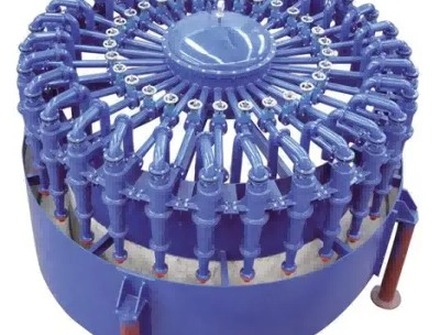
Answer: Yes, radial manifold configurations are one of the most effective solutions. They accurately distribute feed and collect underflow and overflow from multiple cyclones operating in parallel. When combined with wear-resistant linings, they maintain geometry over time and ensure consistent flow to all cyclones. Modern designs also incorporate streamlined partition walls to reduce bias.
Question 7: What is CycloneSense and how does it help?
Answer: CycloneSense is an advanced monitoring system that enables direct, continuous measurement of the air core shape, size, and location within individual cyclones. This allows operators to identify problem situations (roping, blockages) and optimize variables such as feed pressure, density, and the number of operating cyclones. It provides real-time visibility into cluster performance.
Question 8: How can I prevent uneven flow distribution?
Answer: Prevention involves: (1) Proper manifold design—use slimmer distributors with adequate velocity. (2) Radial configurations—ensure even flow splitting. (3) Stable feed pressure—maintain consistent pump output. (4) Regular monitoring—sample individual cyclone performance. (5) Proactive maintenance—replace worn parts before differential wear compounds. (6) Consider air core monitoring for early detection.
Uneven flow distribution in hydrocyclone clusters is primarily caused by slurry segregation in oversized manifolds, where low velocity allows particles to settle and stratify before reaching individual cyclone inlets. This is compounded by poor manifold design and differential wear that creates a feedback loop of degrading performance.
The most effective solutions involve:
Slimmer distributor designs that maintain suspension velocity
Radial manifold configurations with wear-resistant linings
Operational discipline in maintaining stable feed conditions
Balanced cyclone loading and proactive maintenance
Advanced monitoring for early problem detection
With proper attention to these factors, you can achieve uniform flow distribution, consistent classification performance, and stable flotation recovery.
Related Products:
Related Technical Guides:
Related Process Hubs:
Related Category Hubs:
We warmly welcome customers from around the world to contact us and establish mutually beneficial partnerships.
Contact: Annie Lu
Email: annie.lu@huataogroup.com
Phone / WhatsApp: +86 180 3242 2676
Website: https://www.tufflexscreen.com/
Hydrocyclone, Flow Distribution, Slurry Segregation, Manifold Design, Classification, Mineral Processing, Grinding Circuit, Hydrocyclone Cluster, Process Optimization, Wear Parts
admin