How Rubber Belt Design Affects Vacuum Filtration Efficiency
-
 admin
- 06 Nov, 2026
What Is Rubber Belt Design for Vacuum Filtration?
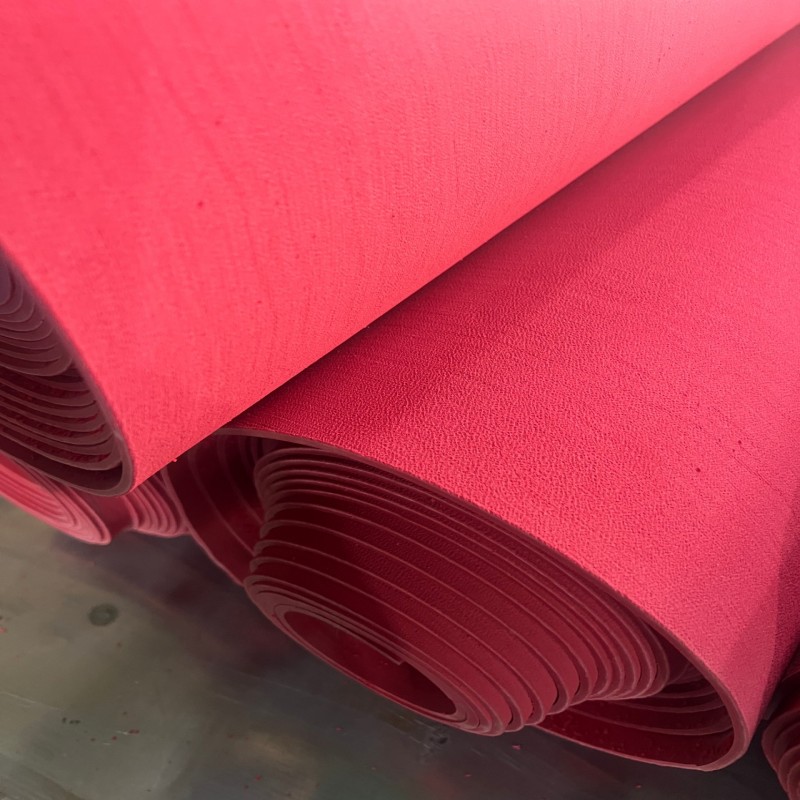
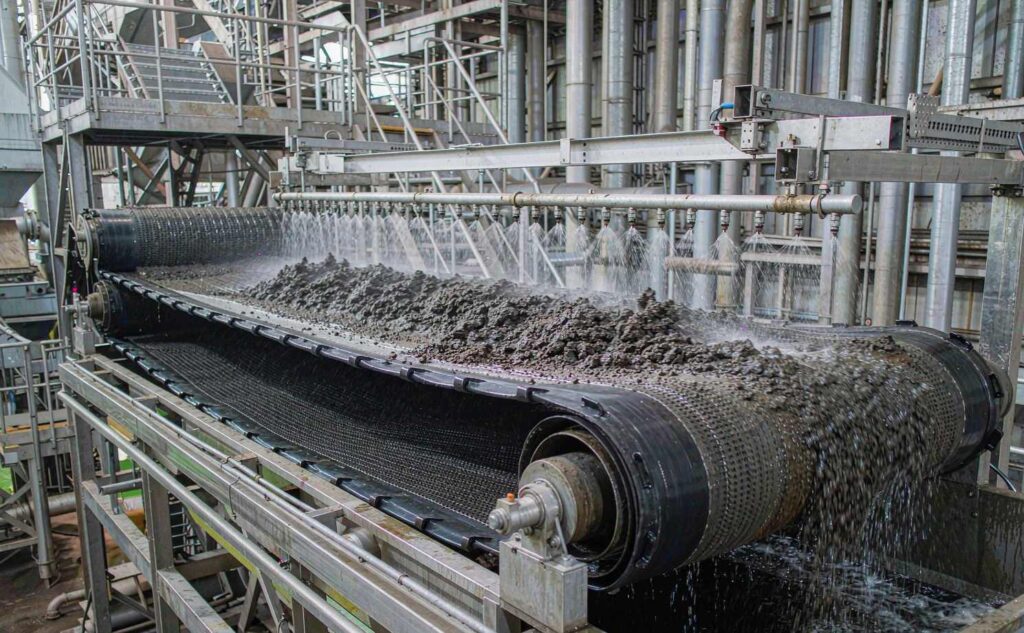
Rubber belt design is the engineering of the drainage belt that runs the length of a horizontal vacuum belt filter: its groove geometry, hole pattern, carcass construction, edge profile and rubber compound. The belt is the drainage manifold, the pressure boundary and the cloth’s foundation in one part, and it carries the slurry from feed to discharge while bending around rollers thousands of times a day. A vacuum belt filter can never outperform what this belt allows: water that can’t reach a groove, or vacuum that leaks past a worn seal, is capacity the plant paid for and never receives. The machine context is on the vacuum belt filter equipment page.
Key Takeaways
✔ Groove pitch, depth and hole pattern must be calculated against your slurry and vacuum box layout — not copied from a catalogue.
✔ Hole-to-slot alignment is the most common cause of a “good pump, wet cake” symptom.
✔ Underside flatness and seal cleanliness preserve vacuum utilization over the belt’s life.
✔ Compound choice sets the wear rate; wear rate sets how quickly efficiency erodes.
✔ Rib-height measurement at fixed stations turns efficiency loss into a manageable trend line.
Summary Table
| Item | Description |
| Function | Carries slurry and cloth, collects and drains filtrate, seals the vacuum box, delivers cake |
| Material | NR or NR/SBR blends, 60-70 Shore A typical; special compounds for hot, oily or acidic duty |
| Application | Horizontal vacuum belt filters in mining, coal washing, chemical and tailings service |
| Service Life | Duty-dependent; honestly measured as rib height or cover thickness loss per month |
| Benefits | Higher vacuum utilization, even cake moisture, longer cloth life, predictable replacement planning |
Definition
A rubber drainage belt is the moving foundation of a horizontal vacuum belt filter. Reinforcement plies carry tensile load and keep the belt flat under vacuum; transverse grooves in the cover collect filtrate from every point beneath the cloth; drilled holes pass that liquid into the vacuum box slots below. The belt also seals against the vacuum deck, delivers wash water through the cake, and hauls the dewatered cake to the discharge roller. It operates inside the filtration stage of the mineral processing flow, fed by the dewatering process upstream — where thickeners bring feed to a density a belt filter can handle.
Working Principle

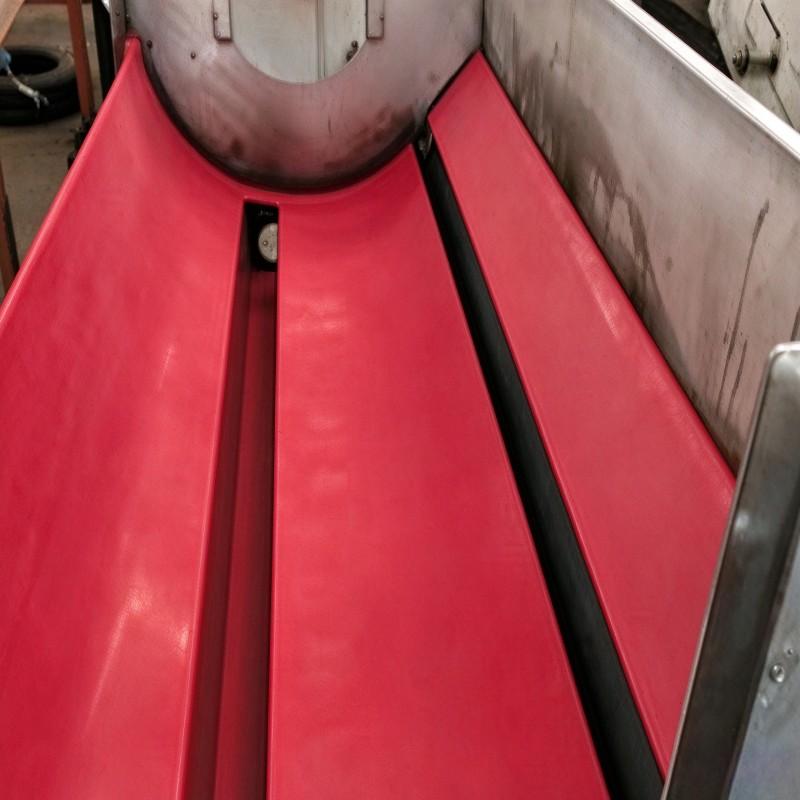
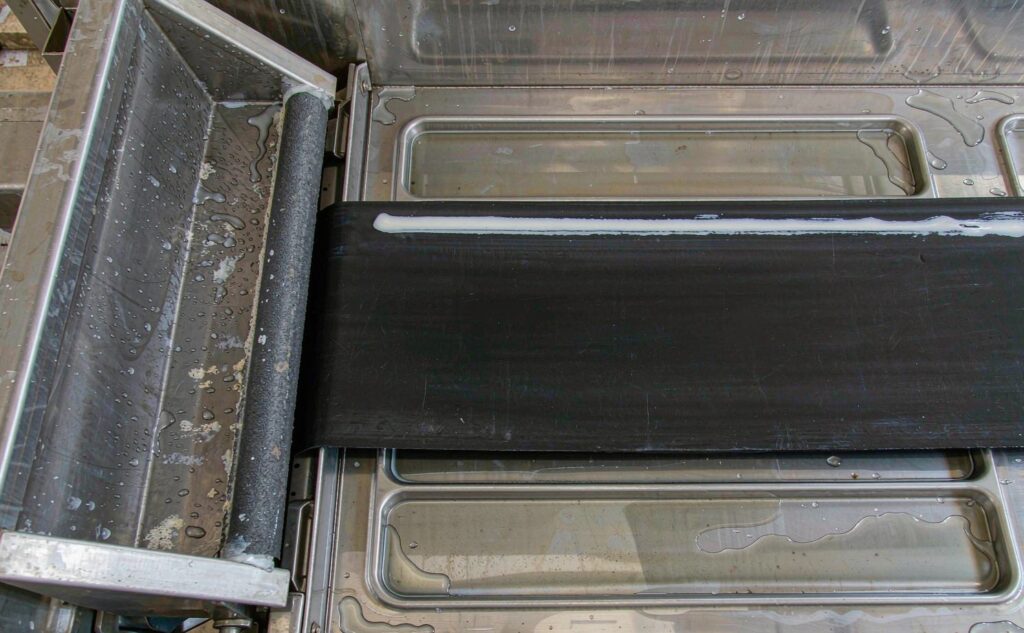
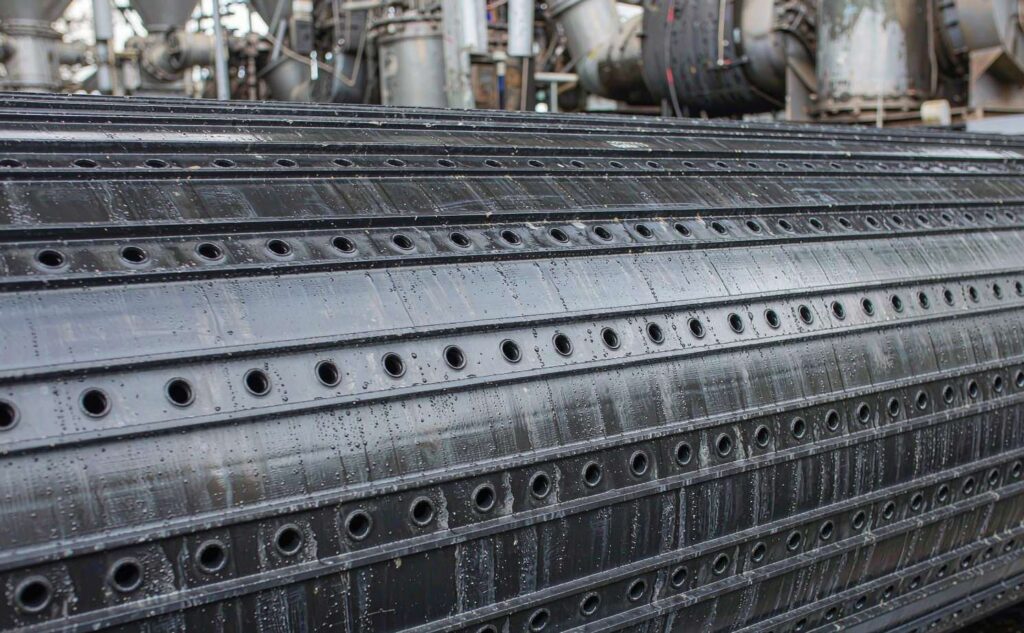
Drainage grooves and vacuum holes — the belt’s drainage path in close-up.
Vacuum never pulls water through rubber. It pulls water into the grooves, along them, and down through the holes. That path has resistance at every step, and each design parameter adjusts one piece of it.
Groove pitch. Closer spacing shortens the sideways travel of filtrate before it reaches a hole. Fine, slow-settling slurries need close pitch; coarse sands can open up. Pitch too wide for the size distribution leaves the cloth bridging between grooves and a striped cake with wet bands.
Groove depth and width. Depth is the belt’s hold-up volume — how much liquid it carries before vacuum engages — and also the rib’s thickness. Deep grooves handle high-solids feed but leave thin ribs that crack early. Shallow grooves drain fast and choke fast.
Hole pattern. The only exit. Diameter and spacing set the flow capacity, and the pattern must match the vacuum box slot layout within millimetres at every position of belt travel. This is the detail that separates a designed belt from a copied one: a replacement belt with a drifted hole pattern leaves part of the deck pumping air and another part never connected.
Carcass stiffness. Under 0.04-0.06 MPa of vacuum, a soft belt pouches between support points. The cloth dips with it, liquid pools in the low spots, and drainage turns uneven. Stiffness is calculated for running conditions — roller spacing and vacuum load — not checked on a bench.
Sealing surface. The underside slides against the vacuum box wear deck continuously. Flatness, thickness tolerance, edge dam geometry and cleanliness decide how much of the pump’s capacity becomes useful vacuum instead of leakage noise.
Four parameters, one trade each. Closer grooves drain better but hold fines. Deeper grooves carry more but crack sooner. Every choice trades something, which is why the belt should be designed against the machine and slurry in front of you.
Benefits
- Vacuum utilization you can bank. Aligned holes and a clean seal convert pump capacity into filtration instead of noise; plants measuring utilization at the deck often find a surprising share was being wasted.
- Cake moisture that holds target. Uniform pitch drains the full cake width, avoiding wet bands that cascade into downstream handling complaints.
- Cloth life you can plan around. A flat, smooth belt spreads cloth wear evenly instead of printing its own damage into an expensive consumable.
- Decay you can measure. Wear shows up in rib height first. Measured monthly, that’s a trend line, not a mystery.
- Fewer unplanned stops. Rounded groove roots and correctly stiff carcasses resist the cracking and pouching that end belts without warning.
Applications
Iron ore concentrate dewatering, copper and lead-zinc tailings, phosphate sands, coal fines, gypsum and chemical slurries — the horizontal belt filter appears wherever a continuous, wash-capable vacuum duty exists. Design emphasis shifts with the duty: abrasive coarse feeds want harder covers and stiffer carcasses; fine concentrates want close pitch and groove flushing; hot or acidic filtrate wants a compound rated for the chemistry, because a generic blend swells, softens and loses its geometry — a specification failure, not a wear one.
Where very low cake moisture is required, belt filters run alongside filter presses on batch duty and disc filters fitted with ceramic filter sectors. Each has its economics; the belt filter wins on continuity and wash capability. Downstream, the conveying train matters too: tracking on the cake transfer conveyors is handled by hardware like the conveyor belt tracker, so a moisture gain isn’t lost in spillage at the transfer point.
Material Comparison
| Property | Natural Rubber (NR) | NR/SBR Blend | Special Compounds |
| Abrasion resistance | Good | Very good | Varies |
| Flex fatigue life | Very good | Good | Formulation-dependent |
| Heat resistance | Moderate | Moderate | Good to excellent |
| Acid/chemical resistance | Poor | Limited | Good |
| Typical hardness | 60-70 Shore A | 60-70 Shore A | 65-75 Shore A |
| Best duty | General mineral service | Coarse abrasive slurries | Hot, oily or acidic filtrate |
Application Comparison
| Duty | Groove Pitch | Compound Focus | Watch Point |
| Iron ore concentrate | Medium | Abrasion | Rib height trend |
| Fine copper tailings | Close | Abrasion + fatigue | Fines blinding |
| Coal fines | Medium | Fatigue | Underside grit |
| Phosphate sands | Wider | Abrasion | Edge dam wear |
| Hot chemical slurry | Per slurry | Chemistry rating | Swelling, softening |
Industry Application Matrix
| Industry | Belt Role | Design Priority |
| Iron ore | Concentrate dewatering | Abrasion, flatness |
| Copper / lead zinc | Tailings and concentrate | Fine pitch, fatigue life |
| Coal washing | Fines dewatering | Seal cleanliness, tracking |
| Phosphate | Sand filtration | Edge durability |
| Chemical / gypsum | Crystallizing feeds | Groove flushing, chemistry |
| Tailings dry stacking | Final dewatering | Moisture stability |
Filtered tailings with higher solids content compact, handle and stack better, and water returns to the circuit instead of the dam — which is why dewatering keeps moving earlier in flow sheets and discharge keeps routing through tailings dry discharge systems within broader tailings management planning.
Selection Guide
Start from the machine. Filter make and model, vacuum box slot layout, roller spacing, vacuum level. Then the process: feed solids and size distribution, temperature, filtrate chemistry, tonnage. A competent manufacturer calculates carcass stiffness for running vacuum, picks groove pitch for your size distribution, aligns the hole pattern to your deck, and proves all of it with a first-article dimensional inspection.
Red flags during selection: a quote without asking for the vacuum box layout; hardness offered as a single number instead of a compound discussion; no first-article inspection; life claims without a measurement method. The full specification checklist sits in our guide on choosing the right rubber belt for a vacuum belt filter.
Feed swings upstream mimic belt failure downstream, so before condemning the belt, rule out classification trouble using the notes on hydrocyclone underflow being too wet and the wear-pattern review in hydrocyclone wear causes and material solutions. A size distribution that shifted can load the grooves differently than the belt was designed for.
Procurement Guide
Required information: filter model, belt dimensions and tolerances, groove and hole drawings or an old belt sample, vacuum level, operating temperature, filtrate chemistry, feed solids and size distribution, tonnage.
Buyer questions that separate suppliers:
- Can you manufacture from drawings and provide first-article inspection reports?
- Can you supply compound certificates, hardness data and material reports?
- Can you reproduce OEM hole patterns against our vacuum box layout?
- What is your MOQ, lead time, packaging and export experience?
- Can you give a wear-life expectation tied to a measurement method we can run ourselves?
MOQ is usually one belt for custom parts; lead time is driven by compound availability and molding. Packaging should protect the belt from sharp bends and UV during ocean freight. Inspection standards should be agreed in writing: dimensional report, hardness certificate, hole-pattern check against the filter drawing. Specify the belt and its filter cloth and filter plates together — capture and drainage are one system, and quoting them separately is how mismatched pairs end up on the same machine.
Failure Analysis

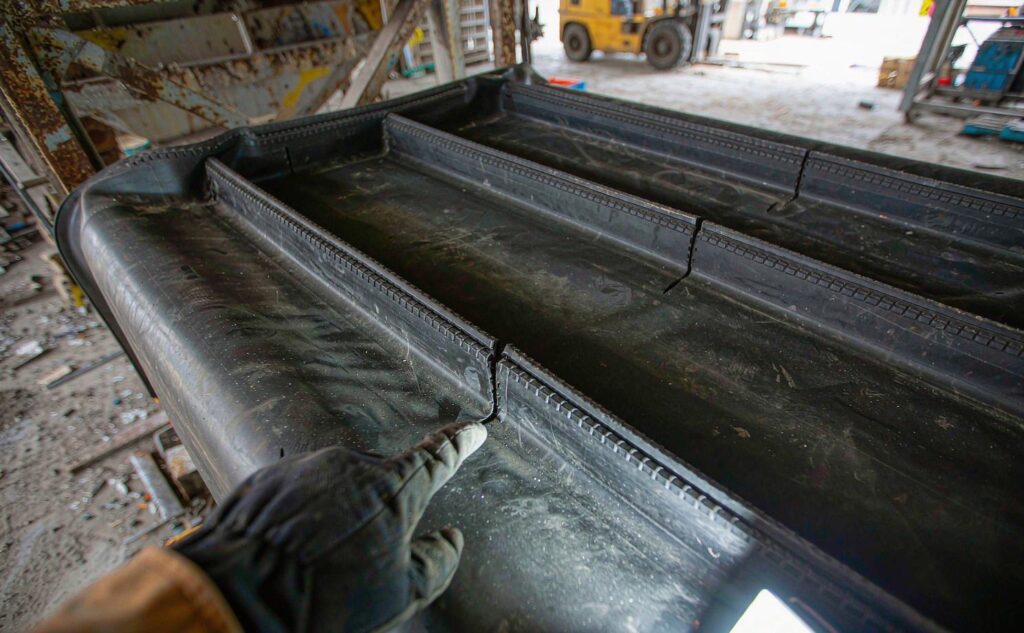
Fatigue cracking starts at groove roots — photographable week over week before it becomes a failure.
| Problem | Possible Cause | Recommended Solution |
| Rising cake moisture | Groove wear, misaligned holes, seal leakage | Measure ribs, verify alignment, clean seal interface |
| Rib cracking | Flex fatigue, sharp groove roots, wrong compound | Larger roller radii, rounded roots, fatigue-rated compound |
| Wet bands across cake | Pitch too wide for fines; cloth bridging | Re-spec pitch for size distribution |
| Underside grooving | Grit at wear deck | Clean deck, verify wear strips and grease |
| Swelling or softening | Compound not rated for filtrate | Re-spec chemistry and temperature |
| Edge tearing | Tracking drift, edge dam catching structure | Track centered, correct dam height |
| Hole blockage | Crystallizing salts, fine carryback | Flush grooves during wash stages |
Maintenance Guide
- Daily: vacuum trend, cake moisture feel, return-run tracking.
- Weekly: photograph groove roots at fixed stations under raking light; inspect edge dams.
- Monthly: measure rib height, log cover thickness loss, review the seal interface.
- Each shutdown: verify hole-to-slot alignment after any belt change; flush grooves; check return rollers for seizure.
- Planning: order replacements from the rib-height trend line, not the calendar; hold spares for critical-path filters.
Case Study
Customer Type: Iron ore concentrator, single horizontal belt filter on concentrate duty.
Ore Type: Hematite concentrate with dominant minus 45 micron fines.
Operating Conditions: Vacuum 0.05 MPa, ambient-temperature filtrate, continuous operation with two-stage cake washing.
Problem: Cake moisture crept up over several months. Vacuum readings looked normal. The cloth had been replaced twice with no improvement, and attention had turned to the vacuum pump.
Solution: Rib-height measurement at three fixed stations showed the outer third of the belt width had lost more than half its groove depth, and the hole pattern of the last replacement belt didn’t match the vacuum box layout at that end. A new belt was built to the filter drawing: corrected hole pattern, harder abrasion-rated cover, rounded groove roots, carcass stiffness recalculated for the roller spacing.
Result: Vacuum utilization recovered and cake moisture returned to target within the first week of operation. The plant now measures rib height monthly and orders on trend data. Recoveries of this type commonly land in the 20-30% range on moisture stability and cycle time — honest numbers require your own slurry and your own measurements, so we quote expectations you can verify rather than guarantees.
Market Note: Why Efficiency Points Are Worth More Now
Two recent items put numbers on this. In October 2026, PSJ Cobre Mendocino signed a preliminary agreement with Metso for the Uspallata copper project’s plant in Argentina, raising planned capacity 50% to 42,000 tonnes per day while keeping the approved water allocation of 141 litres per second unchanged — the increase credited to the water-use efficiency of the tailings filtration technology. And on 2 November 2026, Orvana Minerals reported that filtration was the primary constraint during the ramp-up of its Don Mario operation in Bolivia, fixed by installing and adjusting new filter cloths on all three filter units, with throughput climbing toward 1,400 tonnes per day against a design rate of 1,700. One case says filtration efficiency can raise a plant’s licensed capacity; the other says filtration can cap it. The belt sits under both numbers.
FAQ
How much does belt design affect filtration efficiency?
It sets the ceiling. Grooves, holes and seals decide how much vacuum reaches the cake; the compound decides how fast that capability decays. Pump upgrades can’t recover what a worn or badly aligned belt throws away.
Can I just deepen the grooves?
Deeper grooves carry more filtrate but thin the ribs between them and trap more fines. Depth is a balance between slurry solids and flex duty — calculated, not guessed.
How often should alignment be checked?
After every belt change, and whenever moisture rises without cause. One verification per belt covers its whole life.
Is a harder compound always better?
No. Harder covers resist abrasion but cost sealing conformity and fatigue life. Match to the slurry and machine, not to a number.
What causes “good pump, wet cake”?
Usually leaking or short-circuiting vacuum: misaligned holes, grit-opened seals, blocked grooves. Check those before the pump.
Can belts be made from drawings or samples?
Yes — filter model, dimensions, groove and hole drawings, or the worn belt itself, are standard inputs, with first-article inspection confirming the result.
How is service life honestly measured?
Rib height or cover thickness loss per month on your own machine, trended over time. Catalogue claims aren’t measurements.
What data should a quote include?
Filter model, dimensions and tolerances, groove and hole drawings, vacuum level, temperature, filtrate chemistry, feed data — plus the supplier’s compound certificates and inspection plan.
How does belt design interact with wash efficiency?
Wash water drains through the cake into the same grooves. Blocked or uneven grooves short-circuit wash liquor, so wash efficiency tracks groove condition as closely as cake moisture does.
Conclusion
Rubber belt design affects vacuum filtration efficiency through four interacting levers: groove geometry that moves filtrate, alignment and flatness that connect vacuum to cake, sealing that keeps it there, and compound that decides how slowly the first three decay. None of them is optional and none of them is a catalogue line item. Specify against your machine and slurry, measure rib height monthly, keep the seal clean, and the belt holds the moisture bargain for years. Skip them, and no pump purchase will fix the shortfall.
Related Articles
Related Products
Related Technical Guides
Related Buyer Guides
Related Comparison Articles
Contact
Contact: Annie Lu
Email: annie.lu@huataogroup.com
WhatsApp / WeChat: +86 18032422676
Website: www.tufflexscreen.com
admin
personal profile