How Do You Evaluate the Quality of an Industrial Magnetic Separator?
-
 admin
- 03 Nov, 2026
A quality magnetic separator is proven at the working gap, not at the pole face. Measure field strength 50 mm and 100 mm off the surface at operating temperature, run a seeded capture test with marked tramp metal at your real bed depth and belt speed, and inspect the frame, bearings, wear liners and spares list. Ferrite, NdFeB and SmCo each behave differently with heat, so the magnet grade and its temperature rating belong in the purchase order, not the sales talk. (78 words)
What Is an Industrial Magnetic Separator, and What Does “Quality” Actually Mean?
An industrial magnetic separator projects a magnetic field across a moving material stream and holds ferrous contamination against a working surface while the cleaned material passes. On a suspension magnet the stream travels under the unit; on a drum or roller the circuit rotates inside a stainless shell and releases captured metal where the field ends; on an electromagnetic unit the field is generated by a coil and can be adjusted or switched off.
“Quality” in this context isn’t strength alone. It is the amount of field that arrives at the metal, at your burden depth, at your feed temperature, sustained for years of dust, impacts and heat. Two machines with identical pole-face gauss can differ by a factor of three at the working distance, and the cheaper-looking one is sometimes the better circuit. Judging that difference is a learnable skill, and this guide is the checklist. The Magnetic Separators range exists in several classes precisely because the duties differ.
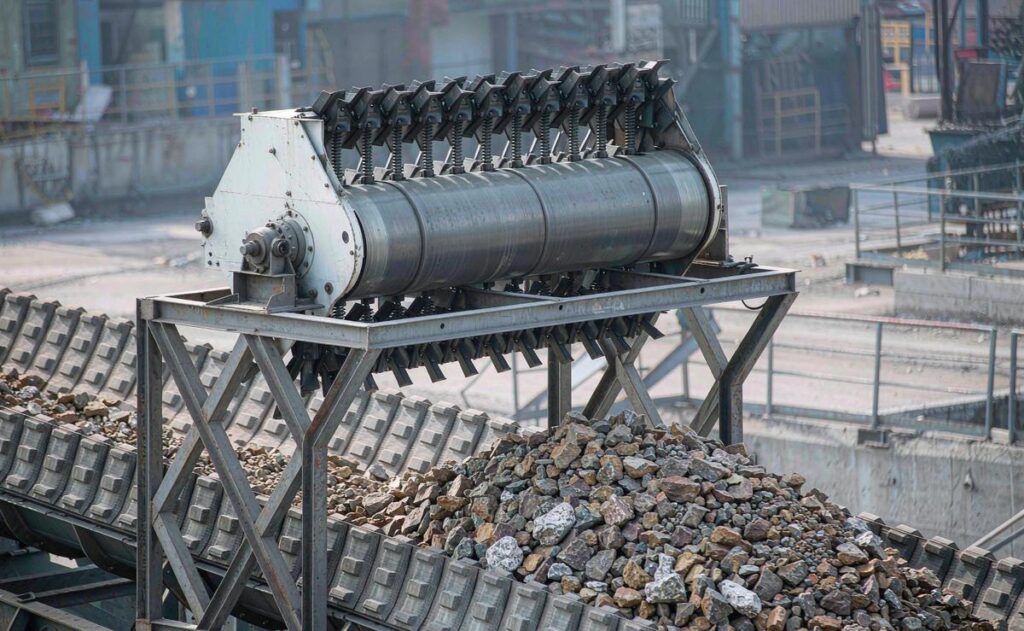
1. Magnetic drum separator installed at a conveyor discharge in a mineral processing plant
Key Takeaways
✔ Field at the working gap decides capture — insist on the field-versus-distance curve ✔ Magnet grade plus temperature rating predicts the field you’ll have in two years ✔ Seeded capture tests settle arguments that datasheets start ✔ Frame stiffness, bearing access and face liners separate strong builds from weak ones ✔ Trend field readings and iron-in-product assays; drift tells you before failure does
Summary Table
| Item | Description |
| Function | Continuous removal of tramp and process iron from conveyed or fed material |
| Material | Ferrite (heat-tolerant, weaker), NdFeB (strong, heat-sensitive), SmCo (balanced, costly) |
| Application | Conveyor tramp removal, head pulley drums, inline rollers, slurry and dry duties |
| Service Life | 8–15 years for the magnetic circuit; liners, belts and bearings wear sooner |
| Benefits | Protected crushers and conveyors, cleaner product, fewer metal-related stoppages |
Definition
Magnetic separation quality has four measurable dimensions. Field projection: how much gauss exists at specified distances from the surface, at specified temperatures. Capture efficiency: what fraction of representative tramp metal the unit holds under your conditions. Build integrity: housing stiffness, bearing specification, face protection and sealing. And serviceability: what wears, how fast, and whether the maker admits it in a spares list. Any separator can be described in these terms, which is exactly what makes two suppliers comparable.
Working Principle

The field has to reach through the burden layer — the gap is where quality is decided.
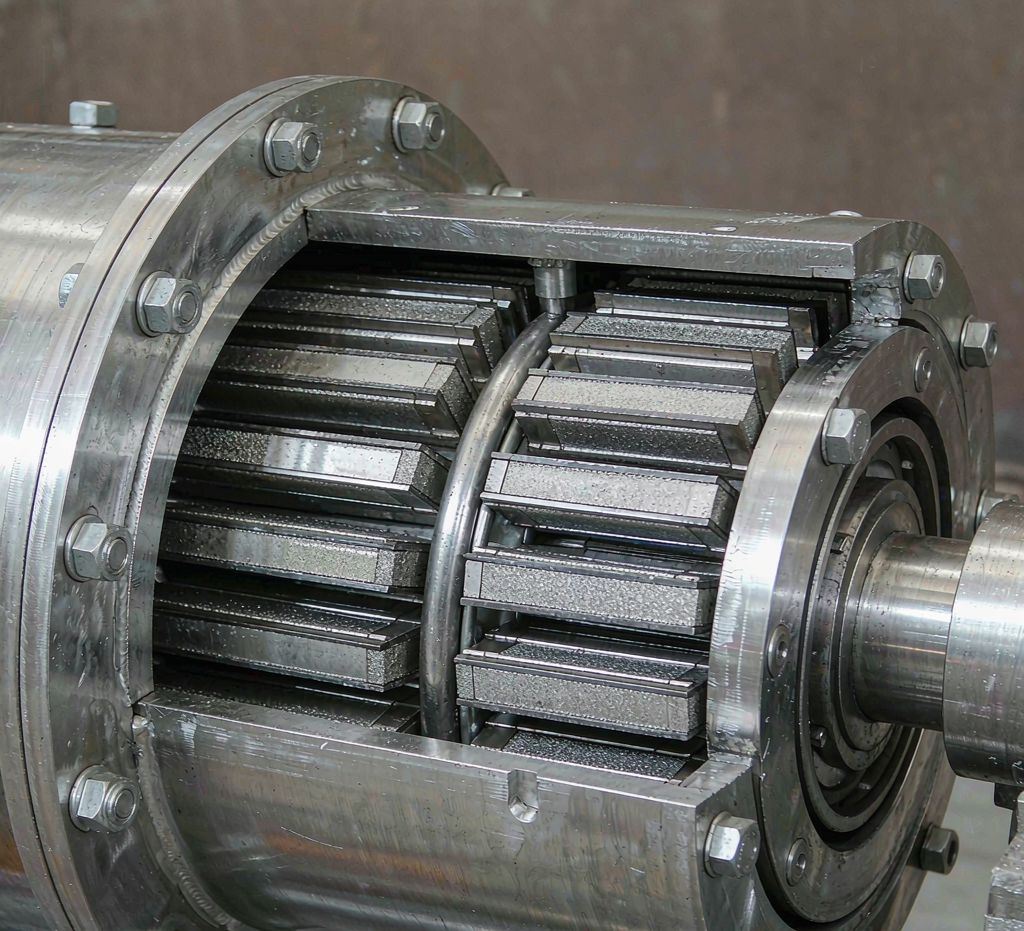
A magnetic circuit arranges permanent magnet blocks — ferrite, NdFeB or SmCo — against steel pole pieces to project flux across an air gap into the burden. Ferrous pieces experience a force toward the pole, and the machine either holds them for manual cleaning or carries them out of the field zone on a cleated belt. Drums and rollers rotate the circuit inside a shell, so captured metal travels around and releases where the field ends.
Two pieces of physics do most of the damage in real plants. Field strength falls off sharply with distance — doubling the gap can leave a quarter of the holding force — and heat demagnetises. NdFeB loses roughly 0.1% of remanence per degree above ambient, with steeper loss past the grade’s rated ceiling. Feed off a Crushing stage can run hot enough to matter, and the loss never announces itself. The machine just captures less, month by month, until someone wonders why.
Benefits
A well-evaluated separator returns money in three currencies. Protection: one bucket tooth stopped is one crusher liner and one day of downtime saved. Product quality: iron in shipped concentrate becomes a claim, and claims cost more than magnets. And stability: a correctly specified unit runs unattended for years, which is the whole point of buying a good one instead of a cheap one twice.
There’s a quieter benefit too. Plants that measure field annually and trend iron assays stop arguing about whether “the magnet seems weaker.” They have numbers. Numbers end those conversations in one line.
Applications
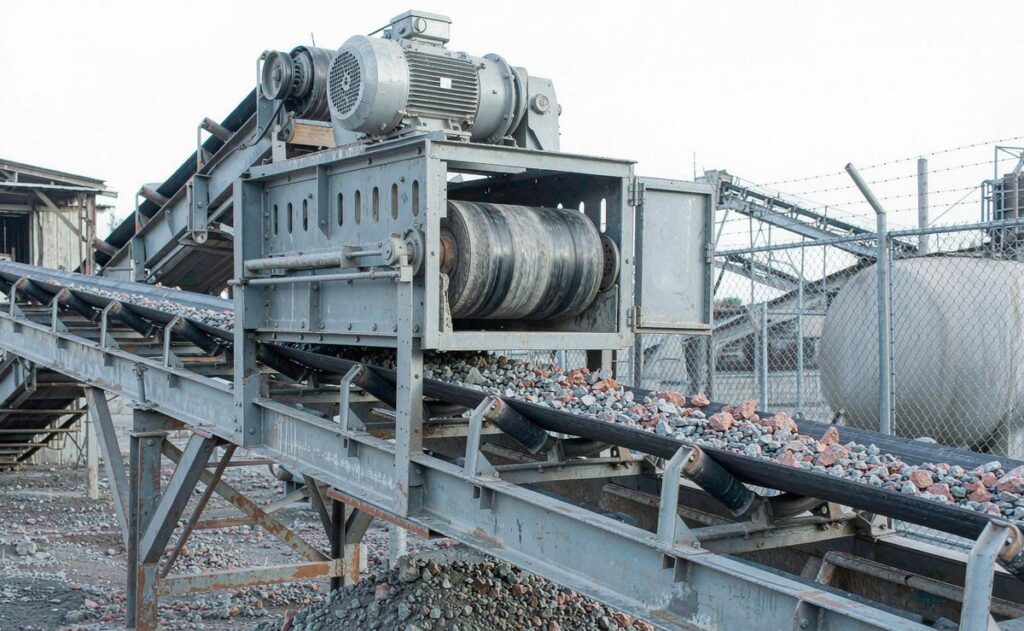
Tramp iron removal over conveyors is the classic duty, and where burdens are deep or hot, the Electromagnetic Overband Separator class earns its running cost through reach and adjustability. Continuous self-discharge without electricity points to permanent self-cleaning designs; where unattended operation matters most, the Self-Cleaning Electromagnetic Separator handles the shift.
At conveyor head pulleys, a Magnetic Drum turns the pulley itself into the separator. Dry granular product lines suit a Magnetic Roller inline, and lighter protection duties often need nothing more than an Iron Magnet in the flow path. Where the stream has been scalped by Screening upstream, the separator sees a cleaner, coarser burden and performs better for the same field. And when the contaminant isn’t magnetic at all but is conductive, the physics changes: that’s Electrostatic Separators territory, not a stronger magnet’s.
Material Comparison
| Magnet Material | Max Operating Temp | Field Strength | Cost | Best Fit |
| Ferrite | ~250 °C | Low | Low | Hot duty, wide gaps, budget circuits |
| NdFeB | 60–200 °C by grade | Very high | Medium | Deep burden, compact housings |
| SmCo | ~300 °C | High | High | Hot plus strong, corrosive duties |
The table reads as a system. NdFeB running continuously at 180 °C may deliver less usable field than ferrite in the same housing. Grade, temperature and gap only mean anything together, which is why the datasheet that publishes all three is the one worth trusting.
Application Comparison
| Machine Class | Best Duty | Cleaning Mode | Key Watch Item |
| Suspension / overband | Tramp iron over conveyors | Manual or self-cleaning belt | Suspension height drift |
| Magnetic drum | Head pulley, continuous | Self-releasing | Shell wear, seal dust ingress |
| Magnetic roller | Dry granular inline | Self-releasing | Bed depth sensitivity |
| Electromagnetic | Deep burden, adjustable field | Self-cleaning | Coil cooling and current drift |
Industry Application Matrix
| Industry | Target Iron | Typical Unit | Duty Note |
| Mining | Crusher-damaging tramp | Electromagnetic overband | Deep burden, hot feed |
| Aggregate | Bolts, teeth, wire | Permanent overband | Manual cleaning acceptable |
| Recycling | Mixed ferrous | Drum plus overband | Variable burden, impacts |
| Chemical / food | Fine process iron | Roller, drum | Wet or powder duty, face coating |
| Cement | Mill-damaging steel | Self-cleaning overband | Hot clinker, continuous |
| Power / port | Coal-handling tramp | Suspension magnet | High tonnage, wide belts |
Selection Guide
Start from the stream, not the catalogue. Temperature, burden depth, moisture, and — most importantly — actual tramp samples from your own plant. Flat plate, wire and round bar behave differently in a field, and a separator optimised for bolts will disappoint on sheet.
Second, the position: over a belt, at a head pulley, inline on a product line. Each position changes the geometry of capture. Third, the cleaning expectation — manual wiping, self-cleaning belt, or genuinely unattended. Fourth, the field requirement, calculated from gap and burden rather than inherited from a previous purchase. Fifth, the operating reality: who adjusts the suspension, who greases the bearings, and what the plan is when the belt tracks off at 3 a.m. The Magnetic section organises the range by duty rather than size, which is the right axis for the first two questions.
Procurement Guide
Put the same five requests to every supplier, in writing. One: a field-versus-distance curve for the actual model, measured at operating temperature. Two: the magnet grade with its maximum operating temperature and coating specification. Three: an agreed capture-test protocol using seeded metal from your plant. Four: the wear-part list — liners, belts, bearings, seals, and for electromagnetic units the coil service kit — with lead times; the Magnetic Separation Spares listing shows what a complete one looks like. Five: a reference installation on comparable duty.
Then read the answers like an engineer. Gauss without distance can’t be checked. Grades without temperature ratings can’t be trusted. Capture percentages without feed conditions can’t be reproduced. Magnetic Drums & Rollers quoted against a written curve are comparable machines; units quoted against a flyer are a conversation, not a specification.
Failure Analysis

Grade, shell thickness and block spacing decide both the field today and the field in year five.
Field decay. Heat, impact and corrosion demagnetise. A chipped coating on a wet-duty drum is structural damage, not cosmetics. Re-measure annually at fixed points; a 10% drop over three years is wear, the same drop in six months is a fault.
Face wear. Captured metal abrades the liner. Painted mild steel wears through, and then the magnet collects the housing instead of the ore.
Bearing and seal failure. Dust migrates along drum shafts. Greaseable, oversized bearings in protected housings last; sealed units behind welded plate don’t.
Tracking loss on self-cleaning belts. Idler drift consumes take-up range. A design with 20 mm of adjustment assumed the belt never stretches — that assumption fails.
Coil problems. Current above nameplate means insulation degradation or blocked cooling. Both show up in the current reading months before the shutdown.
Discharge misplacement. Captured metal thrown back into the clean stream looks like a weak magnet and is actually a geometry problem.
Maintenance Guide
Annual field survey at fixed reference points, logged. Trend iron-in-product assays monthly. Grease on schedule, keep coil cooling paths clean, inspect liners quarterly on heavy tramp duty, and check self-cleaning belt tracking weekly until you know its habit. Keep critical spares on site — a liner and bearing set is cheap insurance compared with a head pulley shutdown.
Case Study
Customer Type: Iron ore processing plant, conveyor protection duty Ore Type: Tramp steel from primary crushing — bolts, tooth fragments, plate pieces Operating Conditions: 1400 mm belt, 350 mm burden, feed temperature around 70 °C, continuous operation Problem: Recurring crusher damage despite a separator whose datasheet claimed 12,000 gauss Solution: Field survey at the working gap, at temperature, measured 900 gauss; the circuit was replaced with a correctly projected design and suspension height re-set against the measured burden Result: Tramp-related crusher stoppages effectively eliminated over the following year; iron-in-product assays held flat across four quarters
FAQ
Is a higher gauss rating always better? No. Capture happens at the working distance, and a tighter, better-projected circuit can outperform a bigger number. Field that stays inside the housing is marketing. Ask for gauss at 50 and 100 mm, at temperature.
How do I test capture performance in my plant? Run a seeded trial. Mark representative tramp pieces, introduce them upstream at controlled rates, and count recoveries at your real bed depth and speed. Three depths, flat and round pieces both, one afternoon.
Why does capture drop on hot feed? Magnet remanence falls with temperature. NdFeB grades lose about 0.1% per degree, faster past the rated ceiling. Check the grade’s temperature rating against actual feed temperature and ask for the derated curve.
What maintenance does a separator actually need? Annual field measurement, scheduled greasing, liner inspection, cooling-path cleaning on electromagnetic units, and belt tracking checks on self-cleaning models. All cheap; all skipped at a price.
Are electromagnetic separators worth the running cost? Where you need adjustable field or very deep burden, yes. Elsewhere a well-specified permanent circuit is simpler, cheaper to run, and has nothing to cook.
Can one separator protect the entire plant? Rarely. Position and burden decide capture, so protection is usually layered — a primary overband plus drums or rollers at critical points, designed from the flowsheet.
What’s the most common buying mistake? Comparing pole-face gauss figures. It compares brochures, not machines. Insist on field-versus-distance curves and a capture protocol, and the mistake vanishes.
How long should a good unit last? The magnetic circuit, 8–15 years with reasonable treatment. Liners, belts and bearings wear sooner and should be on the shelf, not on order.
Conclusion
Evaluating magnetic separator quality is a discipline, and the discipline is short: measure the field where the ore passes, test capture with your own metal, inspect the parts that carry load, and demand written answers to all three. Suppliers who volunteer that information have already done their engineering. Suppliers who resist have done their marketing. The five written requests in this guide sort them in one round of emails.
Related Articles
Related Products
Related Technical Guides
Related Buyer Guides
Related Comparison Articles
Contact
| Annie Lu | annie.lu@huataogroup.com | WhatsApp/WeChat: +86 18032422676 | www.tufflexscreen.com |
 admin
personal profile