
Vacuum Filter Belt vs Conveyor Belt: The Complete Comparison Guide
-
 admin
- 03 Nov, 2026
A conveyor belt moves material and stops there. A vacuum filter belt moves material while draining filtrate through molded grooves and drilled holes, carrying a filter cloth, and sealing a vacuum box beneath it for every metre of travel. Construction, speed, inspection method and failure modes all follow from that difference. One is specified in tensile strength and cover grade; the other in groove pitch, hole pattern, hardness and flatness against a machine drawing.
What Is a Vacuum Filter Belt?
A vacuum filter belt is the grooved, perforated rubber membrane that carries the cake on a horizontal vacuum belt filter, drains filtrate into the vacuum box below, and seals that box while in continuous motion. A conveyor belt only transports solids. That is the core difference, and everything else in this guide follows from it.
Key Takeaways
✔ A conveyor belt transports solids; a filter belt simultaneously transports, drains, seals and supports filtration ✔ Grooves, drain holes and sealing edges exist only on filter belts, and they decide cake moisture ✔ Conveyor belts run at metres per second; filter belts run below one metre per minute, set by cake residence time ✔ Conveyors fail suddenly and visibly; filter belts fail gradually and are caught by monthly measurement ✔ A worn filter belt causes wet cake that destroys downstream conveyor cleaners and idlers, so the handover point couples the two machines
Summary Table
| Item | Description |
| Function | Conveyor: transport. Filter belt: transport plus drainage, sealing and cloth support |
| Material | Rubber on both; filter compounds are chosen for wet chemistry, swelling and sealing |
| Application | Conveyors move ore between process stages; filter belts run horizontal vacuum belt filters |
| Service Life | Conveyors often 3–10 years; filter belts commonly 1–3 years on abrasive mineral duty |
| Benefits | The right belt in the right machine means dry cake, stable vacuum and planned downtime |
Definition
A conveyor belt is an endless traction surface carrying bulk solids between pulleys, judged by tensile strength, carcass build, cover grade and troughability. A vacuum filter belt is the working membrane of a vacuum belt filter for mining and minerals, and it holds four jobs the catalogue rarely prints together: it supports the filter cloth and the growing cake, it channels filtrate through grooves to drilled holes, it seals against the vacuum box, and it survives wet abrasion while doing all of it. One belongs to the conveyor belting side of the plant, the other to whoever answers for cake moisture inside the filtration circuit. They get confused because they look alike, ship from the same factories, and share a head pulley. They behave differently because their briefs are different.
Working Principle

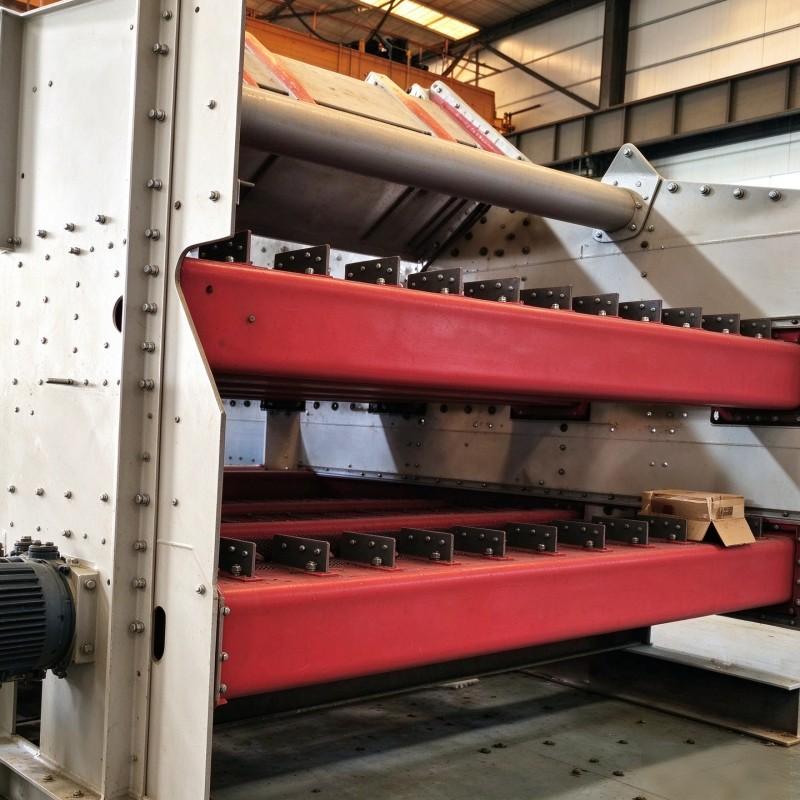
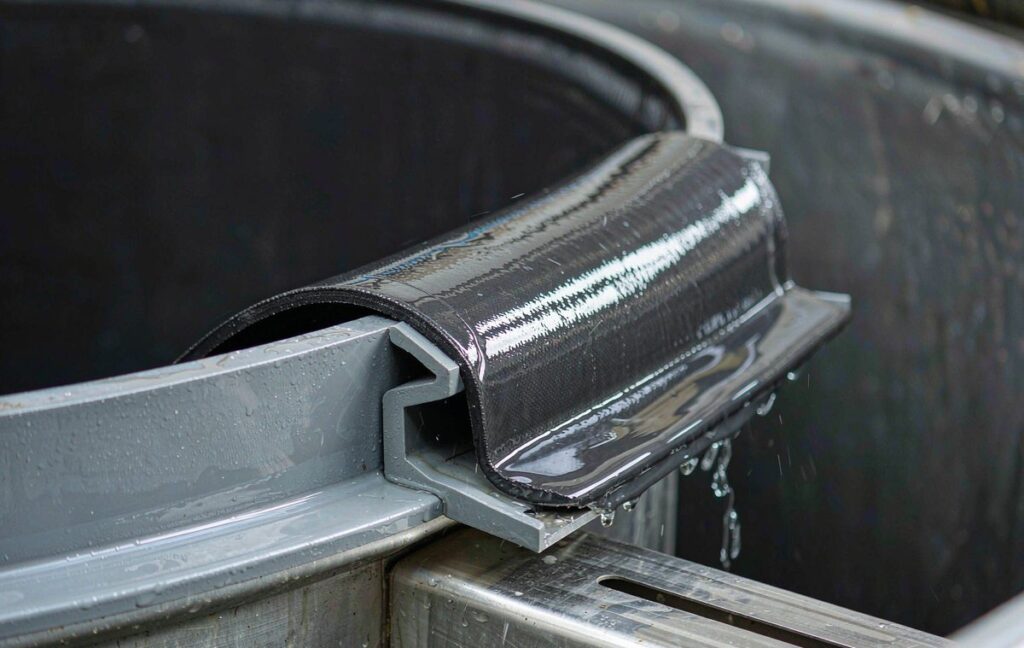
Grooves, lands and drain holes on a filter belt. A conveyor belt has no equivalent geometry.
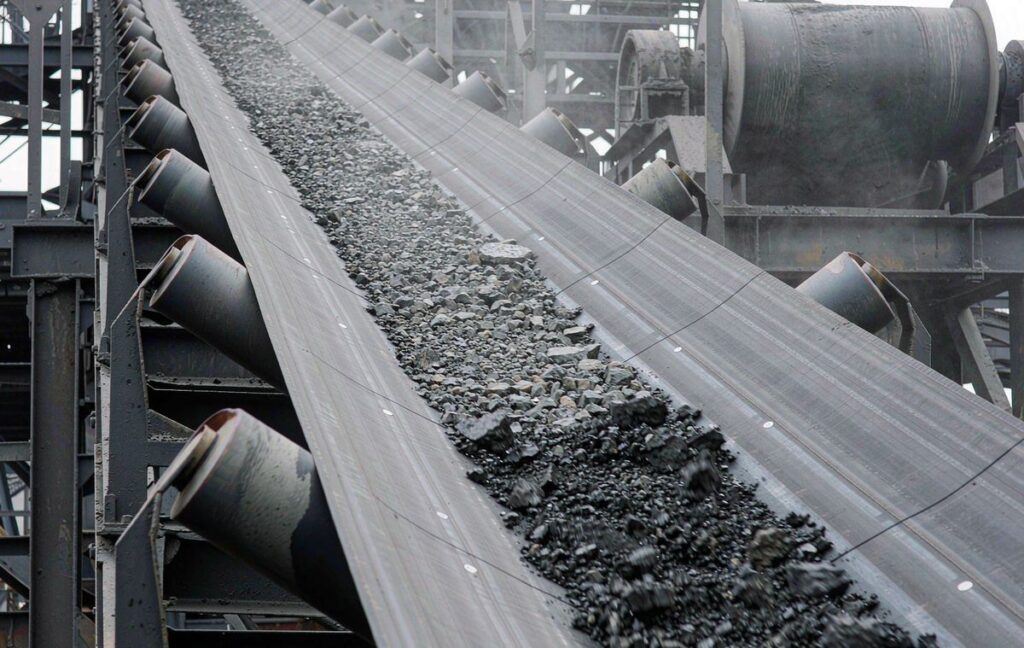
Conveying is friction and tension. A driven pulley turns, the belt grips, the load rides, and idlers support the span. Design questions are about tension, sag, impact and abrasion, and the answer is always a stronger or tougher belt.
Filtration is a moving pressure boundary. Slurry spreads onto the belt at the feed box. Vacuum pulls liquid through the cloth, along the grooves, through drain holes that must align with the box slots, and into the box below. Cake forms, receives wash liquor, dries under air pull, and discharges off the end roller. The belt then loops back beneath the machine, sliding across the wear deck and holding its edge seals the entire way. Every revolution loads the rubber four ways: abrasion on top, friction below, cyclic flexing in the carcass, and chemistry wherever filtrate lingers. A conveyor never sees any of those loads except the first.
Benefits
Getting each belt right pays in its own currency. A well-specified conveyor delivers tonnage quietly: no spillage, honest tracking, components that last their calculated life. A well-specified filter belt delivers process results: vacuum that stays where it belongs, cake moisture that holds a trend line, filtrate clean enough for your slurry pumps and tailings equipment to digest, and replacement work that happens on a schedule instead of at midnight. The filter belt’s benefit list is longer because its job is harder, and so is its list of ways to be wrong. Plants that treat the filter belt as a commodity buy two or three a year and blame the ore. Plants that treat it as an engineered part buy one and forget the topic.
Applications
Conveyors appear at every stage of a plant, from run-of-mine haulage to concentrate loading, and their specification follows tonnage, incline, lump size and abrasion. Filter belts serve horizontal vacuum belt filters dewatering iron ore, copper, lead-zinc, phosphate, potash and coal concentrates, plus industrial minerals and chemical slurries.
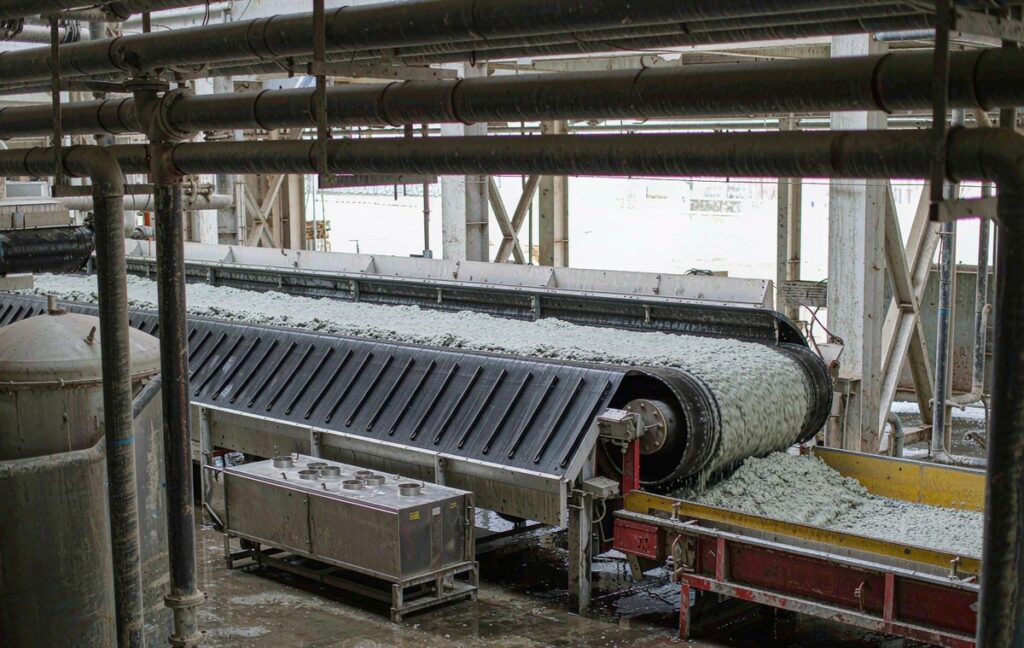
The interesting engineering happens where the two machines meet. Cake drops off the filter end roller onto the receiving conveyor, and that handover carries the filtration result downstream. Wet cake from a worn filter belt sticks, builds on the return run, seizes conveyor idlers and rollers, and overloads belt cleaning systems that were correctly chosen for dry material. Dense cake in lumps also demands an impact bed under the receiving chute and honest conveyor belt skirting at the load point. When a maintenance crew spends a week fighting the conveyor, the root cause is often one machine upstream, still running on a belt that should have been measured months ago.
Caliper measuring cover thickness
Material Comparison
| Property | Conveyor Belt | Vacuum Filter Belt |
| Cover priority | Abrasion, cut and tear resistance | Abrasion plus chemical and swelling resistance |
| Carcass | Multi-ply fabric or steel cord for tension | Flat, stable carcass for vacuum and flex |
| Hardness | 60–70 Shore A typical | 60–70 Shore A, chosen for sealing as much as wear |
| Surface | Plain, patterned or chevroned | Molded grooves plus drilled drain holes |
| Joints | Mechanical fastener or vulcanized splice | Endless vulcanized preferred; a splice is a leak path |
| Compound families | NR, SBR, EPDM blends | NR for abrasion, EPDM for heat and acids, nitrile for oil |
| Failure style | Sudden and visible | Gradual and measurable |
Compound choice on a filter belt follows the slurry first and the ore second. A belt that swells can’t use its abrasion resistance at all, which is why chemistry outranks hardness in the selection order. Conveyor covers almost never face that trade-off, and it’s one more reason the two documents shouldn’t share a template.
Application Comparison
Against filter presses, belt filters win on continuous throughput and wash efficiency, and concede on footprint and capital cost per unit area. Against ceramic disc filters, belts take the coarser, higher-tonnage duties while ceramics dominate fine, hot, acidic pulps. Conveyors face no such contest; their alternative is haulage, and the comparison ends at cost per tonne-kilometre. That asymmetry has a practical consequence: filter belt selection is process engineering with a price tag attached, while conveyor selection is genuinely a procurement exercise. Staff them accordingly. A buyer working alone can be talked into a conveyor on price with little risk, and talked into a filter belt on price with certainty of regret.
Industry Application Matrix
| Industry | Typical Conveyor Duty | Typical Filter Belt Duty |
| Iron Ore | Crushed ore, high tonnage, sharp lumps | Magnetite and hematite concentrate dewatering |
| Copper | Concentrate transport, reagent dust | Reagent-bearing concentrate filtration |
| Coal | Run-of-mine and washery product | Coarse coal fines dewatering |
| Phosphate | Abrasive matrix, high wear | Sticky, fine pulp filtration |
| Potash | Salt dust, corrosion | Brine-tolerant compound selection |
| Sand & Aggregates | Very abrasive, high speed | Mostly thickened upstream; limited belt filter use |
| Industrial Minerals | Product and tailings transport | Chemical slurry dewatering |
Selection Guide
Select each belt from its own starting line. Conveyor: tonnage and incline set width and speed; lump size and drop height set cover grade; centre distance sets carcass; abrasion class decides whether a standard cover survives. Filter belt: pulp temperature and filtrate chemistry set the compound; deck condition sets hardness inside the usual 60–70 Shore A band; cake thickness and drain time set groove pitch; the machine drawing sets everything else, in writing, before the order.
Filter belts reward the same discipline as our filter cloth and plate range: media follows slurry, slurry follows the circuit, and the description precedes the price. Write the slurry paragraph once — ore type, particle size, temperature, filtrate chemistry, vacuum level — and you’ll reuse it for years. Feed preparation matters too, since belts fed from settled thickeners in the dewatering circuit see steadier particle size and flatter wear maps. Belts fed straight from dewatering hydrocyclones inherit every underflow swing, so watch what a cyclone change does to the belt’s wear pattern.
Procurement Guide
Split the RFQs even when both go to the same factory. For conveyors: width, speed, centre distance, tonnage, lump size, drop height, and the splice method your crew can actually execute. For filter belts: machine model and filter area, the belt drawing or a template traced from a worn belt, pulp and filtrate data, vacuum level, and annual operating hours. Require a compound data sheet with hardness, tensile, elongation and DIN abrasion, and confirm the hole pattern against the vacuum box in writing. The buyer guide on choosing the right rubber belt for a vacuum belt filter covers the filter side line by line.
Three questions separate manufacturers from traders on both products: can you manufacture to drawings, can you supply material reports, can you support OEM replacement. Answer speed matters less than answer content. A quotation with no groove data and no hardness is a price, not a specification, and buying on it transfers the risk to your downtime budget.
Failure Analysis

Conveyor failures are visible from the walkway. Filter belt failures are not, and that changes the inspection routine.
| Problem | Possible Cause | Recommended Solution |
| Wet stripe on one side of cake | Drain holes out of phase with box | Re-verify hole pattern against drawing |
| Vacuum loss at edges | Belt cupping or worn side seals | Check flatness, reset or replace seals |
| Grooves blinding fast | Fines in feed, weak wash | Review settling upstream, restore wash flow |
| Belt length growth | Compound swelling in hot liquor | Change compound, confirm chemistry data |
| Cover wear under feed | Sharp lumps, excessive drop | Thicken land, protect the feed zone |
| Conveyor edge fraying | Mistracking | Correct tracking, check frame squareness |
| Cleaner blades wearing fast | Wet carryback from upstream | Fix the filter belt, not the cleaner |
| Seized return idlers | Material buildup from wet cake | Trace cause upstream, restore belt condition |
Maintenance Guide
Conveyor maintenance is visual and frequent: tracking, edges, splice integrity, cleaner blades, idler rotation, spillage under transfers, all checked on a walk-round. Filter belt maintenance is dimensional and monthly: cover thickness at marked reference points, groove depth, edge bead wear, hole alignment over the box, written down and trended. The contrast is not stylistic. Conveyors fail suddenly, so eyes work. Filter belts fail gradually, so numbers work.
Keep one spare filter belt on site if downtime costs more than storage, and rotate rubber stock so it ages evenly. Clean filtrate protects pump wear parts downstream, which makes belt care and pump care the same programme wearing two uniforms. A plant that treats the dewatering stage as one system stops replacing components for reasons nobody can name.
Case Study
Customer Type: Copper concentrator, overseas Ore Type: Copper concentrate with reagent residues Operating Conditions: Horizontal vacuum belt filter, ambient pulp temperature, continuous duty Problem: An “equivalent” replacement belt quoted without groove data ran with wet stripes from week one. Cake moisture rose, the downstream conveyor developed heavy carryback, and cleaner blade consumption tripled Solution: Belt re-ordered strictly to the machine drawing, hole pattern verified against the vacuum box layout, compound confirmed against filtrate chemistry before manufacture Result: Cake moisture steadied within one operating cycle, cleaner consumption returned to its previous level, and the plant added groove and hole data to its standard belt RFQ template. The repair happened on paper before it happened in rubber.
FAQ
Q1: Can a conveyor belt be used on a vacuum belt filter?
No. A plain belt has no drainage path, so vacuum pulls against solid rubber and the cake never dewateres. It also cups between supports, which lifts the edges off the sealing strips and vents vacuum sideways. Expect wet cake, a blinded cloth and a machine that turns without filtering.
Q2: What is the fastest way to tell the two belts apart on paper?
Read the specification lines. Filter belts list groove pitch, land width, drain hole pattern, hardness and a drawing reference. Conveyors list tensile strength in N/mm, ply count, cover grade and splice type. The document tells you what the supplier thinks you ordered.
Q3: Why do filter belts run so slowly?
Cake needs residence time over the vacuum zone to form, shed liquid, accept wash and dry under air pull. Speeds are typically well under one metre per minute. Conveyor speeds are metres per second because their only job is transport. The two speeds differ by two orders of magnitude, and neither is wrong.
Q4: How does hole alignment affect performance?
Directly. Drain holes must pass over the vacuum box slots in phase, at speed. A hole pattern a few millimetres off leaves a wet stripe down the cake, wastes vacuum and confuses everyone until two belts are measured side by side. Confirm the pattern against the box layout in writing before manufacture.
Q5: Is endless vulcanization necessary for filter belts?
In most services, yes. A splice sits in the sealing and drainage path, and field splices in hot or chemical service are the most common leak points we see. Endless vulcanization removes the splice from the failure list entirely. Conveyor belts keep their fastener option because nothing seals there.
Q6: What data should a filter belt RFQ contain?
Machine model and filter area, the belt drawing or a traced template, pulp temperature, filtrate chemistry, vacuum level and annual operating hours. With those, a manufacturer proposes a compound and a groove design with reasons attached. Without them, you receive a price, and prices carry no performance obligation.
Q7: Can a wet cake problem start at the conveyor?
The symptom can, the cause rarely does. Seized idlers, heavy carryback and fast-wearing cleaners usually mean the cake is arriving wetter than design, which points at the filter belt’s groove condition, hole alignment or compound. Check the filter first; the conveyor is where the evidence collects.
Q8: How often should each belt be inspected?
Conveyors: visual checks daily or per shift, plus a weekly walk-round. Filter belts: dimensional checks monthly — cover thickness at fixed points, groove depth, bead wear, hole alignment — recorded and trended. When the trend line shows remaining cover against wear rate, replacement becomes a calendar entry instead of an emergency.
Conclusion
A conveyor belt and a vacuum filter belt share a silhouette and almost nothing else. One converts tension into transport; the other converts vacuum into dry cake while it transports, drains and seals in the same pass. Buyers who name the job before naming the part order the right rubber the first time, inspect each machine the way it actually fails, and stop paying for a filtration problem at the conveyor end of the plant. Send the drawing, ask for the data sheet, and treat the handover point as a system. The rest is maintenance discipline, and it’s cheaper than the alternative.
Related Articles
Related Products
Related Technical Guides
Related Buyer Guides
Related Comparison Articles
Contact
Annie Lu Email: annie.lu@huataogroup.com WhatsApp / WeChat: +86 18032422676 Website: www.tufflexscreen.com
We welcome buyers worldwide to send drawings, worn samples or slurry data for a technical review before ordering.
admin
personal profile