How to Reduce Filter Cake Moisture in a Membrane Filter Press
-
 admin
- 27 Oct, 2026
To reduce filter cake moisture in a membrane filter press, inspect filter cloths and drainage passages first, then optimize feed filtration and membrane squeezing separately. Characterize the slurry, evaluate air blowing where supported, and run controlled single-variable trials. The best operating point meets the moisture target without sacrificing throughput, cycle time, or equipment reliability.
Key Takeaways
-
Blinded cloths and blocked drainage cannot be fixed by higher pressure.
-
Feed filtration and membrane squeezing must be optimized separately.
-
Slurry particle-size distribution strongly affects cake permeability.
-
Controlled trials identify the true best operating conditions.
-
Balance moisture reduction with cycle time and dry-solids throughput.
Summary Table
| Item | Description |
|---|---|
| Equipment | Membrane filter press |
| Core metric | Filter cake moisture |
| First inspection | Filter cloth and drainage passages |
| Stage optimization | Feed filtration, membrane squeezing |
| Material factor | Fines content, particle-size distribution |
| Optional stage | Through-cake air blowing |
| Evaluation | Controlled single-variable trials |
| Decision rule | Moisture target + throughput + cost |
1. Definition: What Is Filter Cake Moisture?
Filter cake moisture is the residual water remaining in the solids cake after filtration and membrane squeezing. It is usually expressed as a percentage of wet cake mass and depends on filter cloth permeability, cake structure, feed pressure, membrane compression, and slurry properties. Lower cake moisture reduces transport cost, improves material handling, and supports stable tailings management.
Cake moisture is not a single-setting problem. It is the combined result of mechanical, material, and operational factors. Plants that treat it as a system issue usually achieve more stable results than plants that only adjust pressure.
2. Working Principle of a Membrane Filter Press
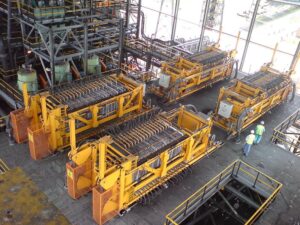
A membrane filter press dewaters slurry through several stages:
-
Feed filtration: Slurry is pumped into the chambers. Liquid passes through the filter cloth while solids accumulate as cake.
-
Membrane squeezing: Flexible membranes expand and compress the cake, forcing additional liquid through the drainage system.
-
Optional air blowing: Air passes through the cake to displace remaining free water.
-
Cake discharge: Plates open and the cake is released.
Each stage contributes differently to final moisture. Feed filtration controls cake formation and permeability. Membrane squeezing removes additional water mechanically. Air blowing can displace free water when cake structure allows effective airflow. Because each stage has a different function, they must be evaluated separately.
3. Step 1: Check Filter Cloth and Drainage Performance
Before increasing operating pressure, inspect the filter cloths, filtrate outlets, drainage passages, and filter plates.
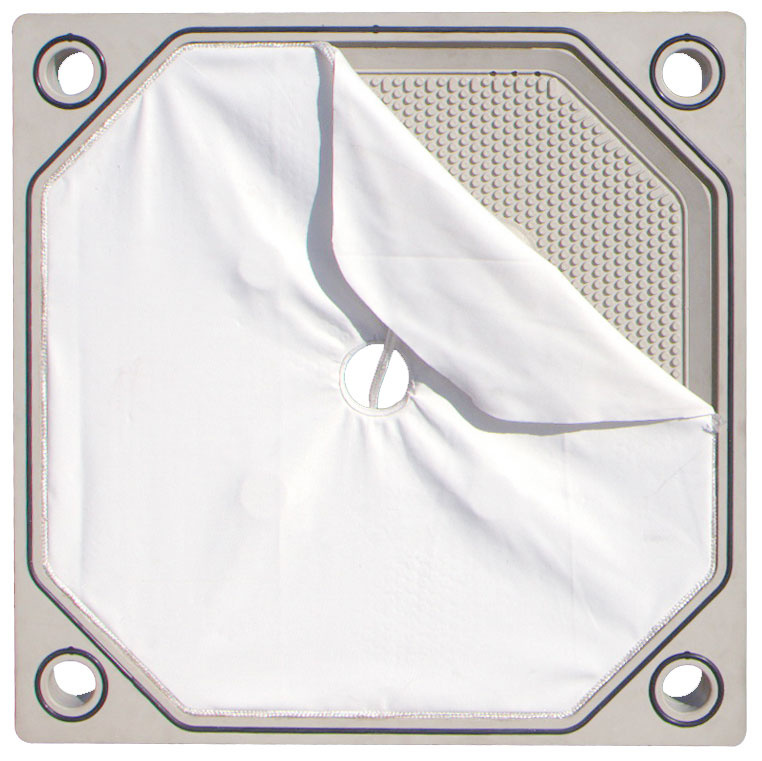
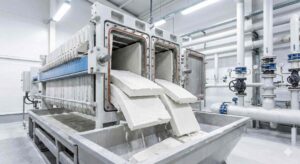
During FILTRATION, liquid passes through the filter cloth while solid particles accumulate inside the chambers. As the cake becomes thicker, it creates additional resistance to liquid flow. If the cloth is blinded by fine particles, damaged, folded, or incorrectly installed, filtration performance may deteriorate. Blocked filtrate ports and restricted drainage passages can also prevent water from leaving the chambers efficiently.
Check the following:
-
Filter cloth condition: embedded fines, blinding, tears, wrinkles, uneven cake release.
-
Drainage passages: clear filtrate outlets and internal channels.
-
Cake uniformity: moisture and thickness across chambers.
-
Cloth selection: permeability and weave matched to particle-size distribution.
-
Membrane condition: damage or uneven squeezing in specific chambers.
Filter cloth selection requires balancing solids retention and liquid permeability. A cloth that is too restrictive may reduce filtrate flow, while one that is too open may allow excessive fine particles to pass through. Cleaning or replacing a blinded cloth may improve drainage more effectively than increasing pressure. For compatible components, review FILTER PLATES & CLOTHS.
4. Step 2: Optimize Feed Filtration and Membrane Squeezing Separately
A MEMBRANE FILTER PRESS generally performs dewatering in two main stages.
Stage One: Feed Filtration
Slurry is pumped into the filter chambers. Liquid passes through the filter cloth while solids accumulate to form the filter cake. The feed pressure profile and filtration endpoint affect cake formation. Increasing pressure too quickly may compact fine particles and reduce the permeability of the developing cake. Instead of automatically extending the feeding stage, evaluate whether additional filtration time produces a meaningful increase in filtrate volume or improves cake formation.
Stage Two: Membrane Squeezing
After primary filtration, flexible membranes expand according to the press design and compress the formed cake. This additional mechanical action forces more liquid through the drainage system. Evaluate:
-
Squeeze pressure within the manufacturer’s approved limits.
-
Squeezing duration and additional filtrate collected.
-
Cake moisture before and after squeezing.
-
Effect on total cycle time.
-
Differences between filter chambers.
Increasing squeeze pressure or holding time may reduce moisture, but the improvement becomes progressively smaller. The objective is to identify the point where additional squeezing no longer justifies the extra operating time. Never use a generic squeeze-pressure target without checking the specifications of the filter plates, membranes, and complete press system.
5. Step 3: Improve Slurry Consistency and Conditioning
Filter press performance depends on the material being processed, not just machine settings. Two slurries with similar solid concentrations can behave differently because their particle-size distributions, mineral compositions, surface properties, and chemical characteristics may differ. Fine particles can form a dense cake with low permeability, making it difficult for water to pass through.
Record the following during normal operation:
-
Feed solids concentration.
-
Particle-size distribution.
-
Slurry pH, where relevant.
-
Coagulant or flocculant type and dosage.
-
Filtration rate and filtrate clarity.
-
Final filter cake moisture.
If the slurry contains substantial fines or forms a poorly draining cake, consider controlled trials of suitable coagulants, flocculants, or compatible filter aids where the process permits. These treatments can change particle interactions and help create a cake structure with more effective drainage paths. However, the best treatment depends on the material and process conditions. Excessive or unsuitable chemical dosing may increase costs or create other operational problems. Evaluate each trial using several indicators rather than relying on floc size alone.
6. Step 4: Evaluate Through-Cake Air Blowing
Some VACUUM FILTER and filter press systems support through-cake air blowing after filtration and membrane squeezing. Air passes through the formed cake and helps displace remaining free water. This can provide an additional dewatering step when the cake structure allows effective airflow.
Air blowing is not suitable for every installation or material. Performance depends on cake permeability, air distribution, equipment configuration, and the approved operating sequence. When evaluating air blowing, measure:
-
Cake moisture before and after the air-blowing stage.
-
Additional time required.
-
Compressed-air consumption.
-
Consistency of improvement across filter chambers.
-
Effect on total dry-solids throughput.
If air blowing produces only a small moisture reduction while significantly extending the cycle, the additional step may not be justified. Use only the air path, pressure, and operating sequence approved for the installed equipment.
7. Step 5: Run Controlled Trials to Find the Best Operating Conditions
Changing several parameters simultaneously makes it difficult to determine which adjustment improves cake dryness. A controlled trial provides a more reliable way to optimize performance.
First, establish a baseline using current operating conditions. Record feed characteristics, pressure settings, cycle duration, filtrate flow, and cake moisture. Next, change one operating variable at a time while keeping other conditions as consistent as practical. Use consistent cake sampling locations and measurement methods to reduce sampling variation.
A practical optimization record should include:
| Parameter | What to Record |
|---|---|
| Feed solids concentration | Percentage of solids in incoming slurry |
| Particle-size distribution | Proportion of coarse and fine particles |
| Feed pressure | Pressure profile and filtration duration |
| Squeeze pressure | Approved operating pressure |
| Squeeze duration | Total time spent squeezing |
| Filtrate flow | Flow rate or collected volume per stage |
| Cake moisture | Moisture measured by a consistent method |
| Air blowing | Operating time and compressed-air use |
| Total cycle time | Time for one complete press cycle |
| Dry-solids throughput | Amount of dry solids processed over time |
The best operating point is not necessarily the one that produces the driest cake in a single cycle. Select conditions that meet the moisture target while maintaining acceptable throughput, operating costs, and equipment reliability. If increasing squeeze pressure or duration produces little improvement, investigate cloth permeability, drainage restrictions, slurry conditioning, and cake formation before further adjustments.
8. Benefits of Systematic Optimization
-
Lower transport and handling costs.
-
Improved water recovery.
-
More stable tailings dry discharge.
-
Longer filter cloth and membrane life.
-
Better cycle-time predictability.
-
Reduced risk of over-compaction and cloth blinding.
-
More reliable maintenance planning.
9. Applications
-
Copper, gold, iron ore, and lead-zinc concentrate dewatering.
-
Coal preparation and fine coal tailings.
-
Tailings dry discharge and paste backfill preparation.
-
Silica sand and industrial mineral processing.
-
Chemical and metallurgical slurry filtration.
10. Material Comparison: Filter Cloth Options
| Cloth Type | Solids Retention | Filtrate Flow | Best Application | Notes |
|---|---|---|---|---|
| Fine monofilament | High | Moderate | Fine concentrates | Risk of blinding |
| Multifilament | High | Lower | Fine slurries | Requires careful cleaning |
| Coarse weave | Lower | High | Coarse free-draining material | May pass fines |
| Membrane-compatible cloth | Balanced | Balanced | Membrane filter presses | Must match plate design |
11. Application Comparison: Feed Filtration vs. Membrane Squeezing
| Parameter | Feed Filtration | Membrane Squeezing |
|---|---|---|
| Driving force | Pump pressure | Membrane compression |
| Main risk | Over-compaction of fines | Excessive pressure/duration |
| Key measurement | Filtrate volume, cake formation | Moisture before/after |
| Typical adjustment | Pressure profile, endpoint | Squeeze pressure, holding time |
| Diminishing returns | Additional filtration time | Additional squeeze time |
12. Industry Application Matrix
| Industry | Typical Material | Key Moisture Concern | Focus |
|---|---|---|---|
| Gold | Concentrate, tailings | Transport, recovery | Cloth + squeeze |
| Copper | Concentrate | Shipping limits | Feed pressure profile |
| Coal | Fine coal tailings | Handling, stability | Slurry conditioning |
| Iron ore | Concentrate | Transport cost | Membrane squeezing |
| Lithium | Chemical concentrate | Product spec | Controlled trials |
| Silica sand | Fine sand | Product quality | Cloth permeability |
13. Selection Guide
-
Confirm filter press model, plate size, and membrane type.
-
Characterize slurry: solids concentration, particle-size distribution, pH, chemistry.
-
Match cloth permeability and weave to particle-size distribution.
-
Verify membrane compatibility with approved pressure.
-
Review upstream SCREENING and CLASSIFICATION performance.
-
Request material reports and wear-life recommendations.
14. Procurement Guide
Required information: equipment model, plate dimensions, OEM part numbers, slurry characteristics, target moisture, operating pressure limits.
Drawings needed: plate and cloth dimensions, membrane profile, fastening arrangement.
Material selection: cloth material and weave, membrane rubber compound, pH and temperature compatibility.
MOQ and lead time: confirm replacement cloth and membrane MOQ, verify lead time against maintenance windows.
Packaging and shipping: protect cloths from creasing and contamination; choose shipping method for urgent shutdown needs.
Inspection standards: dimensional check, material certificate review, visual defect inspection.
Supplier evaluation checklist:
-
Can the supplier manufacture according to drawings?
-
Can the supplier provide material reports?
-
Can the supplier support OEM replacement?
-
Does the supplier have export experience?
-
Can the supplier provide wear-life recommendations?
15. Failure Analysis
| Problem | Possible Cause | Recommended Solution |
|---|---|---|
| Wet cake after squeezing | Blinded filter cloth | Clean or replace cloth |
| Uneven cake across chambers | Blocked filtrate passages | Clear drainage channels |
| High moisture in specific chambers | Membrane damage | Inspect and replace membrane |
| Cake cracking, poor drainage | Over-compaction from rapid pressure rise | Adjust feed pressure profile |
| Short cloth life | Incorrect cloth selection | Re-select permeability and weave |
| High cycle time, little moisture gain | Excessive squeeze duration | Identify diminishing-return point |
16. Maintenance Guide
-
Daily: check filtrate clarity and cake release.
-
Weekly: inspect cloth surface for blinding, tears, wrinkles.
-
Monthly: review membrane condition and squeeze uniformity.
-
Wear pattern monitoring: compare cake moisture across chambers.
-
Replacement timing: replace cloths when cleaning no longer restores flow.
-
Spare parts inventory: keep critical cloths and membranes in stock.
-
Downtime reduction: schedule cloth replacement during planned stops.
-
Preventive maintenance: record pressure profiles and cycle times for trend analysis.
Upstream equipment also matters. Review DEWATERING HYDROCYCLONES and THICKENERS to maintain consistent feed to the filter press.
17. Case Study
Customer Type: Copper concentrator
Ore Type: Copper sulfide concentrate
Operating Conditions: Membrane filter press, target moisture below specification limit
Problem: Cake moisture consistently above target; operators increased squeeze pressure without improvement
Solution: Inspection found blinded filter cloths and partially blocked filtrate passages. Cloths were replaced, drainage cleared, and squeeze duration optimized through controlled trials.
Result: Cake moisture returned to target, cycle time was reduced, and unnecessary pressure increases were avoided. Results should be verified against each plant’s specific slurry and equipment.
18. FAQ
Q1: Does higher squeeze pressure always produce a drier filter cake?
No. Higher pressure may provide diminishing returns and can compact some cakes enough to restrict drainage. Operate within manufacturer limits and measure actual moisture reduction.
Q2: How do I know whether my filter cloth needs cleaning or replacement?
Check for blinding, embedded fines, damage, wrinkles, reduced filtrate flow, and uneven cake release. Compare performance across chambers and follow supplier guidance.
Q3: Can flocculants help reduce filter cake moisture?
They may improve cake structure and drainage for some slurries. Effectiveness depends on material, chemical selection, dosage, and process conditions, so controlled trials are necessary.
Q4: Is air blowing necessary for every membrane filter press?
No. It is an optional stage on suitably configured equipment. Its value depends on cake permeability, achievable moisture reduction, additional cycle time, and compressed-air consumption.
Q5: What information is needed to troubleshoot high cake moisture?
Slurry type, feed solids concentration, particle-size distribution, current and target moisture, cloth specifications, feed pressure, squeeze pressure and duration, filtrate flow, and total cycle time.
Q6: Can upstream screening and classification affect cake moisture?
Yes. They control the particle-size distribution entering the filter press. Poor size control can increase fines content and reduce cake permeability.
Q7: How do I compare OEM and aftermarket filter cloths?
Compare dimensional fit, material certificates, permeability consistency, lead time, and wear-life data. Confirm the supplier can manufacture according to drawings and support OEM replacement.
Q8: How often should filter cloths be inspected?
Inspect visually every shift for obvious damage, and perform a detailed check weekly. Replace or clean when filtrate flow declines or cake release becomes uneven.
19. Conclusion
Reducing filter cake moisture in a FILTER PRESSES system requires more than increasing pressure. Inspect cloths and drainage first, optimize feed filtration and membrane squeezing separately, assess slurry conditioning, and evaluate air blowing where supported. Use controlled trials to find the operating point that meets your moisture target without unnecessary cycle time. For dry tailings handling, review TAILINGS DRY DISCHARGE SYSTEMS.
Related Articles
Related Products
Related Technical Guides
-
IMPROVE FINE SCREENING EFFICIENCY WITH POLYURETHANE SCREEN PANELS
-
HYDROCYCLONE WEAR: ROOT CAUSES, HIGH-WEAR ZONES & MATERIAL SOLUTIONS
Related Buyer Guides
-
HOW DO I CHOOSE THE RIGHT RUBBER BELT FOR A VACUUM BELT FILTER?
-
WHICH MANUFACTURER OFFERS HIGH-QUALITY POLYURETHANE TUFFLEX WIRE SCREENS FOR MINING?
Related Comparison Articles
Contact
Annie Lu
Email: annie.lu@huataogroup.com
Mobile / WhatsApp / WeChat: +86 18032422676
Website: www.tufflexscreen.com
 admin
personal profile