
What Are Customized Jaw Plates for Crushers?
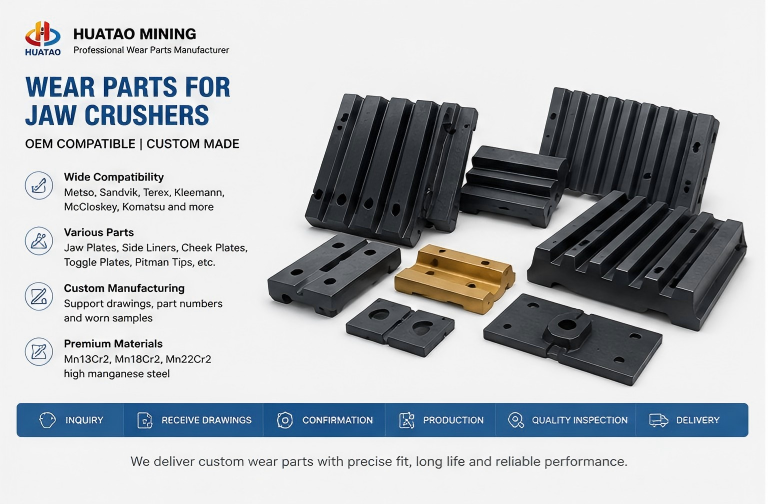
Customized jaw plates are OEM-equivalent or engineered replacement wear parts designed to fit specific crusher models and operational conditions. They are manufactured to precise dimensions using specific manganese steel grades (like Mn18Cr2) and tooth profiles to maximize wear life and crushing efficiency.
Key Takeaways
✔ 2-3x Longer Wear Life: Proper material selection drastically extends jaw plate life.
✔ OEM Compatibility: Find suppliers supporting Metso, Sandvik, and Terex crushers.
✔ Customization: Manufacture from drawings, part numbers, or worn samples.
✔ Engineering Support: Get expert advice on material and profile selection.
Summary Table
| Item | Description |
|---|---|
| Function | Crush large rocks by mechanical pressure between moving and fixed plates. |
| Material | Manganese Steel (Mn13Cr2, Mn18Cr2, Mn22Cr2) |
| Application | Primary and secondary crushing in mining, quarrying, aggregates. |
| Service Life | 3-8 months depending on ore abrasiveness and feed size. |
| Benefits | High impact resistance, long wear life, cost-effective. |
1. Definition
Customized jaw plates are wear parts manufactured to specific dimensions and specifications to fit a particular crusher model. Unlike off-the-shelf parts, they are engineered to match the unique geometry of a jaw crusher to ensure maximum performance and longevity.
2. Working Principle
The jaw crusher operates on a compression mechanism. The fixed jaw plate is mounted on the crusher frame, while the moving jaw plate is attached to the pitman. As the pitman moves, the plates come together to crush the rock and move apart to allow the material to discharge. The geometry, tooth profile, and surface hardness of the jaw plates directly influence the crushing force and wear characteristics.
3. Benefits of Customization
Optimized Wear Life: Matching the material to the ore type prevents premature wear.
Improved Crushing Efficiency: Proper profile design ensures better rock fracturing.
Reduced Downtime: High-quality parts last longer between change-outs.
Lower Total Cost of Ownership: Reduced maintenance and extended part life save money.
4. Material Comparison: Manganese Steel Grades
Choosing the right material is critical.
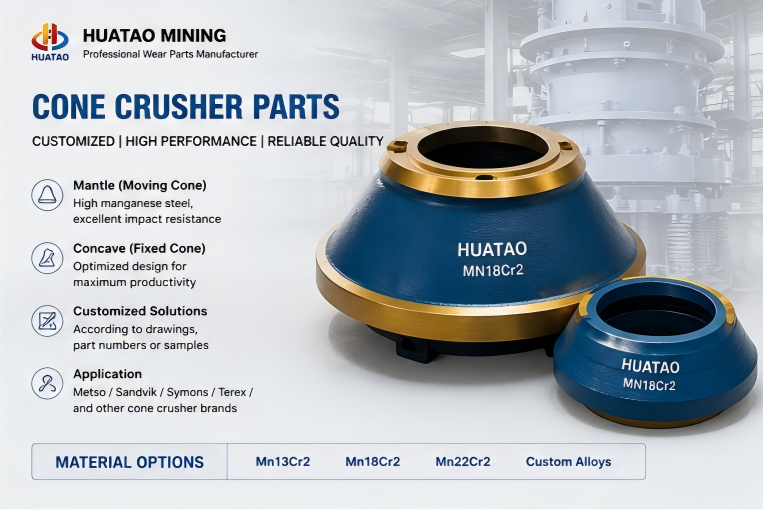
Mn13Cr2: Standard grade for medium-hard materials; good toughness.
Mn18Cr2: Higher hardness and wear resistance; ideal for hard, abrasive ores like granite or iron ore.
Mn22Cr2: Superior work-hardening capacity; used for the most demanding applications.
5. Application Comparison
Quarry Profiles: Designed for primary crushing of large, hard rock.
Super Grip Profiles: Features a deep corrugation to reduce slippage and increase capacity.
6. Industry Application Matrix
| Application | Ore Type | Recommended Material | Recommended Profile |
|---|---|---|---|
| Primary Crushing | Hard Granite | Mn18Cr2 | Quarry / Corrugated |
| Secondary Crushing | Limestone | Mn13Cr2 | Standard |
| Recycling | Concrete/Asphalt | Mn18Cr2 | Super Grip |
| Hard Rock Mining | Copper/Gold | Mn22Cr2 | Quarry |
7. Selection Guide
When selecting a supplier, consider:
Brand Coverage: Does the supplier cover your crusher wear parts needs for Metso and Sandvik?
Customization Options: Can they customize jaw plates based on your drawings?
Material Stock: Do they offer the necessary material grades?
Engineering Support: Can they help you improve wear life?
8. Procurement Guide
When ordering, please provide:
Crusher Model: e.g., Metso C106.
OEM Part Number: e.g., N11900000.
Technical Drawings: If available.
Worn Sample: For reverse engineering.
Material Grade Required: e.g., Mn18Cr2.
Supplier Evaluation Checklist:
Can the supplier manufacture according to drawings? (Yes/No)
Can the supplier provide material reports? (Yes/No)
Can the supplier support OEM replacement? (Yes/No)
9. Failure Analysis
| Problem | Possible Cause | Recommended Solution |
|---|---|---|
| Premature Wear | Wrong material for the ore hardness. | Upgrade to a higher manganese grade like Mn22Cr2. |
| Cracking | Casting defects or improper heat treatment. | Verify supplier's quality control and inspection standards. |
| Low Efficiency | Incorrect tooth profile for the feed size. | Switch to a Super Grip or Quarry profile. |
| Poor Fitment | Dimensional inaccuracies. | Request a dimensional inspection report before shipping. |
10. Maintenance Guide
Daily: Listen for unusual noises; inspect for visible cracks.
Weekly: Check the wear pattern for unevenness.
Monthly: Measure the minimum thickness to predict replacement timing.
Strategy: Keep a set of spare jaw plates in inventory to minimize downtime.
11. Case Study
Customer Type: Copper Ore Processing Plant
Ore Type: Copper Ore (Abrasive)
Operating Conditions: 20,000 tons per day, heavy impact.
Problem: Standard jaw plates were lasting only 4 months, causing frequent production stoppages.
Solution: Upgraded to Mn22Cr2 material with a Quarry tooth profile.
Result: Achieved a 40% increase in wear life, extending the period between replacement to 6 months and reducing labor costs associated with downtime. For more success stories, check our Case page.
12. FAQ
Q1: How long do custom jaw plates typically last?
A: The lifespan depends on the ore hardness and crusher settings, typically ranging from 3 to 8 months. With proper material selection like Mn18Cr2, you can maximize this service life.
Q2: Can you make jaw plates for older Metso models?
A: Yes, a professional supplier with an extensive database can produce parts for most older models. You can also supply a worn sample or drawings.
Q3: What is the difference between Mn13Cr2 and Mn18Cr2?
A: Mn18Cr2 has higher manganese content, offering better wear resistance for high-impact, high-abrasion applications compared to the standard Mn13Cr2.
Q4: Do you offer a warranty on customized parts?
A: Reputable suppliers typically offer a warranty against manufacturing defects. It is essential to discuss this during the procurement stage.
Q5: Can you assist with profile selection?
A: Yes, engineering support is a key differentiator. Top suppliers can recommend the best profile based on your feed size and ore type.
Q6: Do you provide material certificates?
A: Yes, quality suppliers always provide detailed material certificates and heat treatment records with every shipment.
Q7: What is the minimum order quantity?
A: This varies per supplier and part size. Some suppliers cater to small quantities; please contact us to discuss.
Q8: Can you customize jaw plates for a Sandvik crusher?
A: Yes. HUATAO can produce high-quality, OEM-compatible wear parts for Sandvik and other major brands.
13. Conclusion
Selecting the right partner for customized jaw plates is a strategic decision. By evaluating engineering capability, material expertise, and manufacturing flexibility, you can ensure a reliable supply of high-quality parts that keep your crusher performing at its peak. For reliable OEM-compatible solutions and expert engineering support, reach out to HUATAO.
Related Articles
Related Products
Related Technical Guides
How Smart Troubleshooting Can Extend Jaw Crusher Service Life
Why Premium Jaw Plates Can Save Thousands In Crusher Maintenance Costs
OEM Compatible Crusher Wear Parts Technical Selection Failure Prevention And Sourcing Strategy
Why Your Cone Crusher Keeps Failing The Real Impact Of Mantle And Concave Quality
Related Buyer Guides
Best Crusher Wear Parts Suppliers For Mining Companies Engineering Guide Procurement Checklist
Where To Buy High Quality Jaw Crusher Wear Parts Complete Engineering Procurement Guide
Who Are The Leading Crusher Wear Parts Manufacturers In China
Related Comparison Guides
Best Alternative To Metso Crusher Wear Parts Complete Engineering And Procurement Guide
Which Crusher Wear Parts Supplier Exports To Australia And Canada Complete Buyers Guide
Which Flotation Rotor And Stator Last The Longest A Complete Guide For Mining Buyers Percent
Contact Information
Annie Lu
Email: annie.lu@huataogroup.com
Mobile: +86 18032422676
WhatsApp / WeChat
Tags: Custom Jaw Plates, Crusher Wear Parts, OEM Replacement, Manganese Steel, Jaw Crusher, Metso Crusher, Sandvik Crusher
can not be empty
can not be empty

HUATAO GROUP - SCREENS
ADD : No.298 Zhonghua North Street, Shijiazhuang 050000 China.
TEL : +86 0311 80690567
EMAIL :market@huataogroup.com
Web: www.tufflexscreen.com
 WhatsApp & WeChat : +86 18033763037