
Hydrocyclones and centrifuges both separate solids from liquids, but they serve different purposes with different efficiency metrics. Centrifuges generate mechanical centrifugal force through high-speed rotation, enabling ultra-fine particle recovery down to 2–7 microns and producing drier solids cakes. Hydrocyclones are static devices that convert feed pressure into centrifugal force, separating down to 15–100 microns with lower energy consumption and capital cost. The "more efficient" choice depends entirely on your objective: drier solids = centrifuge; fine classification = hydrocyclone. Centrifuges offer superior fine-particle recovery but come with significantly higher energy costs (up to 0.57 MM EUR/year more), complex maintenance, and vulnerability to hard particles. Hydrocyclones are simpler, cheaper, and more robust—but cannot handle high-viscosity slurries or ultra-fine particles effectively.

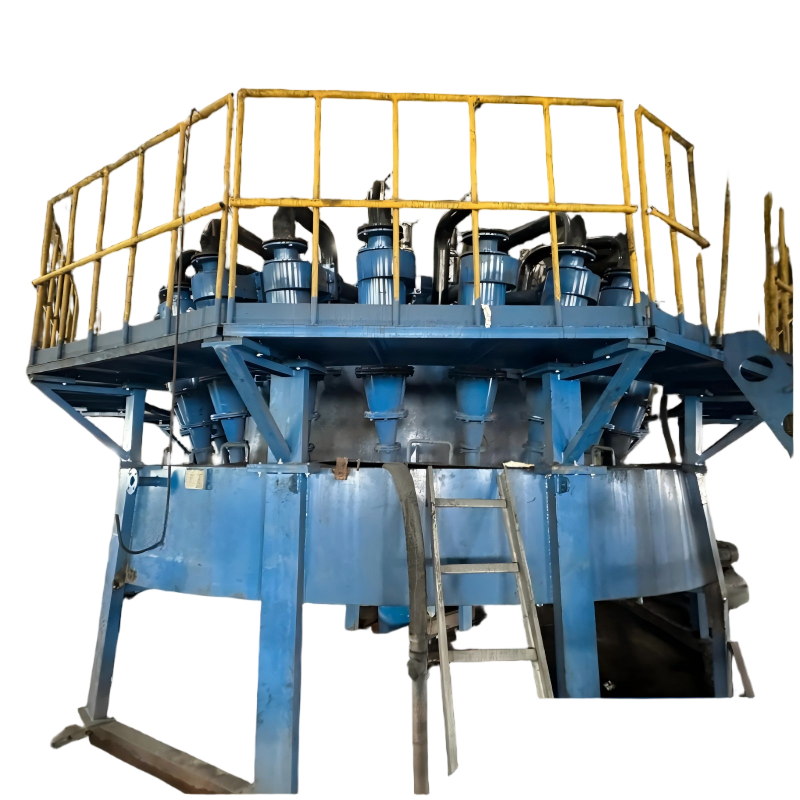
✔ Centrifuges recover ultra-fine particles down to 2–7 microns; hydrocyclones are limited to 15–100 microns
✔ Hydrocyclones have no moving parts—maintenance is frequent but fast; centrifuges have complex rotating assemblies requiring costly, time-consuming repairs
✔ Energy costs for centrifuges can be up to 0.57 MM EUR/year higher than hydrocyclone systems
✔ High viscosity kills hydrocyclones—they effectively become "drain pipes"; centrifuges maintain performance
✔ Hard particles are a centrifuge's Achilles' heel—a single piece of tramp metal can cause catastrophic failure
✔ HUATAO Group manufactures premium wear parts for hydrocyclones, screens, and centrifuges
| Feature | Hydrocyclone | Centrifuge |
|---|---|---|
| Separation Mechanism | Passive (pressure → centrifugal force) | Active (motor-driven rotation) |
| Moving Parts | None | Complex (bowl, screw conveyor, bearings) |
| Fine Particle Limit (d50) | 15–100 μm | 2–7 μm |
| Solids Cake Dryness | Slurry-like (wet) | Dense cake (dryer) |
| Capital Cost | Low | High |
| Energy Consumption | Low | High (up to 0.57 MM EUR/year more) |
| Maintenance Frequency | Frequent but fast swaps | Less frequent but costly, time-consuming |
| Wear Part Replacement | 20-minute spigot change | 2–3 day screw conveyor rebuild |
| Viscosity Sensitivity | High (stops working) | Low |
| Hard Particle Vulnerability | Low (wears liners) | High (damages screw/bowl) |
| Tramp Material Tolerance | High | Very low |
A Hydrocyclone is a static, continuous-flow device that uses centrifugal force to accelerate the settling rate of particles in a slurry. Slurry is fed tangentially into the cylindrical-conical body, creating a high-velocity vortex. The centrifugal force throws coarser, denser particles outward to the wall, where they spiral down and exit through the underflow (spigot). Finer, lighter particles remain in the inner vortex and exit upward through the overflow (vortex finder). Hydrocyclones have no moving parts and rely entirely on feed pressure for separation energy.
A centrifuge is a mechanical device that uses high-speed rotation to separate solids from liquids based on density differences. In decanter centrifuges, a rotating bowl generates centrifugal forces thousands of times greater than gravity. Solids are compacted against the bowl wall, and a screw conveyor continuously scrapes and transports the solids out of the bowl, producing a dense, dry cake. Disc-stack centrifuges use rotating disc stacks to achieve even finer separation. Unlike hydrocyclones, centrifuges are active, energy-consuming machines with complex mechanical assemblies.
A Vibrating Screen Machine and hydrocyclone differ fundamentally, but the hydrocyclone operates as follows:
Tangential Feed: Slurry enters the cyclone body tangentially under pressure, creating a high-velocity spiral flow.
Vortex Formation: The tangential entry creates a double vortex—an outer spiral moving downward and an inner spiral moving upward.
Centrifugal Separation: Centrifugal force accelerates particle settling. Denser, coarser particles are thrown to the wall and spiral downward to the underflow.
Overflow Discharge: Finer, lighter particles remain in the inner vortex and exit through the vortex finder at the top.
Underflow Discharge: The coarse, dense fraction exits through the apex (spigot) at the bottom.
The separation is driven entirely by feed pressure—as the pump impeller wears, pressure drops, and separation efficiency degrades.
A decanter centrifuge operates through mechanical rotation:
Feed Introduction: Slurry enters the rotating bowl through a stationary feed tube.
High-Speed Rotation: The bowl rotates at high speed (typically 2,000–4,000 RPM), generating centrifugal forces 1,000–4,000 times gravity.
Solids Deposition: Under these forces, solids are rapidly deposited against the bowl wall.
Solids Conveying: A screw conveyor rotating at a slightly different speed continuously scrapes solids from the bowl wall and transports them toward the conical discharge end.
Cake Discharge: Solids are discharged as a dense, dry cake through the solids discharge ports.
Liquid Discharge: Clarified liquid overflows from the opposite end.
The separation force is mechanically generated and independent of feed viscosity or concentration.
No moving parts — simple, reliable design
Low capital investment — significantly cheaper than centrifuges
Low operating cost — no high-power motors or complex drive systems
Compact footprint — requires minimal floor space
Fast maintenance — spigot changes take 20 minutes
High tramp material tolerance — sand, steel shot pass through wearing liners
Combined classification and dewatering in one unit
Scalable — multiple units can be manifolded
Superior fine particle recovery — down to 2–7 microns
Drier solids cake — significantly lower moisture content
Handles high-viscosity slurries — unaffected by viscosity up to motor torque limits
Tolerates feed concentration fluctuations — mechanically generated force is constant
Clearer liquid discharge — superior overflow clarity
Continuous operation — screw conveyor discharges solids automatically
Higher solids throughput per unit footprint in some applications
Classification in closed-circuit grinding
Desliming prior to flotation
Dewatering of coarse concentrates
Thickening of feed to flotation circuits
Grit removal from process streams
Counter-current washing in leaching circuits
Fine solids recovery from dilute streams
Sludge dewatering in chemical processing
Clarification of finely dispersed slurries
High-viscosity material separation (titanium dioxide, chemical sludges)
Concentrate dewatering where low moisture is critical
Tailings dewatering for dry stacking applications
| Material | Wear Life | Cost | Best Application | Limitations |
|---|---|---|---|---|
| Polyurethane | 2–4× steel | Moderate | Abrasive slurries, fine particles | Limited temperature (<80°C) |
| Rubber | 3–5× steel | Low | Coarse, abrasive slurries | Limited chemical resistance |
| Steel/Ceramic | Baseline | Varies | High-temperature, high-impact | Heavy, expensive |
Polyurethane Screen Panel offers superior wear life in hydrocyclone and centrifuge feed systems, with field results showing 2–4 times longer service life compared to conventional materials.
Rubber Screen Panel is the preferred choice for coarse, high-impact applications where abrasion resistance and cost-effectiveness are key.
| Application | Recommended Equipment | Reason |
|---|---|---|
| Closed-circuit grinding classification | Hydrocyclone | Size separation is primary requirement |
| Fine solids recovery from dilute stream | Centrifuge | Capable of 2–7 micron recovery |
| High-viscosity slurry separation | Centrifuge | Unaffected by viscosity up to motor limits |
| Space-constrained plant | Hydrocyclone | Small footprint |
| Low capital budget | Hydrocyclone | Significantly cheaper |
| Driest possible solids cake | Centrifuge | Produces much drier cake |
| Slurry with tramp material/debris | Hydrocyclone | Tolerates hard particles |
| Combined classification + dewatering | Hydrocyclone | Single unit performs both |
| Industry | Typical Hydrocyclone Use | Typical Centrifuge Use |
|---|---|---|
| Gold Ore | Grinding circuit classification, desliming | Fine tailings dewatering |
| Copper Ore | Grinding circuit classification | Concentrate dewatering |
| Iron Ore | Desliming, coarse dewatering | Fine concentrate dewatering |
| Coal | Dense medium recovery, fines classification | Fine coal dewatering |
| Titanium Dioxide | Limited use | Primary separation (high viscosity) |
| Chemical Sludges | Grit removal | Primary dewatering |
| Silica Sand | Desliming, classification | Fine sand dewatering |
Step 1: Define the Separation Objective
Is the primary goal classification (size split) or dewatering (dry solids)?
Step 2: Analyze Feed Characteristics
Particle size distribution and cut size required
Solids concentration and expected variability
Slurry viscosity
Presence of hard particles or tramp material
Step 3: Define Output Requirements
Required underflow dryness (moisture content)
Required overflow clarity
Solids recovery efficiency target
Step 4: Evaluate Site Constraints
Available footprint
Capital budget
Energy cost (centrifuge power consumption is significant)
Maintenance crew capability
Step 5: Consider Upstream Protection
For centrifuges: reliable desanding and screening must be in place
For hydrocyclones: consistent feed pressure is critical
Key Decision Rule: If you need dry solids, choose the centrifuge—but only if you can protect it from hard particles. If you need classification at lowest cost, choose the hydrocyclone.
Required Information for a Wear Part Inquiry:
Equipment Specifications: Model, make, and serial number
Drawings: If available, provide original OEM drawing or dimensions
Operating Conditions: Feed rate, solids concentration, particle size distribution, temperature, pH
OEM Part Numbers: Provide if seeking direct replacement
Wear Part Type: Specify if you need spigots, feed heads, liners, or screw conveyor flights
Can the supplier manufacture according to drawings?
Can the supplier provide material test reports?
Does the supplier support OEM replacement compatibility?
Does the supplier have export experience to your region?
Can the supplier provide wear-life recommendations?
What is the typical lead time?
What is the MOQ?
What inspection standards are followed?
"Can you produce parts that match the OEM geometry exactly?"
"What polyurethane or rubber compounds do you recommend for my ore type?"
"Can you provide a wear-life guarantee or field reference?"
"Do you offer a warranty on your parts?"
"What is your maximum manufacturing size capability?"
| Problem | Possible Cause | Recommended Solution |
|---|---|---|
| Hydrocyclone coarse overflow | Spigot worn or feed pressure low | Replace spigot; increase pump speed; check pump impeller wear |
| Cyclone underflow too wet | Feed too dilute; spigot too large | Increase feed density; reduce spigot size |
| Centrifuge high vibration | Bowl imbalance or bearing wear | Rebalance; inspect bearings; check for debris |
| Centrifuge screw conveyor wear | Hard, abrasive particles | Upgrade to wear-resistant material; improve upstream screening |
| Centrifuge frequent shutdown | Tramp metal or heavy solids overload | Install magnets and desanders upstream; reduce feed rate |
| Polyurethane screen panel cracking | Impact damage or incorrect compound | Use higher-strength compound; improve installation |
| Tufflex Screen blinding | Wet sticky material | Increase vibration amplitude; use flip-flop design |
| Hydrocyclone liner excessive wear | Abrasive ore or incorrect liner material | Switch to polyurethane or rubber liner |
| Frequency | Task |
|---|---|
| Daily | Inspect spigot for wear; check feed pressure; observe underflow spray pattern |
| Weekly | Inspect feed head and vortex finder for wear; check all connections for leaks |
| Monthly | Measure liner thickness; check for cracks in cyclone body; review performance data |
| Quarterly | Comprehensive inspection of all wear parts; plan replacement schedule |
| Frequency | Task |
|---|---|
| Daily | Check vibration levels; monitor motor current; inspect discharge solids consistency |
| Weekly | Check bearing temperatures; inspect seals; monitor lubrication levels |
| Monthly | Inspect screw conveyor flights for wear; check bowl condition; review performance data |
| Quarterly | Lubricate bearings; inspect gearbox; calibrate instruments; plan screw conveyor inspection |
| Annually | Complete overhaul: bearing replacement, dynamic balancing, screw conveyor rebuild |
For Hydrocyclones:
Spigots: 2–3 sizes in stock
Feed heads: 2 in stock
Vortex finders: 2 sizes in stock
Full set of liners: 1–2 complete sets
For Centrifuges:
Screw conveyor flights: 1–2 complete sets
Bearing kit: 2 complete sets
Seal kit: 2 complete sets
Lubrication system spares
Customer Type: Iron ore concentrator (Brazil)
Ore Type: Fine hematite (80% passing 45 microns)
Operating Conditions: 500 tph feed, 30% solids, high viscosity in wet season
Problem: Existing hydrocyclones were losing significant fine iron values (<15 microns) to overflow, reducing overall recovery by 8–10%. During wet season, slurry viscosity increased, and hydrocyclone performance degraded further.
Solution: A decanter centrifuge was installed to treat the hydrocyclone overflow stream, recovering fine solids that were previously lost.
Result:
Overall iron recovery increased by 7.2%
Fine particle recovery (<15μm) improved from 45% to 82%
Centrifuge underflow delivered 68% solids cake
Additional revenue: $4.2 million/year
Payback period: 14 months
Key Lesson: The hydrocyclone handled the bulk classification duty, while the centrifuge was deployed specifically for fine recovery. Each machine was optimized for its own role, and together they delivered maximum overall recovery.
Answer: It depends on your definition of "efficient." For fine particle recovery (down to 2–7 microns) and drier solids cake, the centrifuge is more efficient. For low-cost, high-capacity classification and coarse dewatering, the hydrocyclone is more efficient. Comparing "efficiency" without defining the objective is meaningless—they are built for different purposes.
Answer: Depending on configuration, hydrocyclones typically separate down to 15–100 microns. Below 15 microns, fine particles lack sufficient settling velocity to overcome the inward drag of the inner vortex and report to the overflow. Surface chemistry adjustments can improve fines recovery, but the fundamental limitation remains.
Answer: Centrifuges consume significantly more energy than hydrocyclones—operating cost analyses show they can cost approximately 0.57 MM EUR/year more in power alone. They also require complex maintenance: bearings, gearboxes, and screw conveyor flights must be regularly inspected and replaced. A screw conveyor rebuild for hard materials can take 2–3 days and cost tens of thousands of dollars.
Answer: Yes, but with caution. Hard, sharp particles aggressively wear the screw conveyor flights. For materials like quartz sand or iron ore concentrate, screw flight life may be only 3–6 months. Upstream screening and desanding are essential to remove tramp material and extend screw life. Many operators ultimately choose hydrocyclones for abrasive applications despite lower fines recovery.
Answer: Choose a hydrocyclone when: space and capital are tight; the primary goal is classification (coarse/fine split) rather than maximum dryness; feed concentration and viscosity are relatively stable; you want quick, low-cost wear-part replacement; or your slurry contains significant tramp material.
Answer: Choose a centrifuge when: ultra-fine solids (<15 μm) must be recovered; drier solids cake is required; feed concentration and viscosity vary widely; upstream screening and desanding are reliable; you can justify higher capital and operating costs.
Answer: Hydrocyclone performance loss is most often caused by feed pump impeller wear, not the cyclone itself. As the pump impeller wears, pressure drops, centrifugal force decays, and cut size coarsens. Many "hydrocyclone not working" complaints trace back to a worn pump impeller. Always check feed pressure first.
Answer: Hard particles and tramp material. A single piece of tramp metal can cause catastrophic vibration, trigger automatic shutdown, or destroy the screw flight. Before selecting a centrifuge, you must ensure reliable desanding and screening upstream. Without it, the centrifuge becomes a maintenance nightmare.
Answer: Yes. Vibrating screens are commonly used upstream of both hydrocyclones and centrifuges for desliming, pre-classification, and grit removal. Dewatering screens can also be used after hydrocyclones to further reduce moisture content of coarse solids, achieving drier products than hydrocyclone underflow alone.
Answer: HUATAO manufactures polyurethane and rubber screen panels (up to 8x steel life), hydrocyclone liners and spigots, and Tufflex flip-flop screens that eliminate blinding. We also produce custom wear parts for centrifuge feed systems and dewatering applications. All products are engineered to your specific ore type and operating conditions.
Hydrocyclones and centrifuges are both essential tools for solid-liquid separation, but they serve fundamentally different roles and should be evaluated against different efficiency criteria.
Hydrocyclones are passive, static devices that use pressure-converted centrifugal force for separation. They excel when classification is the primary goal, capital is limited, and feed conditions are stable. Their simplicity, low cost, and robustness make them the workhorse of mineral processing classification circuits.
Centrifuges are active, dynamic machines that use motor-driven rotation to generate far higher centrifugal forces. They excel when ultra-fine particles must be recovered, drier solids cake is required, or high-viscosity slurries must be processed. However, their higher capital and operating costs, complex maintenance, and vulnerability to hard particles demand careful justification.
The most effective plants often use both—hydrocyclones for bulk classification and coarse dewatering, centrifuges for fine recovery and final dewatering. Each machine should be selected based on its unique capabilities and limitations.
The harsh conditions inside hydrocyclones, centrifuges, and screens demand high-performance wear parts. HUATAO Group engineers premium polyurethane and rubber screen panels, hydrocyclone liners, and Tufflex flip-flop screens that deliver longer service life, reduced downtime, and lower total cost of ownership.
Hydrocyclone Selection For Mineral Processing Full Engineering Guide
How Do I Calculate Hydrocyclone Capacity For Mineral Processing
Why More Mining Plants Are Switching To Polyurethane Hydrocyclone Parts
Where Can I Find Reliable Hydrocyclone Suppliers In China For Mining And Mineral Processing
Where Can I Find Reliable Mining Wear Parts Suppliers In China
Best Flotation Equipment Spare Parts Suppliers How To Choose For Longer Wear Life Higher Recovery
Best Alternative To Metso Crusher Wear Parts Complete Engineering And Procurement Guide
Polyurethane Screen Panels Vs Rubber Screen Panels Which Is Better
Hydrocyclone Vs Vibrating Screen Which Classification Solution Is Better For Mineral Processing
We warmly welcome customers from around the world to contact us and establish mutually beneficial partnerships.
Contact: Annie Lu
Email: annie.lu@huataogroup.com
Phone / WhatsApp: +86 180 3242 2676
Website: http://www.tufflexscreen.com
HUATAO Group – Your Trusted Supplier for High-Performance Screening and Wear Solutions.
can not be empty
can not be empty

HUATAO GROUP - SCREENS
ADD : No.298 Zhonghua North Street, Shijiazhuang 050000 China.
TEL : +86 0311 80690567
EMAIL :market@huataogroup.com
Web: www.tufflexscreen.com
 WhatsApp & WeChat : +86 18033763037