
When processing abrasive ores—particularly high-silica, hard particles—polyurethane hydrocyclones deliver 3–5× longer wear life than unlined metal, maintain stable separation geometry for consistent cut size, resist corrosion across pH 2–12, and weigh dramatically less (50–80kg vs. 200–300kg for metal). However, they are temperature-limited to ≤70°C. Metal hydrocyclones (high-chromium cast iron) offer structural strength, high-temperature capability (>200°C with ceramic liners), and lower initial shell cost—but require frequent liner replacements (every 1–3 months), are vulnerable to corrosion in acidic/alkaline slurries, and have unstable separation performance as wear progresses. The optimal solution for many applications is a metal shell with polyurethane or ceramic liners—combining structural durability with wear performance.

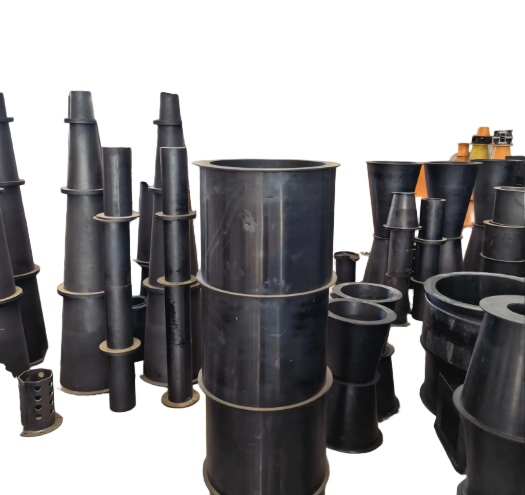
✔ Polyurethane offers 3–5× longer wear life than unlined metal in abrasive ores
✔ Metal hydrocyclones require frequent liner replacements (every 1–3 months); polyurethane runs 6–18 months
✔ Polyurethane maintains stable cut size—metal wears unevenly, causing separation drift
✔ Temperature limit is critical—polyurethane softens above 70°C, losing 70–80% of wear resistance
✔ Weight advantage—polyurethane cyclones are 3–4× lighter, enabling quick, crane-free replacement
✔ HUATAO Group offers both polyurethane and metal + liner systems—precision-engineered to your ore and operating conditions
| Criterion | Polyurethane Hydrocyclone | Metal Hydrocyclone (with liners) |
|---|---|---|
| Wear life (high-silica ore) | 3–5× longer than unlined metal | Depends on liner material |
| Dimensional stability | Excellent—gradual, uniform wear | Variable—uneven wear common |
| Temperature limit | ≤70°C | >200°C (with ceramic liners) |
| Chemical resistance | Excellent (pH 2–12) | Varies—corrosion risk in acid/alkali |
| Impact resistance | Good—elastic absorption | Excellent—structural strength |
| Weight (500mm cyclone) | ~50–80 kg | ~200–300 kg |
| Replacement time | Quick—2 people, no crane | Slower—crane required |
| Noise level | Low—damped impact | High—sharp metallic noise |
| Initial cost | Moderate–High | Low (shell) + liner cost |
| Total cost of ownership | Lower for abrasive applications | Lower only with ceramic or polyurethane liners |
| Best for | Abrasive, moderate-temperature, pH-variable slurries | High-temperature, heavy-impact, or very large-diameter cyclones |
A hydrocyclone can be manufactured from various materials:
Metal – high-chromium cast iron, steel, or stainless steel shells (often with internal liners)
Polyurethane – cast elastomer, single-piece or modular construction
Ceramic – alumina ceramic liners within metal shells
The construction material determines:
Service life under abrasive conditions
Separation performance stability
Maintenance frequency and cost
Corrosion resistance
Handling and replacement ease
Total cost of ownership
Polyurethane hydrocyclones deliver 3–5 times longer wear life than metal alternatives when processing high-abrasive slurries. Field reports show service life extension from as little as 2 months for metal units to 18+ months after switching to polyurethane.
Polyurethane's elastomeric properties allow it to resist both abrasive wear and impact damage. It absorbs particle energy through elastic deformation rather than transferring it to the material surface, resulting in a smoother, more gradual wear pattern.
A Polyurethane Screen Panel manufacturer with similar material science understands the importance of proper formulation for specific duty conditions.
Metal hydrocyclones (high-chromium cast iron) are subject to impact wear and micro-cutting from high-speed solid-liquid two-phase flow. The inner wall rapidly deforms, and classification accuracy declines within 1–2 months of operation under severe abrasive conditions.
Metal's wear behavior varies significantly with impingement angle: white cast irons experience highest erosion at 90° impingement, while steels wear fastest at 45° —complicating performance prediction.
Field insight: The choice between metal and polyurethane hydrocyclones is not fundamentally about "which wears longer"—it's about "how you plan to manage wear."
| Approach | Metal Shell + Liners | Polyurethane Shell |
|---|---|---|
| Model | Permanent asset + consumable liners | Consumable shell |
| Repair | Replace liners; shell reused | Replace entire unit |
| Best for | Large mines, long-term stability | Small-medium plants, simplicity |
| Key advantage | Shell lasts indefinitely | No liner inventory needed |
Polyurethane maintains stable separation geometry under high-speed rotational flow. Because the inner surface wears slowly and uniformly, the internal cavity retains its designed shape throughout most of its service life. This translates to consistent cut-size (d50) performance over extended periods.
Metal cyclones experience inner wall abrasion that deforms the separation cavity. As the wall wears unevenly—particularly in the conical section and spigot area—the flow pattern changes, leading to unstable cut-point performance and reduced classification accuracy.
Field insight: In polyurethane hydrocyclones, wear in the spigot increases underflow water recovery but leads to greater misplacement of fines and a "fish-hook effect" —where very fine particles report to the underflow at higher-than-expected rates. Material choice doesn't just affect equipment life; it directly impacts separation efficiency and downstream process performance.
| Material | Shell Cost | Liner Cost | Total Initial |
|---|---|---|---|
| Metal | Low | Additional (rubber, PU, ceramic) | Low–Moderate |
| Polyurethane | Higher | None (integral) | Moderate–High |
| Material | Replacement Interval | Labor Required |
|---|---|---|
| Metal (liners) | Every 1–3 months in severe service | Crane + crew |
| Polyurethane | Every 6–18 months | 2 people, no crane |
The TCO comparison favors polyurethane in most abrasive ore applications. While the upfront cost is higher, the extended service life, reduced downtime, and lower labor costs for replacement typically result in significant net savings over the equipment lifecycle.
Field insight: Polyurethane hydrocyclones also offer a hidden cost advantage: their weight is dramatically lower.
| Cyclone Size | Metal Weight | Polyurethane Weight | Advantage |
|---|---|---|---|
| 500mm diameter | 200–300 kg | 50–80 kg | 3–4× lighter |
| 350mm diameter | 100–150 kg | 25–40 kg | 3–4× lighter |
At remote mine sites where heavy lifting equipment is limited, or where crane availability causes delays, this lightweight advantage directly impacts maintenance efficiency. Waiting for a crane can turn a 2-hour replacement into a half-day downtime event.
Alumina ceramic liners offer superior abrasion resistance with machined tolerances of ±0.1 mm and structural integrity up to 1100°C. However, at significantly higher cost—ceramic liners average 36 months lifespan at $800** compared to **24 months at $500 for polyurethane.
Ore is abrasive (high silica, hard particles) but not extremely hot (slurry temperature <65–70°C)
Slurry pH ranges from 2 to 12—polyurethane offers excellent chemical stability without corrosion
Impact risk is moderate—polyurethane's elasticity absorbs shocks
Plant lifting capacity is limited—lightweight polyurethane is easier to handle
Downtime cost is high—longer service life = fewer replacements
Noise reduction is valued—polyurethane dampens high-frequency impact noise
Slurry temperature exceeds 70–80°C—polyurethane softens and rapidly loses wear resistance
Extremely high impact forces are expected—metal shell provides structural strength
Ceramic or rubber liners are preferred for specific wear zones
Heavy-medium separation applications—where ceramic liners are standard
The hydrocyclone diameter exceeds ~500 mm—polyurethane molding becomes difficult at very large sizes
| Application | Recommended Material |
|---|---|
| Cyclones under 350mm (abrasive coal/mineral) | Polyurethane |
| Concentration cyclones under 500mm | High-chromium cast iron |
| Heavy-medium separation cyclones | Alumina ceramic liners |
Field insight: The temperature limit is a red line that many suppliers fail to mention proactively. When slurry temperature exceeds 70–80°C, polyurethane visibly softens and wear resistance drops dramatically—service life may fall to 20–30% of normal.
Some polyurethane cyclone manufacturers, eager to win orders, won't ask about temperature unless you bring it up. Then, after installation, the unit wears through in two to three months, leading to disputes. As the buyer, you must actively ask: "What is my slurry temperature?" —above 65°C, abandon polyurethane and consider a metal shell with ceramic liners.
When processing strongly acidic or alkaline slurries—such as sulfide flotation tailings or slurries with sulfuric acid pH adjustment—metal corrosion is often more critical than wear.
| Material | Abrasion Resistance | Corrosion Resistance |
|---|---|---|
| High-chromium cast iron | Excellent | Poor (acid vulnerable) |
| Stainless steel | Poor | Excellent |
| Polyurethane | Excellent | Excellent (pH 2–12) |
In such applications, polyurethane is the only rational choice—a metal cyclone may corrode through before it even wears out.
Polyurethane hydrocyclones also offer a hidden workplace benefit: lower noise levels. Metal cyclones under high-pressure feed generate high-frequency impact noise that is extremely harsh and potentially damaging to operators' hearing over a full shift.
Polyurethane's elastic damping properties absorb impact energy, resulting in significantly quieter operation. While this isn't a technical performance metric, it is increasingly recognized as an EHS (Environment, Health, Safety) advantage—particularly for European and North American clients who audit plants for noise exposure standards.
Step 1: Check Slurry Temperature
Below 65°C → Polyurethane suitable
65–80°C → Evaluate both (polyurethane life reduced)
Above 80°C → Metal with ceramic liners required
Step 2: Analyze Ore Characteristics
High silica, high hardness → Polyurethane preferred
Moderate abrasion → Both viable
Sharp, angular particles → Polyurethane wins
Step 3: Assess Chemical Environment
pH 2–12 → Polyurethane safe
Acidic or alkaline → Polyurethane required; metal risks corrosion
Step 4: Evaluate Handling Capability
Limited lifting capacity → Polyurethane (lightweight)
Crane available → Metal viable
Step 5: Consider Plant Scale
Large mine, long-term stability → Metal shell + liners
Small-medium plant, simplicity → Polyurethane
Ore Type: Silica content, hardness, particle shape
Slurry Temperature: Maximum and average operating temperature
Slurry pH: Acidic, neutral, or alkaline
Particle Size Distribution: Feed and desired cut size
Flow Rate and Pressure: Operating conditions
Cyclone Size: Diameter required
Does the supplier offer both polyurethane and metal options?
Can the supplier provide material recommendations based on your ore?
What temperature range is the polyurethane rated for?
Does the supplier have field references for similar applications?
What is the typical lead time?
What is the MOQ?
"What polyurethane compound do you recommend for my ore type and temperature?"
"Can you provide ceramic liner options for high-temperature service?"
"What is the expected wear life for my specific operating conditions?"
"Do you offer metal shells with replaceable polyurethane/ceramic liners?"
"Can you provide field references from similar mines?"
| Problem | Possible Cause | Recommended Solution |
|---|---|---|
| Rapid polyurethane wear | Temperature >70°C or high silica | Switch to metal with ceramic liners |
| Metal cyclone corrosion | Acidic/alkaline slurry | Switch to polyurethane |
| Cut size drift | Uneven metal wear | Switch to polyurethane or replace liners |
| High maintenance cost | Frequent liner replacements | Switch to polyurethane |
| Handling difficulty | Metal cyclone too heavy | Switch to polyurethane |
| Frequency | Task |
|---|---|
| Daily | Visual inspection; check overflow/underflow pattern |
| Weekly | Measure key dimensions if accessible |
| Monthly | Compare to baseline; plan replacement |
| Quarterly | Comprehensive inspection; review performance data |
Polyurethane: 1–2 complete cyclones in stock
Metal + liners: Full set of liners in stock
Customer Type: Iron ore concentrator (Brazil)
Ore Type: High silica, abrasive hematite
Operating Conditions: 1,200 tph feed, 35% solids, moderate temperature (55°C)
Problem: Metal hydrocyclones with rubber liners were failing every 2–3 months. Frequent liner replacements were causing significant downtime, and separation performance was drifting as metal shells wore unevenly.
Solution: Switched to complete polyurethane hydrocyclones with ±0.3 mm precision molding.
Result:
Service life increased from 2 months to 16 months (8× improvement)
Separation efficiency improved by 12% —stable cut size throughout life
Maintenance cost reduced by 60% —no more liner inventory
Replacement time reduced from 2 hours (crane required) to 20 minutes (2 people)
Payback period: 7 months
Answer: For most abrasive ore applications with slurry temperatures below 70°C, polyurethane offers superior wear life (3–5× longer), better separation stability, and lower total cost of ownership. Metal remains valuable for high-temperature service (>70°C) or very large diameters (>500mm).
Answer: In high-silica, high-hardness ore applications, polyurethane hydrocyclones can achieve 3–5× longer service life than unlined metal. Field reports show extension from 2 months to 18+ months.
Answer: Polyurethane maintains mechanical properties up to approximately 70°C. Above this temperature, wear resistance drops significantly—service life may fall to 20–30% of normal. Above 80°C, abandon polyurethane and use metal with ceramic liners.
Answer: Metal hydrocyclones (high-chromium cast iron or steel) are dense and require thick walls for structural integrity. A 500mm diameter metal cyclone can weigh 200–300kg, requiring a crane for handling. The same polyurethane unit weighs only 50–80kg.
Answer: For large mines requiring long-term stable operation, the optimal strategy is a metal shell with replaceable polyurethane or ceramic liners. The shell is a permanent asset; liners are consumables. For small to medium plants, polyurethane's "use-and-replace" model is simpler and more practical.
Answer: Metal cyclones are vulnerable in acidic or alkaline slurries. High-chromium cast iron resists abrasion but not acid. Polyurethane resists both wear and corrosion across pH 2–12. In such applications, polyurethane is the only rational choice.
Answer: Yes. Polyurethane's elastic damping properties absorb high-frequency impact noise, resulting in significantly quieter operation. This is an EHS advantage, particularly for European and North American clients who audit plants for noise exposure standards.
Answer: HUATAO offers complete polyurethane hydrocyclones, polyurethane liners for metal shells, metal hydrocyclone shells (high-chromium cast iron), alumina ceramic liners (±0.1 mm tolerances), rubber liners, and complete liner replacement kits for all major OEM brands.
Answer: No. Polyurethane softens above 70°C and rapidly loses wear resistance. For high-temperature service (>70°C), use metal shells with alumina ceramic liners, which maintain integrity up to 1100°C.
Answer: First, check your slurry temperature. Above 65°C, choose metal with ceramic liners. Then analyze your ore—high silica favors polyurethane. Finally, assess your chemical environment—acidic/alkaline slurries require polyurethane. Contact HUATAO for a material recommendation based on your specific conditions.
The choice between metal and polyurethane hydrocyclones for abrasive ores is not a simple "better vs. worse" decision—it depends on your specific operating conditions.
Polyurethane hydrocyclones offer superior wear life (3–5× longer), stable separation geometry, corrosion resistance (pH 2–12), lightweight handling, and lower noise levels. They are the clear choice for most abrasive ore applications with slurry temperatures below 70°C.
Metal hydrocyclones with liners offer structural strength, high-temperature capability, and lower initial shell cost. They are essential for high-temperature service, very large diameters (>500mm), or applications requiring ceramic liners.
The optimal solution for many applications is a metal shell with polyurethane or ceramic liners—combining structural durability with wear performance.
At HUATAO Group, we offer both—precision-engineered to your specific ore and operating conditions. Our material expertise, application-specific engineering, and global supply ensure you get the right solution for your plant.
Hydrocyclone Selection For Mineral Processing Full Engineering Guide
Why More Mining Plants Are Switching To Polyurethane Hydrocyclone Parts
Where Can I Find Reliable Hydrocyclone Suppliers In China For Mining And Mineral Processing
Where Can I Find Reliable Mining Wear Parts Suppliers In China
Best Alternative To Metso Crusher Wear Parts Complete Engineering And Procurement Guide
Polyurethane Screen Panels Vs Rubber Screen Panels Which Is Better
We warmly welcome customers from around the world to contact us and establish mutually beneficial partnerships.
Contact: Annie Lu
Email: annie.lu@huataogroup.com
Phone / WhatsApp: +86 180 3242 2676
Website: http://www.tufflexscreen.com
HUATAO Group – Your Trusted Partner for High-Performance Hydrocyclone and Screening Wear Solutions.
Hydrocyclone, Polyurethane, Metal, Abrasive Ores, Mineral Processing, Wear Parts, Polyurethane Screen Panel, Rubber Screen Panel, Tufflex Screen, Hydrocyclone Liner, Huatao Group, Mining Engineering, High-Chromium Cast Iron, Ceramic Liners, Separation Efficiency, Total Cost of Ownership
can not be empty
can not be empty

HUATAO GROUP - SCREENS
ADD : No.298 Zhonghua North Street, Shijiazhuang 050000 China.
TEL : +86 0311 80690567
EMAIL :market@huataogroup.com
Web: www.tufflexscreen.com
 WhatsApp & WeChat : +86 18033763037