
The choice between Chinese and European hydrocyclone suppliers depends on your project's scale, complexity, and risk tolerance. European manufacturers deliver premium quality with 18+ months wear life, CFD-optimized designs, full engineering support, and local spare parts inventory—at 30-40% higher cost ($2,200–$3,500+ per unit). Top-tier Chinese suppliers now achieve 10–12 months wear life at significantly lower cost ($800–$1,200), with faster lead times and scalable production, but after-sales support varies widely. The best value often comes from a hybrid strategy: European pilot validation followed by Chinese scale production, or sourcing wear parts from a specialist like HUATAO that combines Chinese cost efficiency with quality rivaling premium brands. The hidden cost factor is wear part availability—a spigot change takes 20 minutes, but waiting weeks for a replacement costs thousands in downtime.
✔ European hydrocyclones deliver 18+ months wear life in hard ore applications—20-30% longer than top-tier Chinese liners (10–12 months)
✔ Chinese suppliers offer 30–40% lower initial cost ($800–$1,200 vs. $2,200–$3,500+) and faster lead times
✔ After-sales support is the critical differentiator—European manufacturers provide full lifecycle engineering; Chinese mid-tier suppliers often offer limited on-site support
✔ Wear part availability is the hidden cost factor—suppliers with in-house polyurethane casting lines deliver replacement parts in days; intermediaries take weeks
✔ Hybrid sourcing strategy—European pilot + Chinese scale production—captures engineering confidence and cost efficiency
✔ HUATAO Group specializes in wear components (liners, spigots, vortex finders) combining Chinese cost efficiency with quality rivaling premium brands
| Evaluation Criterion | Chinese Suppliers | European Manufacturers |
|---|---|---|
| Initial cost | $800–$1,200 | $2,200–$3,500+ |
| Price difference | 30–40% lower | Premium |
| Wear life (hard ore) | 10–12 months | 18+ months |
| Wear life gap | 20–30% shorter | 20–30% longer |
| Lead time | Faster (80–100% on-time) | Moderate |
| Engineering support | Limited to moderate | Full lifecycle (CFD, simulation, commissioning) |
| Spare parts availability | Varies widely (days to weeks) | Predictable, global inventory |
| Customization capability | Standard options | Full custom engineering |
| Advanced features | Basic | Vacuum-assisted, online monitoring |
| Best for | Mature processes, mid-sized, budget-conscious | High-risk, high-wear, complex first-time applications |
| Total cost of ownership | Lower for low/moderate wear | Lower for severe, continuous high-wear |
A Hydrocyclone supplier provides not just the equipment body, but the complete separation solution—including wear liners, spigots, vortex finders, and ongoing technical support. The supplier's capability directly impacts the hydrocyclone's classification efficiency, underflow density, and total cost of ownership.
The hydrocyclone is a critical link in the grinding-classification circuit. A poorly selected or poorly supported hydrocyclone forces the entire grinding circuit to be retuned, and lost production is measured in days, not dollars. The supplier's engineering support, wear part quality, and spare parts availability determine whether your hydrocyclone delivers optimal performance or becomes a maintenance bottleneck.
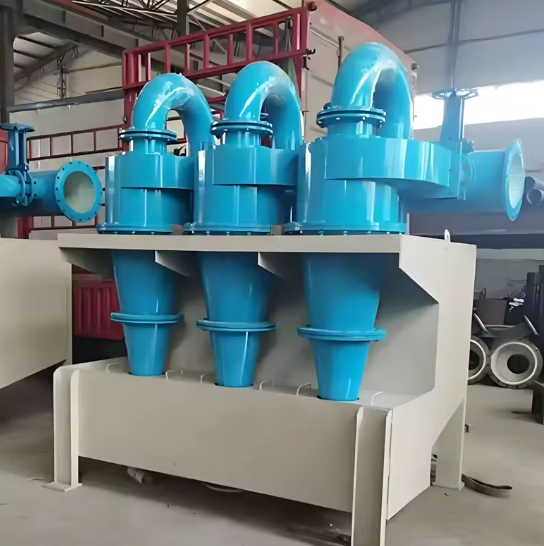
European manufacturers have long been the benchmark for hydrocyclone quality. Premium brands offer:
Single-piece conical sections with evenly distributed polyurethane wear zones
Advanced CFD-optimized geometries for maximum classification efficiency
Proprietary elastomer formulations that significantly outlast standard rubber liners
Tighter dimensional tolerances (±0.2 mm vs. ±0.5 mm for standard production)
In high-wear mining applications—particularly iron ore, copper, and gold—European liners frequently achieve 18+ months of service life under severe abrasion.
Chinese suppliers have made remarkable strides in recent years. Established manufacturers in Jiangxi and Shandong provinces have developed vertically integrated production lines, with in-house polyurethane casting capabilities that rival European formulations.
Field experience shows that top-tier Chinese liners now achieve 10–12 months in similar hard ore applications—a gap that has narrowed from "double the life" just five years ago to roughly 20–30% today.
Not all Chinese suppliers are equal. Suppliers with their own polyurethane casting lines deliver consistent quality; those that outsource liners from third-party vendors produce highly variable results. When evaluating Chinese suppliers, verifying whether they manufacture wear components in-house is as important as checking the hydrocyclone body itself.
A Polyurethane Screen Panel manufacturer with in-house casting capability can deliver consistent quality; a trading intermediary cannot.
| Supplier Type | Typical Price Range | Cost Advantage |
|---|---|---|
| Entry-level Chinese | $800–$1,200 | 65% lower than European |
| Top-tier Chinese | $1,200–$1,800 | 40–50% lower |
| European standard | $2,200–$2,800 | Premium |
| European premium | $2,800–$3,500+ | Premium |
Chinese suppliers' cost advantage stems from:
Lower labor costs
Established local raw material supply chains
Clustering of specialized suppliers in manufacturing hubs (Jiangxi, Shandong)
China's specialized industrial ecosystems enable faster lead times and greater scalability compared to European production models:
80–100% on-time delivery rates
Response times under 2 hours
Rapid scalability for large, multi-unit orders
European manufacturers typically provide:
Full lifecycle engineering services
Process flow diagrams and CFD simulations
On-site commissioning and commissioning support
Ongoing technical troubleshooting
Local service offices in key mining regions
Bonded warehouses with spare parts inventory
Replacement components arriving within 48 hours
Chinese mid-tier suppliers often offer:
Limited on-site troubleshooting beyond the sale
Most export through trading intermediaries
Spare parts shipping from China: 2 weeks to 1 month (sea freight + customs)
Variable technical support quality
The trust gap isn't about product quality—it's about "who do I call when something goes wrong, and how fast can they fix it?" For a mine losing tens of thousands of dollars per day of downtime, that wait time is unacceptable.
European manufacturers justify their premium pricing through three core differentiators:
European suppliers don't sell "standard models." They perform:
Computational Fluid Dynamics (CFD) simulations to optimize geometry
Pilot-scale testing with actual ore samples
Detailed process calculations ensuring perfect geometry matching
This "selection insurance" is invaluable for large-scale mines or first-of-a-kind process circuits—because a mis-sized hydrocyclone forces the entire grinding circuit to be retuned, and lost production is measured in days, not dollars.
European offerings include:
Vacuum-assisted systems achieving underflow densities up to 1.9 t/m³
Online monitoring options (e.g., CycloneSense for real-time performance tracking)
Single-piece polyurethane conical sections eliminating seam-related wear hotspots
Proprietary elastomer formulations with proven wear life advantages
European manufacturers view themselves as process partners, not just equipment suppliers:
Ongoing operational recommendations
Wear life forecasting
Performance benchmarking
Continuous process optimization support
For large-scale, high-complexity projects where separation performance directly impacts downstream recovery rates, this premium engineering support often pays for itself many times over.
| Condition | Why Chinese Suppliers Excel |
|---|---|
| Small to medium-sized projects | Capital cost savings of 30–40% |
| Mature, well-understood process applications | Circuit design is already proven |
| Low to moderate abrasion | Standard liners are sufficient |
| Experienced on-site operating teams | No need for manufacturer hand-holding |
| Fast-track projects | Faster lead times, rapid scalability |
| Budget constraints | Lower initial investment |
In these scenarios, Chinese hydrocyclones at 60–70% of European prices deliver performance differences of less than 5% in actual operation—representing a clear value win.
| Condition | Why European Suppliers Excel |
|---|---|
| Large-scale greenfield mining projects | Engineering validation reduces production risk |
| High-wear applications (magnetite, copper porphyry) | 18+ months wear life vs. 10–12 months |
| First-of-a-kind process circuits | CFD optimization and pilot testing are critical |
| Limited local technical expertise | Reliance on supplier for ongoing process support |
| High downtime cost | Local spare parts availability justifies premium |
Consider this scenario:
Hydrocyclone spigot failure causes downtime
Mine production value: $50,000/hour
Spigot change time: 20 minutes ($16,667 value)
Spare part shipping from China: 2–4 weeks
Lost production cost during wait: up to $33.6 million
In such cases, the European premium is not an expense—it's insurance.
Field experience across multiple African and Southeast Asian projects has validated a pragmatic hybrid strategy:
Phase 1: European Pilot
Procure a European hydrocyclone for the initial pilot or first production train
Validate the process design
Confirm separation performance
Establish operational baselines
Phase 2: Chinese Scale Production
Source hydrocyclone bodies from an established Chinese manufacturer with verified in-house polyurethane casting
Confirm dimensional tolerances of ±0.3 mm
Scale production for plant expansion
Result: Operational performance difference is typically under 5%, while capital investment is reduced by over 30%.
This approach gives you the engineering confidence of the European pilot while capturing the cost efficiency of Chinese scale production for the full plant.
One often-overlooked aspect of value is wear part replacement speed. The hydrocyclone's consumable components—apex (spigot), vortex finder, and feed head liners—wear out far more frequently than the body itself.
| Supply Model | Replacement Speed | Risk |
|---|---|---|
| Chinese supplier with in-house casting | Days | Low |
| Chinese trading intermediary | Weeks (outsourced) | High |
| European direct manufacturer | Days (global inventory) | Low |
When evaluating Chinese suppliers, always verify: "Do you manufacture your own polyurethane wear parts, or do you outsource them?"
A supplier that casts its own liners is a supplier that can keep your plant running. A trading intermediary may offer lower initial prices but cannot guarantee parts availability when you need them most.
A Rubber Screen Panel supplier with in-house manufacturing capability is preferable to a trading intermediary selling multiple brands.
At HUATAO Group, we occupy a unique position in the global hydrocyclone value chain. While we do not manufacture complete hydrocyclone bodies, we specialize in the critical wear components that determine your equipment's operational life and total cost of ownership:
| Product | Benefit | Wear Life Advantage |
|---|---|---|
| Polyurethane hydrocyclone liners | Custom-formulated for your specific ore type | Up to 4× steel |
| Rubber screen panels | Heavy-duty screening applications | 5–10× steel |
| Tufflex flip-flop screens | Eliminate blinding | 30% efficiency boost |
| Custom spigots, vortex finders, feed head liners | Precision-machined to ±0.3 mm tolerances | OEM-compatible |
1. In-House Material Science
We operate our own polyurethane and rubber casting lines, giving us full control over formulation, curing, and quality consistency. This is the same capability that separates top-tier Chinese suppliers from trading intermediaries.
2. Proven Field Performance
Independent field trials show HUATAO wear parts deliver:
Up to 8x longer service life than conventional steel screens
40% reduction in annual screening maintenance costs
Hydrocyclone liners engineered to close the durability gap with European premium brands—at Chinese cost levels
3. Rapid Global Supply
With our vertically integrated manufacturing in China, we offer the fast lead times and scalability that make Chinese sourcing attractive, while maintaining the quality consistency that earns repeat business from mines across North America, Africa, and Southeast Asia.
4. Technical Partnership
We don't just sell parts—we provide:
Wear life forecasting
Material selection recommendations
On-site troubleshooting support through our international service network
We understand that a hydrocyclone's performance depends not just on the body, but on every wear component inside it.
Step 1: Define Your Project Parameters
Project scale (number of units, throughput)
Budget constraints
Timeline requirements
Ore type and abrasiveness
Step 2: Evaluate Your Technical Requirements
Required separation efficiency
Underflow density target
Feed concentration and variability
Particle size distribution
Step 3: Assess Your Support Needs
Do you have experienced operators on site?
Can you handle routine adjustments and wear-part replacements independently?
Do you need the supplier for ongoing process optimization?
Step 4: Verify Supplier Capabilities
In-house manufacturing: Does the supplier cast its own polyurethane/rubber parts?
Quality control: What are their dimensional tolerances and inspection standards?
Engineering support: Can they provide CFD simulations or process calculations?
Spare parts availability: How quickly can they deliver replacement components?
Step 5: Consider the Hybrid Strategy
European pilot + Chinese scale production
Or: European body + HUATAO wear parts
Does the supplier manufacture wear components in-house?
Can the supplier provide material test reports?
Does the supplier support OEM replacement compatibility?
Does the supplier have export experience to your region?
Can the supplier provide wear-life recommendations?
What is the typical lead time for wear parts?
What is the MOQ?
What inspection standards are followed?
Equipment Specifications: Model, make, and serial number of your hydrocyclone
Drawings: Original OEM drawing or dimensions
Operating Conditions: Feed rate, solids concentration, particle size distribution, temperature, pH
OEM Part Numbers: Provide if seeking direct replacement
Wear Part Type: Specify if you need spigots, vortex finders, feed head liners, or full liner sets
"Can you produce parts that match the OEM geometry exactly?"
"What polyurethane or rubber compounds do you recommend for my ore type?"
"Can you provide a wear-life guarantee or field reference?"
"Do you manufacture your own polyurethane liners, or do you outsource them?"
"What is your maximum manufacturing size capability?"
"How quickly can you ship replacement parts to my location?"
"What is your MOQ and lead time?"
| Problem | Possible Cause | Recommended Solution |
|---|---|---|
| Spigot excessive wear | Abrasive ore or incorrect compound | Switch to polyurethane; use harder compound |
| Vortex finder cracking | Impact damage or improper material | Use higher-strength compound; inspect installation |
| Feed head liner premature failure | Incorrect liner selection | Match liner compound to ore type |
| Inconsistent underflow density | Spigot wear or feed pressure variation | Replace spigot; check feed pump impeller |
| Coarse particles in overflow | Spigot worn or feed pressure low | Replace spigot; increase pump speed |
| Polyurethane liner swelling | Chemical incompatibility | Switch to chemical-resistant compound |
| Liner seam failure | Inconsistent casting quality | Choose supplier with in-house quality control |
| Frequency | Task |
|---|---|
| Daily | Inspect spigot for wear; observe underflow spray pattern; check feed pressure |
| Weekly | Inspect vortex finder and feed head for wear; check all connections for leaks |
| Monthly | Measure liner thickness; check for cracks in cyclone body; review performance data |
| Quarterly | Comprehensive inspection of all wear parts; plan replacement schedule |
Spigots: 2–3 sizes in stock
Vortex finders: 2 sizes in stock
Feed head liners: 2 in stock
Full set of liners: 1–2 complete sets
Customer Type: Copper concentrator (Zambia)
Ore Type: Porphyry copper, high abrasion
Operating Conditions: 2,500 tph feed, 35% solids, high wear
Problem: Initial European-sourced hydrocyclones performed well but were expensive to scale. The mine needed 8 additional hydrocyclones for plant expansion but faced capital constraints.
Solution:
Phase 1: Retained European hydrocyclone for existing circuit
Phase 2: Sourced 8 hydrocyclone bodies from established Chinese manufacturer with in-house polyurethane casting
Phase 3: Standardized wear parts (spigots, vortex finders, liners) from HUATAO Group for both European and Chinese units
Result:
Capital cost savings: 35% on the 8-unit expansion ($1.2 million saved)
Wear part standardization: One supplier (HUATAO) for all liners—reducing spare parts inventory complexity
Performance: Operational difference between European and Chinese units under 5%
Wear part availability: 48-hour emergency shipment for critical spigots
ROI: Payback period on the hybrid strategy—8 months
Answer: It depends on your project. Chinese suppliers offer 30–40% lower initial cost and faster lead times, making them better for mature, low-to-moderate wear applications. European manufacturers offer 18+ months wear life, full engineering support, and local spare parts, making them better for high-risk, high-wear, complex projects. The best value often comes from a hybrid strategy—European pilot + Chinese scale production.
Answer: In hard ore applications, European liners typically achieve 18+ months of service life, while top-tier Chinese liners achieve 10–12 months. The gap has narrowed from "double the life" just five years ago to roughly 20–30% today.
Answer: Chinese suppliers benefit from lower labor costs, established local raw material supply chains, and clustering of specialized suppliers in manufacturing hubs (Jiangxi, Shandong). Entry-level Chinese units can be 60–70% less expensive than European premium units.
Answer: After-sales support and spare parts availability. Many Chinese mid-tier suppliers export through trading intermediaries, meaning spare parts must ship from China—sea freight plus customs clearance can take 2 weeks to a month. For a mine losing tens of thousands per day of downtime, this wait time is unacceptable.
Answer: Always verify: (1) Do they manufacture their own polyurethane wear parts in-house? (2) Can they provide material test reports? (3) What are their dimensional tolerances? (4) Do they have references from mines similar to yours? (5) What is their lead time for replacement parts?
Answer: Phase 1: Procure a European hydrocyclone for the initial pilot or first production train to validate process design. Phase 2: Source hydrocyclone bodies from an established Chinese manufacturer for plant expansions. The operational performance difference is typically under 5%, while capital investment is reduced by over 30%.
Answer: The hydrocyclone's consumable components—spigot, vortex finder, feed head liners—wear out far more frequently than the body itself. A spigot change takes 20 minutes—but waiting weeks for a replacement costs thousands in downtime. Suppliers with in-house casting lines can deliver replacement parts in days; intermediaries may take weeks.
Answer: HUATAO specializes in critical wear components: polyurethane hydrocyclone liners, rubber screen panels, Tufflex flip-flop screens, and custom spigots, vortex finders, and feed head liners. We combine Chinese cost efficiency with quality that rivals premium brands, with in-house material science and proven field performance.
Answer: Yes. HUATAO engineers custom liners, spigots, and vortex finders to match OEM specifications for any hydrocyclone brand—European or Chinese. We operate our own polyurethane and rubber casting lines, ensuring consistent quality and fast delivery.
Answer: Contact us with your hydrocyclone specifications (model, make, dimensions) and operating conditions (ore type, feed rate, particle size). We'll provide material recommendations, wear-life forecasts, and a quotation within 48 hours.
The choice between Chinese and European hydrocyclone suppliers is not a simple "better vs. worse" decision. Both regions offer compelling value propositions—but for different applications and different project profiles.
European manufacturers deliver premium quality, proven wear life, and comprehensive engineering support. They are the right choice for large-scale, high-risk, high-wear applications where production downtime costs far exceed the equipment price differential.
Top-tier Chinese suppliers offer exceptional value for mature applications, moderate-budget projects, and situations where experienced operators can handle routine maintenance independently. The performance gap has narrowed significantly, and for many applications, the cost savings outweigh the wear life difference.
The smartest strategy is often hybrid: European pilot validation followed by Chinese scale production, or sourcing complete hydrocyclones from one region and wear parts from a specialist like HUATAO.
At HUATAO Group, we combine the cost efficiency of Chinese manufacturing with the quality standards that mines worldwide demand. Our polyurethane hydrocyclone liners, rubber screen panels, and custom wear parts are engineered to deliver longer service life, reduced downtime, and lower total cost of ownership.
Hydrocyclone Selection For Mineral Processing Full Engineering Guide
How Do I Calculate Hydrocyclone Capacity For Mineral Processing
Why More Mining Plants Are Switching To Polyurethane Hydrocyclone Parts
Where Can I Find Reliable Hydrocyclone Suppliers In China For Mining And Mineral Processing
Where Can I Find Reliable Mining Wear Parts Suppliers In China
Best Crusher Wear Parts Suppliers For Mining Companies Engineering Guide Procurement Checklist
Best Alternative To Metso Crusher Wear Parts Complete Engineering And Procurement Guide
Polyurethane Screen Panels Vs Rubber Screen Panels Which Is Better
Which Crusher Wear Parts Supplier Exports To Australia And Canada Complete Buyers Guide
We warmly welcome customers from around the world to contact us and establish mutually beneficial partnerships.
Contact: Annie Lu
Email: annie.lu@huataogroup.com
Phone / WhatsApp: +86 180 3242 2676
Website: http://www.tufflexscreen.com
HUATAO Group – Your Trusted Partner for High-Performance Screening and Wear Solutions.
can not be empty
can not be empty

HUATAO GROUP - SCREENS
ADD : No.298 Zhonghua North Street, Shijiazhuang 050000 China.
TEL : +86 0311 80690567
EMAIL :market@huataogroup.com
Web: www.tufflexscreen.com
 WhatsApp & WeChat : +86 18033763037