What Are the Main Functions of a Rubber Drainage Belt in Vacuum Filtration?
-
 admin
- 05 Nov, 2026
What Are the Main Functions of a Rubber Drainage Belt in Vacuum Filtration?
Quick Answer
A rubber drainage belt is the moving foundation of a horizontal vacuum belt filter. It supports the filter cloth, carries slurry from feed to discharge, drains filtrate through grooves into the vacuum box, seals the vacuum system, and delivers the dry cake. Belt design and condition directly control cake moisture, vacuum efficiency and cloth life.
What Is a Rubber Drainage Belt?
It’s the reinforced rubber belt that runs over the vacuum deck of a horizontal belt filter and carries everything else on its back. Cloth, slurry, cake — all of it travels on a grooved rubber surface that must stay flat under vacuum, seal against the vacuum boxes below, and flex around rollers thousands of times per shift. Neither a plain conveyor belt nor a filter cloth can do that job.
Key Takeaways
✔ The belt combines five functions: carrying, cloth support, filtrate drainage, vacuum sealing and cake transport.
✔ Groove pitch, groove depth and hole-to-slot alignment decide drainage efficiency more than any other dimensions.
✔ The belt underside is the vacuum seal; keeping it clean and flat protects performance.
✔ Compound choice must match slurry abrasiveness, filtrate chemistry and temperature.
✔ Most failures announce themselves early through cake moisture drift and vacuum fluctuation.
Summary Table
| Item | Description |
| Function | Supports cloth, drains filtrate, seals vacuum box, carries cake |
| Material | NR or NR/SBR blend, 60-70 Shore A typical, special compounds for duty |
| Application | Horizontal vacuum belt filters in mining, coal washing, chemical dewatering |
| Service Life | Duty dependent; verify by monthly cover thickness measurement |
| Benefits | Stable cake moisture, longer cloth life, sealed vacuum, predictable wear |
Definition
A rubber drainage belt is a structural component of horizontal vacuum belt filters. Its top surface carries the filter cloth and slurry; its grooved surface collects filtrate; its underside slides against vacuum box wear decks to seal the system. Reinforced with fabric layers, the belt holds flatness under 0.04-0.06 MPa vacuum while flexing around head and tail rollers. In process terms, it sits inside the filtration stage of a mineral plant, receiving feed prepared by the dewatering process upstream. The complete machine context — feed boxes, vacuum boxes, cloth washing and discharge — is described on the vacuum belt filter equipment page.

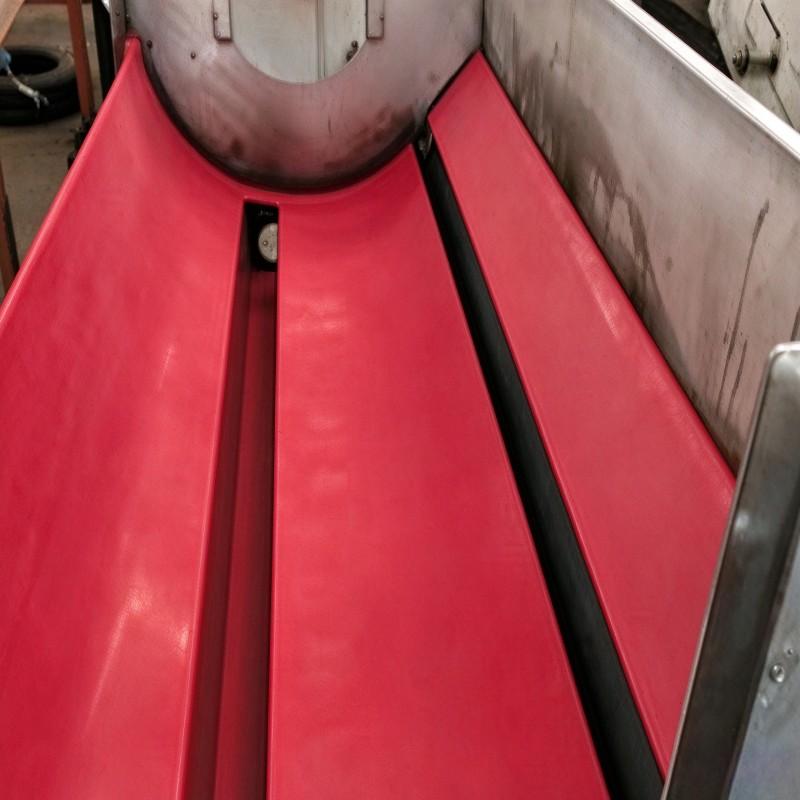
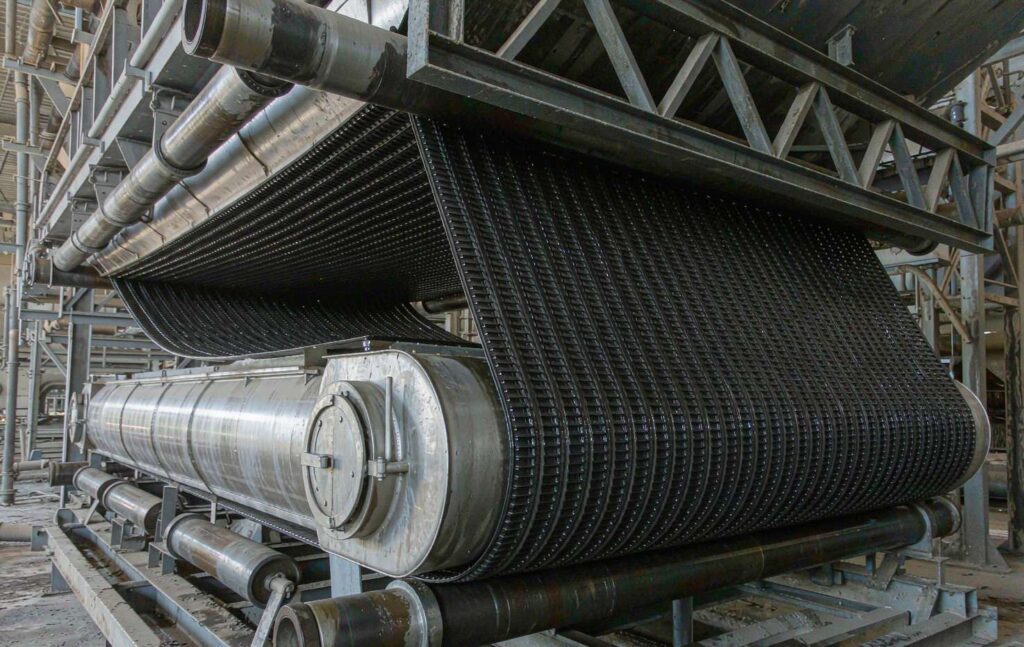
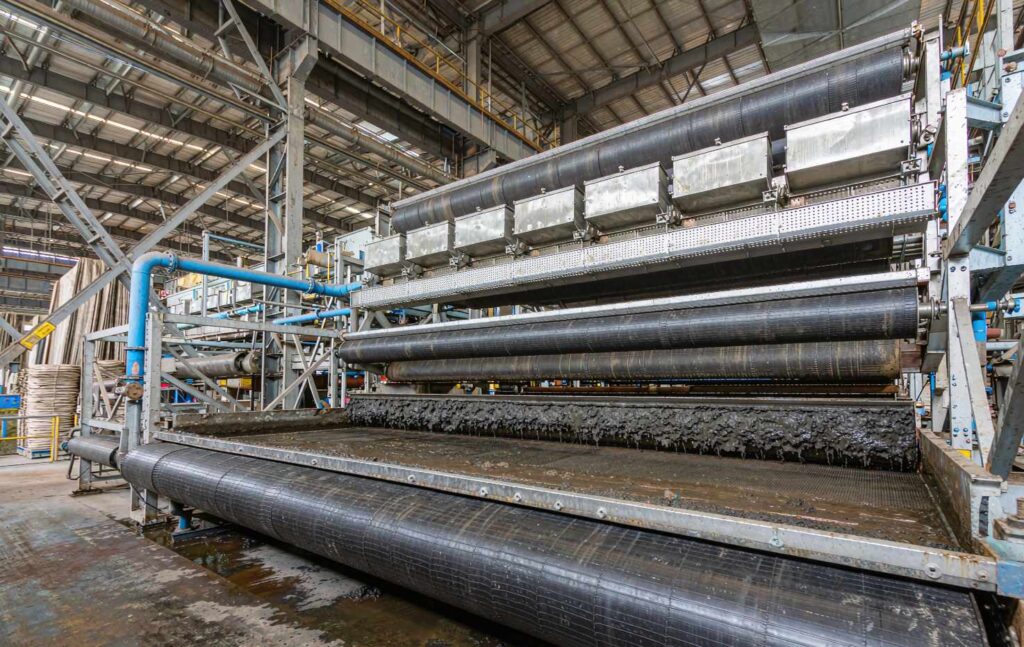
The belt runs the full length of the filter, carrying cloth and slurry over the vacuum deck.
Working Principle
Slurry is distributed across the belt at the feed end. As the belt travels, vacuum under the deck draws liquid through the cloth, leaving solids as a cake. Filtrate enters the transverse grooves, runs to the nearest hole, and drops into the vacuum box below. The belt passes through cake formation, washing and drying zones, then rounds the discharge roller where the cloth peels away and the cake drops.
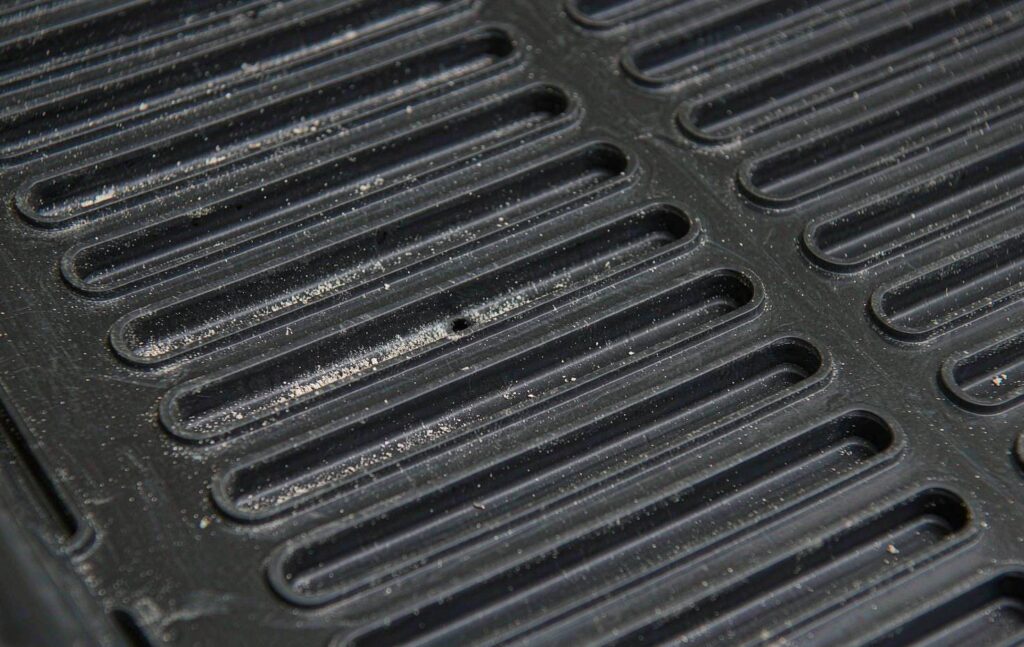
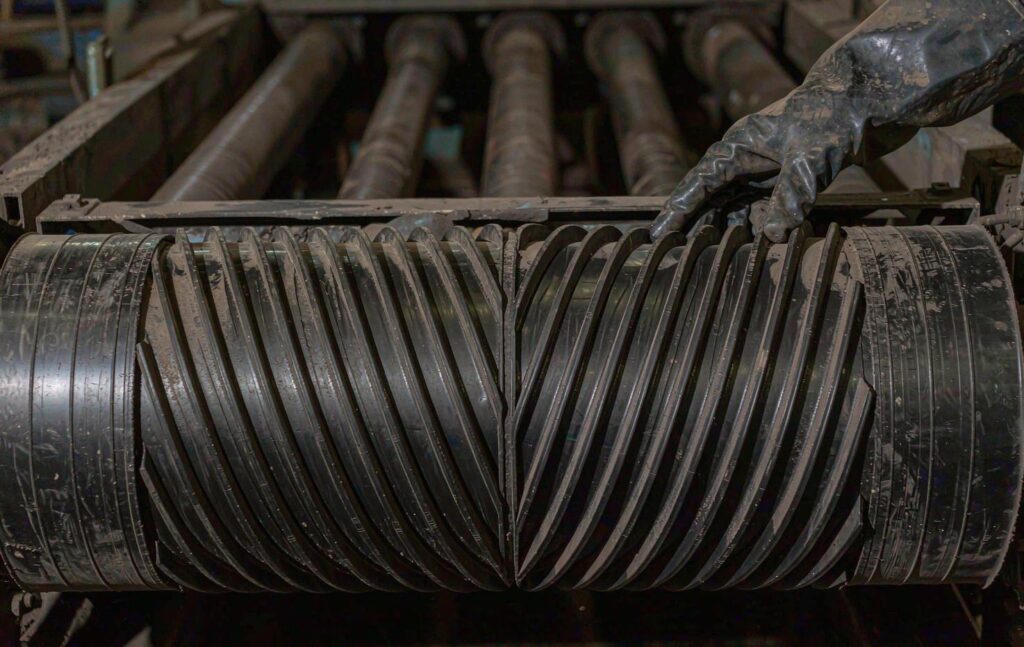
Grooves are where the physics happens. Vacuum doesn’t pull water through the belt; it pulls water into the grooves, along the grooves, and down through the holes. If grooves are too shallow, they fill with fine solids and the vacuum stalls. If they’re too far apart, the cloth bridges the gaps and the cake drains unevenly, leaving wet stripes across the width.
Upstream feed matters as much as belt design. Thickener underflow density, or feed prepared by dewatering hydrocyclones, sets whether the grooves run flooded or starved. The belt operates inside that balance; it can’t correct it.
One detail separates good installations from mediocre ones: hole alignment. When groove holes line up with vacuum box slots, filtrate leaves immediately and vacuum does useful work. When alignment drifts after a belt change, filtration slows without any obvious fault. Check alignment after every belt replacement, not just the first time.
Benefits
Stable cake moisture comes first, because even grooves drain evenly and a sound seal keeps vacuum where it belongs. Cloth life improves next, since the belt takes the abrasion, impact and flexing that would otherwise destroy expensive media. Vacuum efficiency stays high because the sealing interface doesn’t leak air into the system. And maintenance becomes predictable: cover thickness loss is measurable, so replacement can be scheduled instead of emergency.
There’s a diagnostic benefit too. The cake reads like a gauge. Wet stripes point to blocked grooves or banded cloth blinding. Wet edges point to dam or seal trouble. A uniform moisture rise with clean grooves points upstream to feed density. Technicians who learn to read the cake diagnose in minutes what takes others days.
Applications
Horizontal belt filters with rubber drainage belts serve iron ore concentrate, copper concentrate, phosphate, coal fines, fluorite, gold tailings retreatment and chemical slurries such as FGD gypsum. The common thread: continuous, high-tonnage dewatering of abrasive or fine wet solids where the cake must leave dry enough to handle.
Where the outputs go matters as well. Cake moves to storage or transport; filtrate and wash water return to the plant or route to tailings management facilities, increasingly through tailings dry discharge systems where water recovery and stackable tailings are priorities. Belt filter performance therefore affects the whole water balance of a site, not just one machine’s output.
Material Comparison
| Property | Natural Rubber (NR) | NR/SBR Blend | Special Compounds |
| Abrasion resistance | Good | Better | Best, by formulation |
| Chemical resistance | Limited | Limited | Matched to filtrate |
| Temperature limit | Moderate | Moderate | Higher, by compound |
| Sealing conformity | Excellent | Good | Varies by design |
| Typical duty | General mineral | Abrasive ore | Hot, acidic or oily service |
For abrasive ores, a harder blend trades a little sealing conformity for much longer cover life. For acid or hot filtrate, natural rubber swells and fails fast — a specification conversation, not a price one. The rubber belt selection guide works through this matching process in detail.
Filter media around the belt follows the same logic. Cloth selection depends on particle size and filtrate clarity targets, and pairs like filter cloth and filter plates for presses or ceramic filter sectors for disc filters each suit different duties. A belt filter wins on throughput; a ceramic disc filter wins on very fine solids with lower vacuum cost; filter presses win on minimum cake moisture in batch operation; ceramic filter plates reduce vacuum demand by capillary action. Choose by duty, not by habit.
Application Comparison
| Duty | Best Fit | Why |
| High tonnage, fast-settling solids | Belt filter with drainage belt | Continuous operation, simple cake handling |
| Very fine slurry, low moisture need | Ceramic disc filter | Lower vacuum cost, clear filtrate |
| Minimum cake moisture, batch OK | Filter press | Highest dewatering pressure |
| Sticky, blinding feed | Belt filter with good washing | Open cloth washing access |
Industry Application Matrix
| Industry | Typical Slurry | Belt Priority |
| Iron ore | Abrasive concentrate | Wear-resistant compound, deep grooves |
| Coal | Fine washery rejects | Fine pitch grooves, effective cleaning |
| Copper | Abrasive, sometimes acid | Matched compound, strong carcass |
| Phosphate | Sticky, fine feed | Anti-blinding cloth pairing, groove flushing |
| FGD gypsum | Fine, mildly aggressive | Chemical-resistant compound |
Selection Guide
Start from the slurry. Particle size distribution sets groove pitch; solids density sets groove depth; filtrate chemistry and temperature set compound; the vacuum box geometry sets hole pattern. Then verify the mechanical envelope: belt width, length, thickness tolerances, carcass construction and edge dam type. Finally, ask for dimensional inspection on the first article and keep the approved drawing on file, because a replacement ordered years later should match the belt that worked, not a guess from a catalogue.
Procurement Guide
Bring suppliers real data: filter make and model, belt drawing or an old belt sample, groove and hole dimensions, edge dam type, operating temperature, filtrate chemistry, vacuum level, and feed tonnage and size distribution. Then ask five questions. Can you manufacture from drawings? Can you provide material reports? Can you support OEM replacement? Do you have export experience with packaging and shipping? What wear-life do you expect on this duty, and how should we measure it?
A supplier who answers those five with specifics earns a shortlist slot. One who dodges them is selling a shape, not a component. Price matters, of course it does, but a belt that fails six months early costs more than the discount saved, once you count downtime and cloth damage.
Failure Analysis

Cracking starts small, at groove roots, where flex fatigue concentrates.
| Problem | Possible Cause | Recommended Solution |
| Groove rib cracking | Flex fatigue, small rollers, sharp edges | Larger roller radius, rounded groove edges |
| Cover wear at vacuum box | Grit, rough deck, high load | Clean deck, low-friction wear strips |
| Edge tearing | Tracking drift, catching structure | Center the belt, inspect return run |
| Swelling or softening | Compound mismatch | Match compound to filtrate and temperature |
| Hole blockage | Crystallizing salts, fines carryback | Flush grooves, verify cloth permeability |
| Belt-cloth slippage | Glazed surface, low tension | Re-dress cover, check tension |
Almost none of these arrive unannounced. Wet cake precedes groove failure. Vacuum fluctuation precedes seal wear. Cloth edge damage precedes tracking problems. Inspection on a schedule converts failures into maintenance items.
Maintenance Guide
Daily, track cake appearance and vacuum readings against feed conditions. Weekly, walk the return run, check tracking and listen for seized rollers. Monthly, measure cover thickness at high-wear points, inspect groove edges under raking light, and verify hole alignment after any adjustment. Keep a spare belt matched to the approved drawing in inventory. Flush grooves regularly on fine-slurry duty before they blind. None of this is complicated; all of it is skipped by plants that later pay for shutdowns.
Case Study
Customer Type: iron ore concentrator operating horizontal belt filters continuously.
Ore Type: abrasive hematite concentrate.
Operating Conditions: high tonnage, 0.05 MPa vacuum, ambient temperature, mildly abrasive filtrate.
Problem: cake moisture creeping up over months, vacuum readings fluctuating, cloth replacement intervals shortening.
Solution: inspection found worn groove edges and a roughened wear deck. The plant fitted a harder abrasive-duty compound belt, re-machined the wear deck, and started a monthly cover-thickness measurement routine.
Result: cake moisture returned to target and held, vacuum readings stabilized, and cloth life extended because the fresh belt surface spread wear evenly across the media.
FAQ
What is the difference between a drainage belt and a filter cloth?
The cloth does fine filtration; the belt does everything structural. The rubber drainage belt supports the cloth, collects filtrate in its grooves, seals the vacuum box and carries the cake. They fail differently and get replaced on different schedules, so never spec them as one item.
How does groove design affect filter cake moisture?
Grooves are the exit path for filtrate. Undersized or blocked grooves choke the flow, vacuum stalls, and cake leaves wet even when the pump reads fine. Match groove pitch and depth to your slurry size distribution, keep grooves clean, and verify hole alignment after every belt change.
Can a drainage belt be made from drawings or an old sample?
Yes, and it’s the normal route. Supply the filter model, dimensions, groove drawing and hole pattern, or ship the used belt itself. Manufacturers working from drawings reproduce OEM geometry and adjust compound and hardness. Ask for dimensional inspection reports on the first article before approving production.
How long should a rubber drainage belt last in mining service?
There’s no honest single number. Life depends on slurry abrasiveness, filtrate chemistry, temperature, vacuum load and maintenance quality. Judge candidates by measured cover thickness loss per month on your own machine, not by catalogue claims or a salesman’s assurance.
What information do I need to order a replacement belt?
Filter make and model, belt dimensions and tolerances, groove and hole drawings, edge dam type, operating temperature and filtrate chemistry, vacuum level, and feed tonnage and size distribution. With those details a manufacturer can quote compound, price and lead time accurately.
Why does my cake show wet stripes across the width?
Striped cake usually means uneven drainage. Blocked grooves are the most common cause, followed by banded cloth blinding and groove wear that varies across the width. Inspect grooves under raking light and check the cloth; the cake pattern usually matches the belt pattern.
Do edge dams matter on a drainage belt?
Yes. Edge dams hold the slurry pool across the full width and stop filtrate escaping at the edges. Worn dams let slurry spill, wasting feed and wetting the sealing area, which shows up as wet cake edges. Inspect dam condition whenever you inspect grooves.
Can I run a thicker belt to get longer life?
Thicker isn’t automatically better. Extra cover adds wear volume but can stiffen the belt, changing how it conforms to the vacuum box seal and how it flexes around rollers. Discuss thickness against your actual vacuum geometry rather than assuming more rubber means more life.
How often should the vacuum box sealing area be checked?
At least monthly, and immediately after any moisture or vacuum anomaly. Grit in the sealing interface grinds both the belt and the wear deck, and every bit of leakage is vacuum you pay for but never use. Clean decks and sound wear strips protect both components.
Conclusion
A rubber drainage belt holds a demanding position in vacuum filtration: carrying surface, drainage manifold, vacuum seal and cake conveyor, all in one part. Specify it against your actual slurry and vacuum geometry, keep it clean and tracked, and inspect groove edges the way you’d inspect mill liner bolts. Plants that do this hold their cake moisture target for years; plants that don’t buy vacuum upgrades and wonder why nothing improves.
Related Articles
Related Products
Related Technical Guides
Related Buyer Guides
Related Comparison Articles
Contact
Contact: Annie Lu
Email: annie.lu@huataogroup.com
WhatsApp / WeChat: +86 18032422676
Website: www.tufflexscreen.com
admin
personal profile