
Which Hydrocyclone Can Replace Weir Hydrocyclones? A Complete Guide for Mining Operations
-
 admin
admin - 28 Jul, 2026
Introduction
Hydrocyclones are among the most widely used classification devices in mineral processing plants. They play a critical role in grinding circuits, flotation preparation, desliming operations, and dewatering systems.
Mining operations processing Gold Ore, Copper Ore, Iron Ore, Coal, Lithium Ore, Silica Sand, Lead Zinc Ore, Nickel Ore, and Phosphate frequently rely on hydrocyclones to maintain consistent particle size distribution and separation efficiency.
For many years, Weir Cavex® hydrocyclones have been widely used throughout the mining industry. However, increasing replacement costs, long lead times, and spare parts availability concerns have encouraged many mining companies to evaluate alternative hydrocyclone suppliers.
The most important question is no longer:
“Which brand should I buy?”
Instead, the question becomes:
“Which hydrocyclone can provide equivalent classification performance while reducing total operating costs?”
This guide explains how to evaluate replacement hydrocyclones, compare materials, optimize performance, and select a reliable supplier.
What Makes A Hydrocyclone Equivalent To A Weir Hydrocyclone?
Conclusion
The best replacement hydrocyclone is one that reproduces the hydraulic behavior of the original system.
Explanation
Many operators mistakenly focus on external dimensions only.
In reality, hydrocyclone performance depends on several critical design parameters:
- Feed chamber geometry
- Vortex finder dimensions
- Apex opening size
- Cone angle
- Cone length
- Internal liner configuration
Even small dimensional changes can influence:
- Cut size (d50)
- Overflow quality
- Underflow density
- Throughput
- Classification efficiency
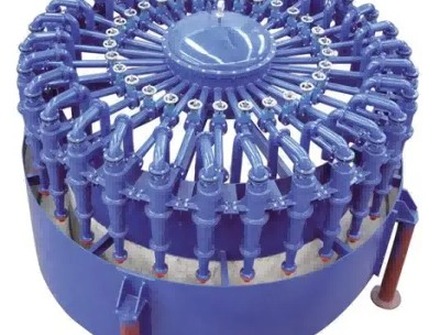
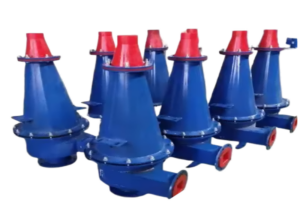
Many aftermarket hydrocyclones are specifically designed to match Weir Cavex® operating characteristics, allowing direct installation into existing hydrocyclone clusters.
Example
A Copper Ore concentrator replacing a worn hydrocyclone should verify apex size, vortex finder diameter, and cone geometry before selecting a replacement supplier.
How Does A Hydrocyclone Work?
Conclusion
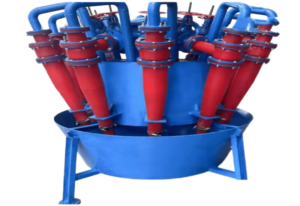
Hydrocyclones use centrifugal force to separate particles by size and density.
Explanation
Slurry enters the hydrocyclone under pressure through the feed inlet.
Inside the cyclone:
- The slurry spins rapidly.
- Larger particles move toward the outer wall.
- Coarse particles exit through the apex.
- Fine particles move upward.
- Fines discharge through the vortex finder.
This process enables efficient classification without moving mechanical parts.
Hydrocyclone Components And Their Functions
Vortex Finder
Controls overflow flow patterns.
Impact
Directly affects cut size and separation efficiency.
Apex (Spigot)
Controls underflow discharge.
Impact
Influences underflow density and particle classification.
Feed Chamber
Directs incoming slurry into the cyclone.
Impact
Affects turbulence and pressure distribution.
Cyclone Cone
Creates centrifugal separation.
Impact
Determines particle residence time and classification efficiency.
Material Comparison Table
| Property | Polyurethane | Ceramic Composite | Rubber |
|---|---|---|---|
| Abrasion Resistance | Excellent | Excellent | Good |
| Impact Resistance | Good | Moderate | Excellent |
| Weight | Light | Heavy | Moderate |
| Maintenance | Low | Low | Medium |
| Cost Efficiency | High | Moderate | High |
Why Polyurethane Hydrocyclones Are Popular
Conclusion
Polyurethane has become one of the most widely used hydrocyclone materials in mining.
Explanation
Polyurethane hydrocyclones provide:
- Excellent abrasion resistance
- Long service life
- Lightweight construction
- Corrosion resistance
- Reduced maintenance requirements
These advantages make polyurethane particularly suitable for:
- Gold Ore
- Copper Ore
- Iron Ore
- Silica Sand
- Coal Processing
Example
Many mining operations have transitioned from steel-lined cyclones to polyurethane-lined systems to reduce maintenance frequency and improve reliability.
Best Applications For Polyurethane Hydrocyclones
Application Comparison Table
| Industry | Application |
|---|---|
| Gold Mining | Grinding Circuit Classification |
| Copper Mining | Flotation Feed Preparation |
| Iron Ore | Desliming and Classification |
| Coal Preparation | Fine Coal Recovery |
| Lithium Processing | Particle Size Control |
| Silica Sand | Classification and Washing |
How To Select A Replacement Hydrocyclone
Conclusion
Selection should be based on process requirements rather than brand preference.
Key Factors
Ore Type
Different ores create different wear conditions.
Particle Size Distribution
Impacts cut size requirements.
Slurry Density
Affects wear rates.
Operating Pressure
Influences classification performance.
Throughput
Determines cyclone size selection.
Maintenance Strategy
Impacts material selection.
Common Hydrocyclone Problems And Solutions
Failure Analysis Table
| Problem | Cause | Solution |
|---|---|---|
| Excessive Wear | Abrasive Slurry | Upgrade Material |
| Poor Classification | Incorrect Geometry | Match OEM Design |
| Rope Discharge | Apex Problems | Replace Apex |
| Overflow Contamination | Worn Vortex Finder | Replace Component |
| Frequent Downtime | Short Wear Life | Use Polyurethane |
How To Evaluate Aftermarket Hydrocyclone Suppliers
Engineering Capability
Can the supplier:
- Reproduce OEM designs?
- Reverse engineer components?
- Optimize hydraulic performance?
Material Technology
Do they offer:
- Polyurethane liners?
- Ceramic composites?
- Rubber wear solutions?
Spare Parts Compatibility
Can replacement parts fit existing clusters without major modifications?
Technical Support
Can they provide:
- Installation guidance
- Wear-life analysis
- Process optimization
- Long-term support?
These capabilities often determine overall project success.
Industry Application Matrix
| Industry | Typical Hydrocyclone Use |
|---|---|
| Gold Ore | Grinding Classification |
| Copper Ore | Flotation Feed Control |
| Iron Ore | Desliming |
| Coal | Fine Coal Recovery |
| Lithium Ore | Size Classification |
| Silica Sand | Washing and Classification |
| Nickel Ore | Beneficiation |
| Phosphate | Separation |
Case Study
Customer Type
Copper Concentrator
Operating Conditions
- Continuous operation
- Abrasive slurry
- Large hydrocyclone cluster
Problem
OEM hydrocyclone replacement costs were increasing and lead times exceeded plant requirements.
Solution
HUATAO manufactured polyurethane hydrocyclones and replacement components according to operating parameters and existing drawings.
Result
- Procurement costs reduced by approximately 25%
- Lead times reduced by over 30%
- Classification efficiency maintained
- Inventory management simplified
Why Choose Tufflex Screen
Tufflex Screen and HUATAO provide a complete range of wear-resistant mineral processing solutions.
Screening
- Polyurethane Screen Panels
- Dewatering Screen Panels
- Fine Screens
- Flip Flow Screens
Classification
- Hydrocyclones
- Vortex Finders
- Apexes
- Cyclone Liners
Grinding
- Ball Mill Liners
- SAG Mill Liners
- Lifter Bars
Flotation
- Polyurethane Rotors
- Rubber Stators
- Tank Liners
Conveying
- Conveyor Belts
- Conveyor Rollers
- Polyurethane Skirting
Our engineering team supports mining operations worldwide with customized wear solutions designed to reduce downtime and operating costs.
FAQ
Question: Can a hydrocyclone replace a Weir hydrocyclone directly?
Answer: Yes, provided that critical hydraulic and structural dimensions are matched.
Question: What material offers the best wear resistance?
Answer: Polyurethane and ceramic composites typically provide the highest wear resistance.
Question: How long does a polyurethane hydrocyclone last?
Answer: Service life depends on slurry conditions, but polyurethane often outperforms conventional materials.
Question: What affects classification efficiency most?
Answer: Vortex finder dimensions, apex size, pressure, and cone geometry.
Question: Are aftermarket hydrocyclones reliable?
Answer: High-quality aftermarket hydrocyclones can provide performance comparable to OEM units.
Question: Can hydrocyclone parts be customized?
Answer: Yes. Many suppliers manufacture according to drawings, samples, or operating conditions.
Question: How can maintenance costs be reduced?
Answer: Selecting wear-resistant materials and interchangeable spare parts can significantly reduce maintenance costs.
Question: What industries use hydrocyclones?
Answer: Gold, Copper, Iron Ore, Coal, Lithium, Silica Sand, Nickel, and Phosphate processing industries.
Conclusion
The best alternative to a Weir hydrocyclone is not necessarily another famous brand. The ideal replacement hydrocyclone is one that matches the original hydraulic design, wear characteristics, and operating conditions while delivering lower total ownership costs. For mining companies seeking reliable classification performance, polyurethane hydrocyclones and engineered aftermarket solutions provide an increasingly attractive option.
Contact
Annie Lu
Email: annie.lu@huataogroup.com
Mobile: +86 18032422676 (WhatsApp / WeChat)
Website: www.tufflexscreen.com
Tags
#Hydrocyclone
#PolyurethaneHydrocyclone
#MiningEquipment
#MineralProcessing
#Classification
#GoldMining
#CopperMining
#IronOreProcessing
#CycloneLiner
#VortexFinder
#ApexSpigot
#MiningWearParts
#DewateringScreen
#BallMillLiner
#FlotationRotor
#MiningSolutions
#OEMHydrocyclone
#CoalPreparation
#SilicaSandProcessing
#TufflexScreen
Tags:
admin
personal profile