
Where to Buy High-Quality Jaw Crusher Wear Parts – Complete Engineering & Procurement Guide
-
 admin
admin - 28 Jul, 2026
1. Definition
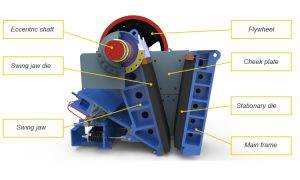
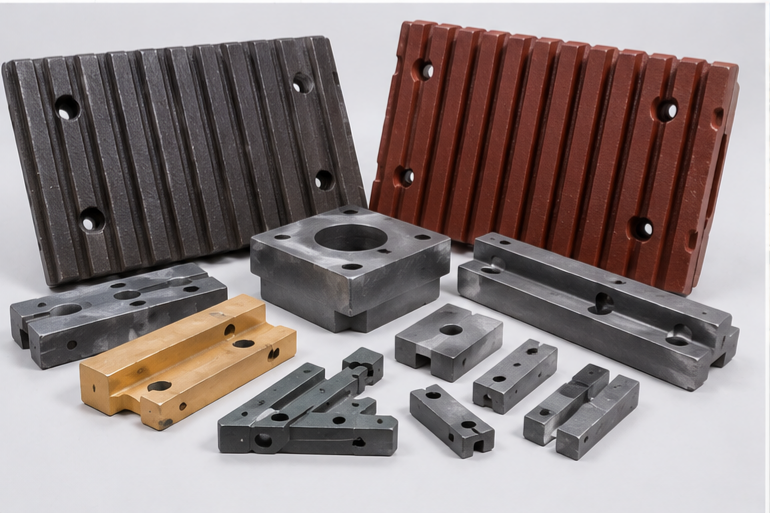
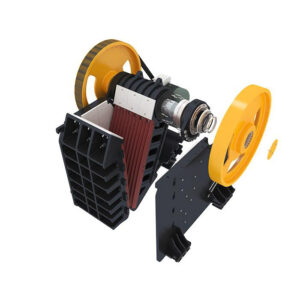
Jaw crusher wear parts are consumable liners that directly contact and crush material. They include:
- Fixed jaw plate (stationary)
- Swing jaw plate (moving)
- Cheek plates (side liners, protect crusher frame)
- Toggle plate (safety/overload protection)
- Wedges (for clamping)
2. Working Principle
The jaw crusher uses compressive force. Material enters the V-shaped chamber between fixed and moving jaws. The moving jaw plate exerts pressure, crushing material against the fixed plate. Manganese steel work-hardens: surface hardness increases significantly under impact, providing wear resistance while maintaining a tough core.
3. Benefits of High-Quality Jaw Crusher Wear Parts
- Extended wear life: Up to 2× longer with correct Mn grade and profile.
- Lower operating cost: Reduced cost per ton (not just part price).
- Stable product size: Maintains closed side setting (CSS) longer.
- Less downtime: Fewer liner changes per year.
- Custom optimization: Tooth profile designed for your feed size.
4. Applications by Industry and Ore
| Industry | Ore Type | Typical Crusher Model | Recommended Mn Grade |
|---|---|---|---|
| Gold mining | Quartz vein | Metso C106, Sandvik CJ411 | Mn18 |
| Copper mining | Porphyry | Terex JW42, Symons 4.25 | Mn18 |
| Iron ore | Hematite/magnetite | Sandvik CJ612, Metso C160 | Mn22 |
| Lithium | Pegmatite | Trio CT3254 | Mn18 |
| Aggregates | Granite, basalt | Various | Mn18 or Mn22 |
| Coal mining | Soft rock | Single toggle | Mn13 |
5. Comparison: OEM vs Premium Aftermarket Jaw Plates
| Attribute | OEM (Metso, Sandvik, Terex) | HUATAO Aftermarket |
|---|---|---|
| Dimensional accuracy | Reference standard | Verified via CMM/3D scan |
| Material range | Mn13, Mn18 (limited) | Mn13, Mn18, Mn22, custom |
| Heat treatment control | Good | Documented + certified |
| Custom tooth profile | No | Yes (drawing or sample) |
| Engineering support | General | Direct application engineer |
| Lead time (typical) | 8–12 weeks | 4–6 weeks |
| Cost | High | 30–50% lower |
| Wear life (abrasive ore) | Baseline | +30–80% possible |
6. Material Comparison Table (Detailed)
| Mn Grade | Initial BHN | Work-hardened BHN | Impact Toughness (J/cm²) | Best Application |
|---|---|---|---|---|
| Mn13 | 180–220 | 450+ | >180 | Very high impact, tramp iron risk, large feed, coal |
| Mn18 | 200–240 | 500+ | 150–180 | Standard hard rock, copper, gold, average abrasion |
| Mn22 | 220–260 | 550+ | 120–150 | High abrasion (Ai>0.6), iron ore, basalt, silica |
7. Industry Application Matrix
| Industry | Abrasion Index (Ai) Range | Recommended Mn Grade | Expected Wear Life Improvement vs Mn18 |
|---|---|---|---|
| Gold – low silica | 0.2–0.4 | Mn18 | Baseline |
| Gold – high silica | 0.5–0.7 | Mn22 | +40–60% |
| Copper | 0.3–0.5 | Mn18 | Baseline |
| Iron ore | 0.6–0.8 | Mn22 | +50–80% |
| Lithium pegmatite | 0.4–0.6 | Mn18 | Baseline |
| Aggregates (hard) | 0.5–0.7 | Mn22 | +30–50% |
| Coal | <0.2 | Mn13 | Similar to Mn18 but tougher |
8. Selection Guide (Engineering Steps)
Step 1 – Data collection
- Crusher model, serial number, OEM part number
- Feed size distribution (P80, top size)
- Ore work index (Wi) and abrasion index (Ai)
- Desired closed side setting (CSS)
Step 2 – Initial material selection
- Ai < 0.3 → Mn13 (if high impact) or Mn18 (standard)
- Ai 0.3–0.6 → Mn18
- Ai > 0.6 → Mn22
Step 3 – Request trial set from qualified supplier with material test reports.
Step 4 – Installation and monitoring
- Install with proper torque
- Measure CSS weekly
- Record hours and tons at each CSS adjustment
Step 5 – Optimization
- If wear is uneven → adjust toggle plate or jaw profile
- If life too short → upgrade to higher Mn grade or modified tooth design
9. Procurement Guide (Detailed)
Information required for accurate quotation:
- Crusher make and model (e.g., Metso C106, Sandvik CJ612)
- OEM part number (stamped on old plate)
- Drawing (PDF, DXF, or 3D STEP) – preferred
- Physical sample (if no drawing)
- Desired manganese grade (Mn13/18/22)
- Quantity (sets or pieces)
- Target lead time
- Destination port
Supplier evaluation checklist (score 1–5 each, minimum 40/50):
- Own foundry? ______
- In-house heat treatment furnace? ______
- ISO 9001:2015 certification? ______
- Spectrometer for chemical analysis? ______
- Brinell hardness tester? ______
- Dimensional inspection (CMM or gauges)? ______
- Engineering team (not just sales)? ______
- Can produce from drawing or sample? ______
- Provides material test reports with every shipment? ______
- References from same industry/ore type? ______
Typical commercial terms:
- MOQ: 1–5 sets (negotiable for trial)
- Lead time: 4–6 weeks standard, 2–3 weeks expedited (extra cost)
- Packaging: Steel pallet or fumigated wooden crate
- Shipping: FOB Xingang, CIF destination port, EXW
- Inspection: Supplier internal + optional third-party (SGS, BV)
10. Failure Analysis Table
| Failure Mode | Observable Signs | Root Cause | Corrective Action |
|---|---|---|---|
| Premature cracking | Linear cracks through plate thickness | Poor heat treatment (too fast cooling) or wrong Mn grade for impact | Require certified Mn steel + impact test report; use Mn13 for very high impact |
| Uneven wear (top vs bottom) | Fixed jaw top worn out, bottom nearly new | Incorrect toggle plate angle or flywheel timing | Adjust crusher setting per OEM manual |
| Uneven wear (left vs right) | One side worn more | Uneven feed distribution | Install and maintain proper chute/splitter |
| Rapid overall wear | Plate life <50% of expected | Mn grade too low for abrasion (e.g., Mn18 in iron ore) | Upgrade to Mn22 |
| Cheek plate breakage | Cracked or fragmented side liner | Poor fit, incorrect clamping, or low ductility | Verify dimensions, tighten bolts, use Mn13 for cheek plates |
| Excessive plastic deformation | Plate edges curled | Over-torquing or soft material | Verify torque spec; increase Mn grade |
11. Maintenance Guide
Daily (operator):
- Listen for unusual knocking or metallic sounds.
- Check for excessive dust leakage (indicates wear).
Weekly (maintenance supervisor):
- Measure closed side setting (CSS) using lead ball or laser tool.
- Visually inspect jaw plates for cracks or uneven wear patterns.
- Record tons crushed, CSS, and visual findings in logbook.
Every replacement (engineer):
- Clean jaw seat, wedge, and clamping areas thoroughly.
- Inspect seat for wear or damage.
- Apply anti-seize to bolts and wedges.
- Torque bolts to OEM specification (use calibrated wrench).
- Record installation date, hours, and photo of new plates.
Long-term tracking:
- Calculate cost per ton = (jaw plate cost + direct labor) / tons crushed since last replacement.
- Target reduction every quarter via material or profile optimization.
12. Case Study – Iron Ore Mine, Minas Gerais, Brazil
Customer: Medium-sized iron ore producer, 1.2 million tons per year.
Crusher: Terex JW42 jaw crusher, primary crushing, 16 hours/day.
Ore: Hematite with high silica content, Ai = 0.74, Wi = 17.
Original parts: OEM Mn18 jaw plates.
Problem:
- Wear life only 920 hours.
- CSS drifted from 150mm to 180mm within 300 hours → oversize product.
- Monthly replacement required: 1.3 sets per month.
- Cost per ton: $0.094.
Solution provided by HUATAO:
- Mn22 jaw plates with deeper tooth profile for better grip on high-silica ore.
- Supplied as trial set (1 fixed + 1 swing plate) with material test reports.
Result after 3-month trial:
- Wear life increased to 1,580 hours (+71.7%).
- CSS stable for first 1,000 hours.
- Monthly replacement reduced to 0.75 sets.
- Cost per ton dropped to $0.059 (37% reduction).
- Annual savings for this single crusher: ~$78,000.
Customer feedback: “We were skeptical about aftermarket, but HUATAO’s Mn22 plates outperformed our OEM parts significantly. Now standardizing across our site.”
13. FAQ (12 questions)
Q1: Where can I buy high-quality jaw crusher wear parts that fit Metso crushers?
A: HUATAO manufactures OEM-compatible jaw plates for Metso, Sandvik, Terex, Symons, Trio, and others. We require a drawing or OEM part number to ensure exact fit.
Q2: Are aftermarket jaw crusher parts as good as OEM?
A: Yes – when sourced from a qualified foundry with proper heat treatment and QA. Many aftermarket parts (e.g., HUATAO Mn22) exceed OEM wear life on abrasive ores.
Q3: How do I know if I need Mn13, Mn18, or Mn22?
A: Provide your ore’s abrasion index (Ai). If Ai<0.4 → Mn18. If Ai>0.6 → Mn22. For very high impact with tramp iron → Mn13.
Q4: Can you make jaw plates from my old sample or drawing?
A: Yes – we reverse-engineer from physical samples or manufacture directly from your CAD drawing (PDF, DXF, STEP).
Q5: What is the typical lead time for custom jaw plates?
A: 4–6 weeks from drawing approval and deposit. Repeat orders: 4 weeks.
Q6: Do you provide material test reports?
A: Yes – every batch includes chemical composition (spectrometer) and Brinell hardness test results.
Q7: What is the minimum order quantity (MOQ)?
A: For trial orders, 1 set (1 fixed + 1 swing jaw plate). Larger quantities for production.
Q8: How are jaw crusher wear parts packaged and shipped?
A: Steel pallets or fumigated wooden crates. Shipped by sea or air. FOB Xingang, CIF your port, or EXW.
Q9: Do you offer any warranty?
A: Dimensional conformance and material certification are guaranteed. Wear life depends on application; we guarantee our alloy and heat treatment.
Q10: How to prevent premature cracking of new jaw plates?
A: Ensure the supplier uses proper heat treatment (water quenching controlled). Avoid Mn22 on very high impact applications with tramp iron.
Q11: Can you design a custom tooth profile for my ore?
A: Yes – we analyze your feed size and wear pattern, then optimize tooth depth and angle.
Q12: How do I start a trial order with HUATAO?
A: Contact Annie Lu with your crusher model, OEM part number, or drawing. We will provide a quotation, material recommendation, and commercial terms.
14. Conclusion
High-quality jaw crusher wear parts are essential for cost-effective primary crushing in gold, copper, iron ore, lithium, and aggregate operations. While OEM brands like Metso set a high standard, qualified aftermarket suppliers such as HUATAO now offer OEM-compatible jaw plates with superior metallurgy (Mn18, Mn22), exact dimensional accuracy, and shorter lead times – at 30–50% lower cost.
When selecting a supplier, verify in-house foundry capability, heat treatment control, material testing (spectrometer, hardness), and custom manufacturing from drawings or samples. Use cost per ton – not purchase price – as your primary metric.
HUATAO combines engineering expertise, strict quality control, and global export experience to deliver jaw crusher wear parts that improve productivity and reduce operating costs. Contact us for a free wear life assessment.
Contact:
Annie Lu
Email: annie.lu@huataogroup.com
Phone / WhatsApp / WeChat: +86 18032422676
Website: http://www.tufflexscreen.com
We warmly welcome customers worldwide to contact us and establish mutually beneficial partnerships.
Tags:
admin
personal profile