What Is a Spiral Chute and How Does It Work in Mineral Processing?
-
 admin
- 16 Nov, 2026
Quick Answer
A spiral chute is a stationary helical trough that separates minerals by gravity alone. Slurry enters at the top as a thin film; over the first two or three turns, heavy, round grains in the 0.1–2 mm band drop through the film into a slow layer at the trough wall and migrate to the inside of the helix, while light grains ride the fast outer stream. Splitters at the bottom cut concentrate, middlings and tailings. There is no motor, no reagent and no operator per unit — the performance lives entirely in feed preparation, flow stability and splitter discipline.
Key Takeaways
- The sorting engine is two overlapping flows: a fast downstream film and a slow secondary circulation across the trough.
- Most of the separation happens in the first two turns; the rest of the helix transports what the top decided.
- Feed window: 0.1–2 mm, deslimed below ~50 µm, 20–40% solids, 1–3 t/h per start, constant.
- A concentration criterion above ~1.5 is the entry ticket; below ~1.25, buy something else.
- The three silent killers are liner wear at the top turns, splitter drift and feed surge.
- Middlings are unfinished business: return them to feed, then finish on tables or centrifugal concentrators.
Summary Table
| Parameter | Typical Range | Why It Matters |
| Feed size | 0.1–2 mm | Below 50 µm values ride the film; above 2 mm they bounce |
| Solids content | 20–40% w/w | Thin films starve stratification; thick films short-circuit |
| Feed rate per start | 1–3 t/h | No reserve for surge — stability beats peak capacity |
| Column height | 2–4 m, 5–7 turns | Tall enough for strand development and wash water control |
| Wash water | Continuous, inner edge | Keeps the heavy strand fluid without diluting recovery |
| Power at machine | Zero | Cost sits in one pump and one water line |
| Middlings | Returned to feed | They are unfinished work, not waste |
Definition: What Counts as a Spiral Chute
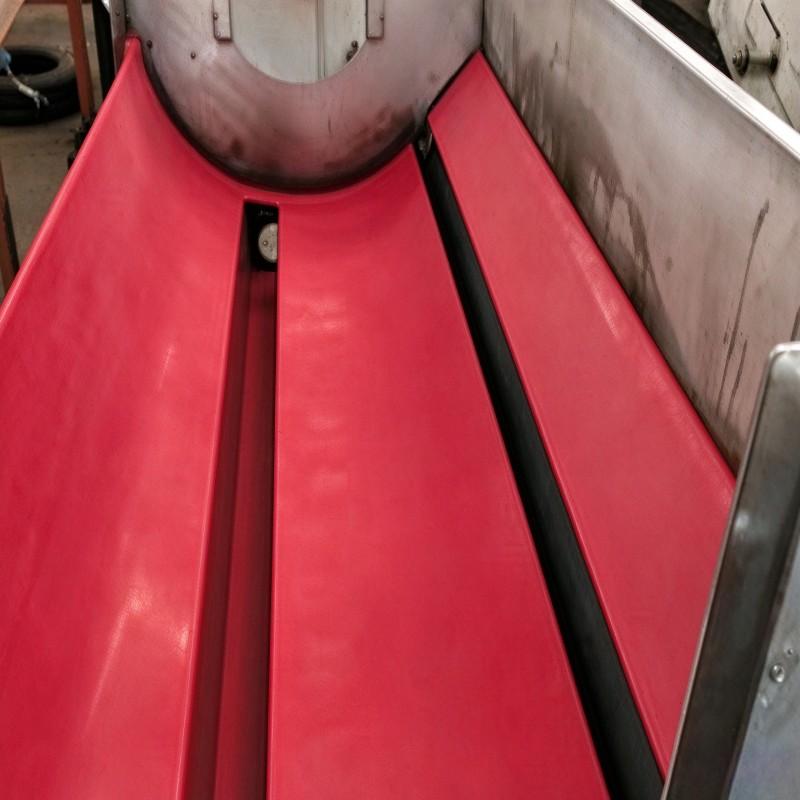
A spiral chute is a semicircular trough wound into a vertical helix of five to seven turns, 2 to 4 metres tall, standing on a light steel frame. Modern columns are built from glass-reinforced plastic, often polyurethane-faced in abrasive duty, and most banks use double-start or triple-start units so two or three independent streams share one column. “Spiral chute” and “spiral concentrator” name the same machine in practice; what actually differentiates one quotation from another is pitch, trough diameter, start count, liner material and the test work behind the recommended split.
It belongs to the gravity separation family alongside shaking tables and centrifugal concentrators — the gravity equipment class — occupying the high-tonnage, low-cost end. A table concentrates a few tonnes per hour under an attentive operator; a spiral takes 1–3 t/h per start with nothing to attend, which is why plants buy them in rows of dozens and let a single distribution box feed the lot. Standard start configurations and bank layouts are documented on the spiral chutes and spiral chute | spiral concentrator product pages.
Working Principle: Two Flows in One Trough
The separation mechanism is worth understanding properly, because every operating decision downstream of it follows from these two flows.
The downstream film. Feed enters through a box and distributor that spreads slurry evenly across the trough width. Gravity accelerates the film down the helix. Curvature makes the outer edge of the bend faster than the inner edge — the same differential that sweeps a river around the outside of its bend. Light, flaky and coarse particles ride this fast outer stream and never settle.
The secondary circulation. The same curvature rolls the film across the trough: the surface layer flows outward while the bottom layer drifts inward. This is the engine of the separation. Heavy, spherical particles drop through the film in the first turns, enter the slow near-wall layer, and are carried inward to the helix’s inside edge. Wash water dosed along the inner radius keeps the collected heavy strand fluid; without it, the strand packs and starts shedding values.
The split. By the bottom turn, the trough carries three distinct zones across its width: a slow heavy strand inside, a fast light stream outside, a middling band between them. Adjustable splitters convert the zones into product launders. The splitters are not trim — they are the actual grade-recovery dial, and the right position moves with feed grade.
Two consequences follow. Particle shape competes with density: a flat mica flake hugs the wall and impersonates a heavy mineral, which is why scrubbing and desliming matter so much in clay-bound feeds. And because the top turns do the sorting, liner wear there is the first place recovery leaks — the rest of the helix merely transports what the top decided.
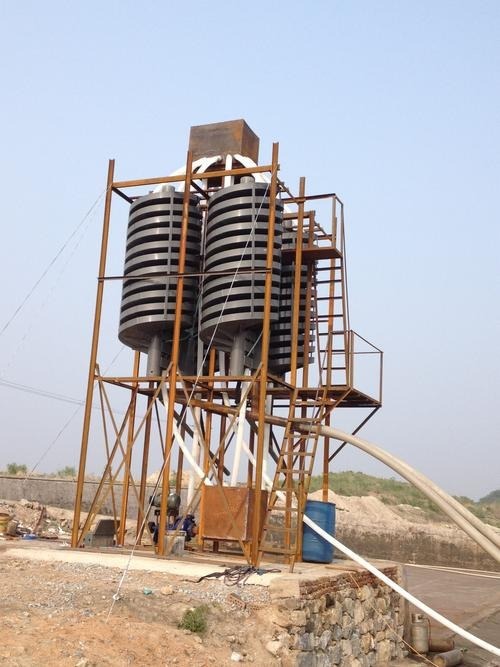
Two independent streams per column: double-start arrangements halve the floor space per tonne of feed.
Benefits: What the Machine Is Worth
- Zero power at the machine.Operating cost is a feed pump and a water line. Over ten years, that dwarfs any powered alternative’s energy bill.
- No reagents, no dosing, no downstream chemistryto undo.
- Capacity per square metre.Double-start columns pack two streams into one column footprint; a row of twenty columns can rough 100 t/h.
- Forgiving to run.One operator walks the row, listens to the starts, checks splitters. Nothing needs an instrument to tell you it’s unhappy — a gurgling start is surging, a silent start is starving.
- Fast installation.A flat pad, a feed head and a launder. Small sites run spirals on the simplest frames in the plant.
- Gradual degradation.Worn liners reduce recovery slowly, which monthly inspection can manage — the failure mode is a trend, not an event.
Applications: Where Spirals Earn Their Keep
The classic duties share one profile: heavy mineral, light gangue, sand-size feed.
- Tin and tungsten.Cassiterite and wolframite against quartz gangue, in primary and alluvial ores alike. The market around this duty is active: in November 2026, Peru’s Minsur filed for environmental approval to retreat roughly 651,000 tonnes of B3 tailings at its San Rafael tin mine — about US$22 million to recover residual cassiterite through the existing plant, with preconcentrate returning to the main circuit. Recovering sand-size tin from old tailings is exactly the duty spiral banks were built for.
- Mineral sands.Ilmenite, rutile, zircon and monazite roughed from quartz in wet concentration plants, feeding concentrator upstream of separation plants.
- Metallurgical and beach deposits, always after washing and desliming.
- Iron ore.Gravity roughing of fine hematite and goethite where flotation is not justified by value.
- Alluvial and placer gold.Roughing duty ahead of tables, with washing and screening plant handling the coarse fraction. See the gold process equipment range for the surrounding machines.
- Garnet, slag and monazite recovery— anywhere the density ratio survives.
Context matters too: on 10 November 2026, mining.com.au reported Uzbekistan’s state metals complex pursuing twelve investment projects across eleven additional metals including tin and tungsten, and earlier in the month MINING.com carried the news that Alphamin had signed a two-year offtake for up to 3,600 tonnes per year of contained tin from Bisie. More primary and secondary tin feed is entering the market, and most of it passes a gravity circuit somewhere in front of the smelter.
Material Comparison
| Material | Where Used | Strengths | Watch-outs |
| GRP (glass-reinforced plastic) | Full trough | Smooth, light, cheap | Gelcoat wears first at top turns |
| Polyurethane facing | Full trough or hot spots | Best wear life, stable surface | Higher unit cost |
| Cast basalt / ceramic | First two turns only | Extreme abrasion resistance | Retrofit complexity |
| Steel frame, galvanised | Structure | Cheap, rigid | Corrosion in wet coastal air |
For abrasive feed or high tonnage, polyurethane facing pays for itself; for small, gentle circuits, plain GRP is fine. Spares strategy matters more than material choice: the top turns of every column in a row should be replaced together, because mixing old and new surfaces in one bank splits its performance. The gravity separation spares range covers trough sections, feed boxes and splitters as matched sets.
Application Comparison
| Device | Capacity | Power | Best Role | Limit |
| Spiral chute | 1–3 t/h per start | None | Roughing, scavenging | Poor below ~50 µm |
| Shaking table | 0.5–2 t/h | Yes | Final cleaning | Low capacity, labour |
| Centrifugal concentrator | 2–10 t/h | Yes | Fine gold, upgrading | Moving parts, maintenance |
| Jig | Up to 10+ t/h | Yes | Coarse alluvial pre-conc | Lower enrichment ratio |
| Sluice box | Very high | None | Very coarse gold | Crude separation |
The pattern is clear: spirals rough, tables finish, centrifugal machines catch what film flow misses. Flowsheets that assign each device its natural role get the most from all three. A sluice box ahead of the spirals can take the coarse values for free; a gold centrifugal concentrator behind them recovers the fine fraction; a table line does the final polish, with the wider gold recovery equipment options covering the combinations in between.
Industry Application Matrix
| Industry | Typical Duty | Spiral Passes |
| Tin mining | Cassiterite roughing; tailings retreatment | Rougher + scavenger + cleaner |
| Mineral sands | Heavy mineral preconcentration | Long rougher rows feeding WCP |
| Chromite | Beach and metallurgical ore | Roughing after scrubbing |
| Gold (alluvial) | Feed preparation, roughing | Roughing ahead of tables |
| Iron ore | Fine hematite gravity roughing | Rougher + cleaner |
| Recycling / slag | Metal and garnet recovery | Scavenging rows |
Selection Guide: Work Back From the Feed
Start with a head assay and a size distribution, not a catalogue. The working sequence:
- Confirm the concentration criterion — (SG heavy − 1) / (SG light − 1) — is comfortably above 1.5.
- Confirm the values sit inside 0.1–2 mm. If they don’t, the project is a desliming and classification problem before it is a spirals problem.
- Plan the desliming: minus-50-micron material goes to hydrocyclones, never to the spiral. Closed-circuit grinding feeds get their size cut from a spiral classifier.
- Size the start count: feed tonnage ÷ t/h per start = roughing starts; add cleaner and scavenger passes from the rougher mass balance.
- Group into banks with a common distribution box, and specify the spares set with the machines.
A 100 t/h roughing duty at 2.5 t/h per start means 40 starts — twenty double-start columns — plus cleaning capacity. Clay-bound alluvial feeds should also carry a washing step ahead of classification: a screw washer breaks down agglomerates that would otherwise ride the film as fake middlings.
Procurement Guide: What to Send, What to Ask
Send:
- Head assay, target mineral and its specific gravity.
- Feed size distribution after planned desliming.
- Slurry density and hourly feed rate.
- Available head and a plant layout sketch.
- Water quality and climate constraints.
Ask:
- Which similar feed have you actually run, and what recovery did it achieve?
- What is the recommended split position, and how is it verified during commissioning?
- What is the liner wear allowance at the first two turns for this duty?
- What spares set ships with the bank, and can trough sections be replaced column by column without re-levelling the row?
A quotation built without test work is a guess with a price. The machine is cheap; the downtime from a wrong recommendation is not.
Failure Analysis: The Three Quiet Killers
Liner wear at the top turns. The first two turns do the separation; a roughened surface sheds the heavy strand early and quietly bleeds recovery for months. Inspect monthly with a torch and a feeler, replace trough sections as a set, and never nurse a worn helix through a season to save liner cost.
Splitter drift. Operators rotate, feed grade steps, splitters stay where they were. Grade loss at constant recovery is almost always a splitting decision, not a machine fault. Record feed grade and splitter position together, and re-cut when grade steps change.
Feed surge. A spiral has no reserve. Pump cycling, an uneven distribution box or a surging upstream tank turns a good separation into noise. Fix the feed, not the spirals — and listen to the row: starts that sound different from their neighbours are telling you about distribution, not about themselves.
The upstream cause behind all three is slimes. Minus-50-micron material stays suspended in the film, never reaches the wall layer, and exits as dirty middlings that contaminate everything downstream. When recovery disappoints, check desliming first.
Maintenance Guide
- Daily:walk the row; listen to every start; check splitter positions and wash water; note strand colour and width at the first turns.
- Weekly:inspect feed boxes and distribution launders for scaling and grit; verify every start receives the same flow.
- Monthly:measure liner wear at the top two turns; assay shift-average tailings; review recovery against feed grade.
- Quarterly/annually:plan trough replacement for the row as one job; check frame level and anchor bolts; repaint or galvanise corroded steel.
None of these needs a shutdown longer than a coffee break, which is the maintenance argument for the machine: everything is reachable, nothing is buried.
Case Study: Sand-Size Tin From Old Tailings
Minsur’s November 2026 filing for San Rafael, its tin operation in Puno, Peru, describes retreating about 651,000 tonnes of B3 tailings and roughly 540,000 tonnes of usable material from the Larancota dump for about US$22 million, with preconcentrate returning to the existing plant. The arithmetic works because the duty fits the machine: cassiterite is heavy, the tailings are already sand-sized and history has done the desliming, and gravity roughing at near-zero operating cost turns old waste into feed. For the same reason, every new bank we quote starts from the spiral chutes duty list rather than from a stock configuration. The same template applies wherever a plant’s historical tailings still hold values between 0.1 and 2 mm with a workable density ratio — audit the tailings before buying new ore.
FAQ
What is the difference between a spiral chute and a spiral concentrator?
In practice, nothing — vendors use both names for the same helical trough device. Compare pitch, diameter, start count, liner material and test work, not the label on the drawing.
How fine can a spiral chute recover values?
Reliably down to roughly 50 microns. Below that, efficiency falls steadily; below 20 microns the device is effectively a washing machine. Fine fractions belong on tables, centrifugal concentrators or flotation.
How many spirals do I need?
Feed tonnage ÷ t/h per start, multiplied by the number of passes your flowsheet needs, plus cleaning capacity sized from the rougher concentrate mass.
Do spiral chutes need power?
The machine needs none. The plant pays for feed pumping, wash water and head.
Why does concentrate grade fall when feed grade falls?
The splitters are fixed while the feed is not. A strand set for yesterday’s grade now cuts water into the concentrate. Re-cut on grade steps, and record positions against feed assays.
Can a spiral handle clay-bound feed?
Not directly. Clay needs scrubbing — a washer or scrubber stage — and the released slimes need removal before the helix, or they ride the film and dirty every product.
Conclusion
A spiral chute converts a density difference into three product streams using gravity, film flow and water. Nothing moves, nothing runs except one pump, and nothing about the result is automatic: feed preparation, flow stability and splitter discipline carry the whole performance. Plants that hold those three get concentrating power that costs almost nothing per tonne and degrades gracefully enough to manage with a torch and a notebook. Plants that don’t get an elegant sculpture that reproduces their shortcuts in the tailings. Audit the feed first, buy the machine second, and record everything the operator does — because on a device with no moving parts, the moving part is the decision.
Related Articles
- Rotor & Stator in Mechanical Flotation Cells: The Heart of Efficient Mineral Flotation
- How Do I Choose the Right Rubber Belt for a Vacuum Belt Filter?
- Self-Cleaning Screen vs Traditional Woven Wire Mesh: Which One Should You Choose?
Contact
Contact: Annie Lu
Email: annie.lu@huataogroup.com
WhatsApp / WeChat: +86 18032422676
Website: www.tufflexscreen.com
HTL Solutions (Tufflex brand) supplies glass-reinforced and polyurethane-lined spiral chutes, matched wear spares and full rougher-cleaner-scavenger bank layouts for mineral processing plants worldwide. Send feed size distribution, slurry density and target mineral, and we will recommend start count and pass arrangement before quoting.
 admin
personal profile