How Often Should I Replace Hydrocyclone Liners?
Oct 20, 2026
 admin
admin Hydrocyclone instability is a major operational challenge that directly impacts separation efficiency, product quality, and downstream process performance. Unlike steady, stable operation where a consistent air core forms and the underflow discharges in a uniform umbrella-shaped spray, instability manifests in various disruptive ways . Understanding the root causes is the first step toward diagnosis and correction.
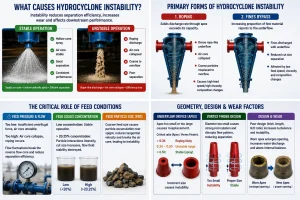
Hydrocyclone instability typically presents in two distinct forms, both of which can seriously affect downstream processes and accelerate machinery wear :
The stability of a hydrocyclone is highly sensitive to the characteristics and consistency of its feed.
Maintaining the correct feed pressure is the most fundamental requirement for stable operation. Insufficient pressure (typically less than 5-6 psi) fails to generate the centrifugal force needed to maintain the cyclonic action and the air core. Conversely, excessive pressure can cause the air core to collapse, leading to roping and severe classification issues .
Flow fluctuations are another major destabilizing factor. In de-oiling hydrocyclones, for example, the reverse flow core can break down when the feed rate exceeds a critical value, causing a catastrophic drop in separation efficiency. This establishes a finite turndown ratio (the operating range of feed rates) beyond which the equipment cannot maintain stable separation .
The interaction between inlet concentration and inlet velocity is critical. At low inlet velocities, the cut size and separation precision show no regular change as concentration increases. However, once concentration exceeds about 20.25%, interactions among particles intensify dramatically, increasing the cut size and destroying flow field stability, which prevents uniform particle distribution in the radial direction .
Fluctuations in feed PSD directly affect stability. When the underflow orifice is extremely small, coarser feed median sizes cause rapid deterioration in efficiency and sharpness. The mechanism is particle accumulation near the spigot, which reduces tangential velocity and breaks the air core, destroying the regular equilibrium particle distribution .
The geometry of a hydrocyclone is meticulously designed to create a stable vortex. Alterations, whether from wear or improper selection, can induce instability.
The diameter of the underflow orifice (apex or spigot) is a primary control point for stability. Either a too-small or too-large diameter will cause numerous particles to be misplaced, resulting in poor separation performance . Research shows that the ratio of apex to vortex finder diameter is critical: as this ratio increases, the free-vortex region expands and the forced-vortex region shrinks. Fluctuation frequency also increases, causing disorder in the flow field and reducing separation efficiency .
The vortex finder also plays a crucial role in stability. Reducing its diameter below a critical threshold can cause substantial recirculation and a loss of effective separation. This occurs because the axial velocity exhibits predominantly downward movement within the outer cyclone, disrupting the intended flow pattern .
An “inadequate hydrocyclone design” is a primary reason for poor efficiency and instability. Factors such as an overly small inlet diameter, an incorrectly proportioned underflow length, and a sub-optimal height-to-diameter ratio can all exacerbate flow instability and turbulence .
Component wear, particularly of the apex, is a primary cause of operational changes. As the apex wears, its opening enlarges, increasing water discharge through the underflow and altering the internal balance of the cyclone .
Hydrocyclone instability is typically the result of a combination of factors. The most common causes include extreme or fluctuating feed pressure, feed flow, concentration, or particle size; critical geometric imbalances, such as an incorrect apex-to-vortex ratio; and component wear. A systematic approach to troubleshooting, starting with verifying feed pressure and examining the underflow discharge pattern, is essential for identifying and correcting the root cause of instability .
admin