How Often Should I Replace Hydrocyclone Liners?
Oct 20, 2026
 admin
admin The best polyurethane flip-flow screen mesh for sticky iron ore uses MDI-based polyether polyurethane with approximately 80–85 Shore A hardness, featuring tapered self-relieving apertures and gradient thickness design. This combination provides the optimal balance of wear resistance, elasticity, and anti-blinding performance for high-moisture iron ore applications.
✔ Wet screening is the primary challenge for sticky iron ore – anti-blinding design is critical
✔ Polyurethane hardness around 80–85 Shore A offers the best balance of flexibility and wear resistance
✔ Tapered apertures prevent pegging by allowing near-size particles to pass through freely
✔ Gradient thickness design delivers higher impact resistance in the feed zone and more flexibility in the discharge zone
✔ The 10 Engineering Factors framework provides a systematic selection approach
✔ Avoid the “harder and thicker is better” trap – flexibility is essential for flip-flow screening
| Factor | Recommendation for Sticky Iron Ore | Why It Matters |
|---|---|---|
| Polyurethane Type | MDI-based polyether PU | Superior wet resistance, abrasion resistance, and flex fatigue resistance |
| Hardness | 80–85 Shore A | Balances wear resistance with the flexibility needed for self-cleaning |
| Aperture Design | Tapered self-relieving apertures | Prevents pegging by near-size particles; wider relief area allows free passage |
| Aperture Shape | Slotted or square depending on product specs | Slots increase open area and dynamic release of fines; squares provide accurate separation |
| Mat Thickness | Gradient design (thicker feed zone, thinner discharge zone) | Balances impact resistance in feed zone with flexibility in screening zones |
| Dynamic Acceleration | 30G–50G range typical for flip-flop designs | Achieves effective self-cleaning without excessive fatigue |
| Deck Inclination | 15–22° depending on screen design | Controls material bed thickness and residence time |
| Tear Strength | >70 kN/m (reference target) | Essential for clamping areas subject to repeated stretching |
| Abrasion Resistance | DIN abrasion loss <30 mm³ (reference target) | Critical for handling highly abrasive iron ore |
| Dynamic Fatigue | Must resist millions of deformation cycles | Prevents cracking, edge tearing, permanent deformation, and heat buildup |
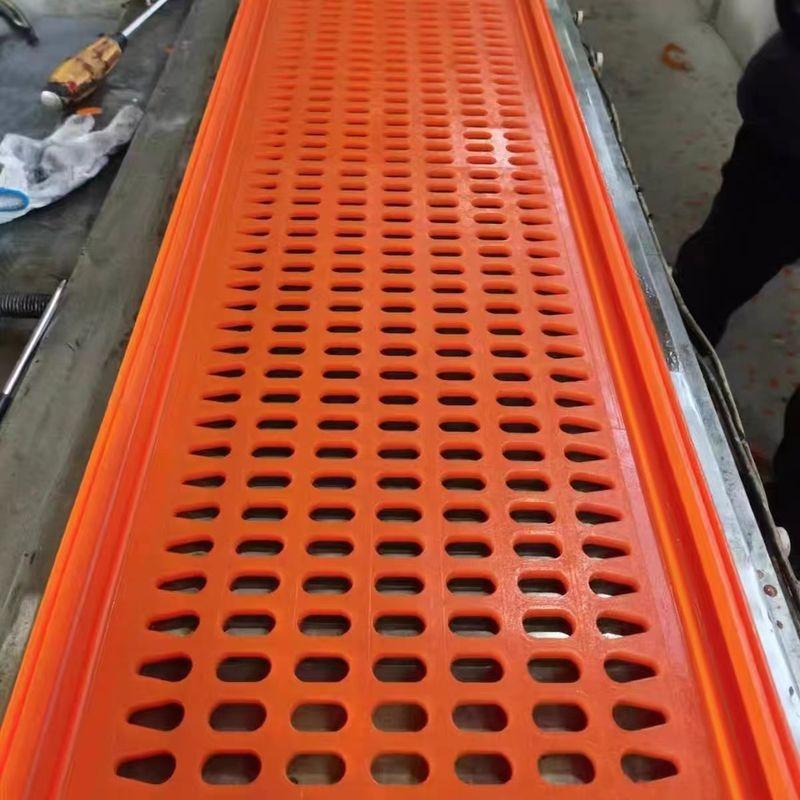
A polyurethane flip-flow screen mesh is a flexible screening media used on flip-flow screening machines. Unlike rigid screen panels, flip-flow screens use elastic polyurethane mats that alternately stretch and relax during operation. This dynamic motion generates high acceleration at the screen surface, which effectively dislodges adhered material and prevents blinding – making it particularly effective for wet, sticky, and difficult-to-screen materials like high-moisture iron ore.
Sticky iron ore refers to iron ore with high moisture content and significant clay mineralogy. When clay minerals absorb water, they create highly adhesive material that tends to agglomerate and blind standard screen plates. This reduces effective aperture size, decreases processing capacity, and increases maintenance downtime.
The polyurethane flip-flow screen mesh operates on a dynamic self-cleaning mechanism:
Alternating Tension and Relaxation: The elastic screen mat is mounted between two vibrating frames that move in opposing directions. This causes the mat to alternately stretch and relax.
Dynamic Aperture Change: As the mat stretches, the apertures elongate and change shape. As it relaxes, the apertures return to their original form. This continuous cycle prevents particles from becoming wedged.
High Surface Acceleration: The rapid stretching and relaxation generates high local surface acceleration – often in the 30G–50G range in certain designs. This force dislodges adhered material.
Self-Cleaning Action: The combination of dynamic aperture change and high surface acceleration effectively removes wet fines and clay that would otherwise blind the screen.
Continuous Screening: This self-cleaning action ensures continuous and stable screening even under high-moisture conditions, maintaining throughput and reducing unscheduled downtime.
The dynamic expansion and contraction of the screen mat prevents material buildup, ensuring continuous screening efficiency even with sticky, high-moisture materials.
High-quality MDI-based polyether polyurethane formulations provide significantly longer service life than conventional screening media, particularly in abrasive applications.
Self-cleaning action minimizes the need for manual cleaning and unscheduled maintenance, improving overall plant availability.
Maintaining open area and screening efficiency ensures consistent particle size distribution in the final product.
Extended wear life, reduced downtime, and consistent performance translate to lower cost per screened ton.
Iron ore beneficiation
Coal preparation
Copper ore processing
Gold ore screening
Nickel ore classification
Limestone screening
Granite processing
Basalt classification
Construction waste processing
Slag screening
Dewatering screens
Slurry classification
Fines recovery
| Property | Polyurethane | Rubber |
|---|---|---|
| Wear Resistance | ★★★★★ | ★★★★ |
| Elasticity | ★★★★★ | ★★★★ |
| Tear Strength | ★★★★ | ★★★★★ |
| Wet Screening Performance | ★★★★★ | ★★★ |
| Impact Resistance | ★★★★ | ★★★★★ |
| Abrasion Resistance | ★★★★★ | ★★★★ |
| Cost per Ton | ★★★★★ | ★★★★ |
When selecting between polyurethane and rubber for flip-flow screens, consider your primary failure mode:
Blinding/Pegging → Polyurethane (superior self-cleaning and aperture design)
Impact Damage → Rubber (superior impact absorption)
| Property | Polyurethane | Woven Wire |
|---|---|---|
| Open Area | ★★★★ | ★★★★★ |
| Anti-Blinding | ★★★★★ | ★★★ |
| Wear Life | ★★★★★ | ★★★ |
| Flexibility | ★★★★★ | ★ |
| Wet Screening | ★★★★★ | ★★ |
| Cost per Ton | ★★★★★ | ★★★ |
The 5× Rule: If you’re replacing woven wire more than 5 times per year due to wear or blinding, upgrade to polyurethane flip-flow screens.
| Factor | Polyurethane Flip-Flow | Conventional Rigid Screen |
|---|---|---|
| Anti-Blinding | ★★★★★ Dynamic self-cleaning | ★★ Frequent blinding issues |
| Wet Material Handling | ★★★★★ Excellent | ★★ Poor; rapid blinding |
| Wear Life | ★★★★★ 8–10× longer | ★★★ Standard |
| Maintenance Frequency | ★★★★★ Low | ★★ High |
| Throughput Stability | ★★★★★ Consistent | ★★ Degrades rapidly |
| Cost per Ton | ★★★★★ Lowest | ★★ Higher |
| Application | Recommended Solution | Key Selection Criteria |
|---|---|---|
| Sticky Iron Ore – Wet Screening | Polyurethane flip-flow with 80–85 Shore A, tapered apertures | Anti-blinding, tear strength, moisture handling |
| Coal Preparation – Wet Screening | Polyurethane flip-flow with slotted apertures | High throughput, self-cleaning |
| Aggregate – Dry Screening | Rubber flip-flow or woven wire | Impact resistance, high open area |
| Copper Ore – Wet Classification | Polyurethane flip-flow with gradient thickness | Abrasion resistance, flexibility |
| Tailings Dewatering | Polyurethane dewatering flip-flow | Fine screening, moisture removal |
Step 1: Assess Your Material
Moisture content (wet, dry, sticky)
Abrasiveness (hardness, silica content)
Particle size distribution
Clay percentage and type
Step 2: Identify Primary Failure Mode
Blinding/pegging → Polyurethane with tapered apertures
Impact damage → Rubber panels
Abrasive wear → Polyurethane or rubber
Edge tearing → Check tear strength specifications
Step 3: Define Your Priority
Throughput → Woven wire or high-open-area polyurethane
Long wear life → Premium polyurethane formulation
Anti-blinding → Polyurethane with tapered self-relieving apertures
Impact resistance → Rubber
Step 4: Select Polyurethane Hardness
70–75 Shore A: Higher flexibility, better self-cleaning, lower wear resistance
80–85 Shore A: Recommended starting point for sticky iron ore – balanced performance
85–90 Shore A: Higher wear resistance, lower flexibility, reduced self-cleaning
Step 5: Choose Aperture Design
Tapered apertures: Essential for wet screening to prevent pegging
Slotted apertures: Higher open area, better for sticky fines
Square apertures: Accurate particle separation
Step 6: Design Mat Thickness
Feed zone: Thicker (20–30 mm) for impact resistance
Middle zone: Moderate (15–20 mm) for balanced performance
Discharge zone: Thinner (10–15 mm) for maximum flexibility
Step 7: Calculate Cost Per Ton
Compare options based on life expectancy
Include downtime and labor costs
Don’t buy on purchase price – buy on cost per screened ton
Material Information:
Material type (iron ore, coal, aggregate, etc.)
Feed particle size distribution (PSD)
Required cut size
Moisture content (%)
Clay content (%) and type, if known
Capacity (TPH)
Abrasiveness (high/medium/low)
Screen Information:
Screen manufacturer and model
Number of decks
Existing screen mat dimensions (length × width × thickness)
Aperture size and shape
Mounting / clamping method
Screen acceleration and frequency, if known
Operating Conditions:
Wet or dry screening
Operating temperature
Feed rate
Impact level (high/medium/low)
Problem Description:
Severe blinding?
Pegging?
Excessive wear?
Edge tearing?
Low screening efficiency?
Short service life?
Photos/Drawings:
Photos of existing screen mats
Installation area photos
Photos of worn parts
Existing screen mat drawings, if available
| Evaluation Factor | Questions to Ask |
|---|---|
| Material Expertise | Does the supplier understand polyurethane compounding for wet screening? |
| Customization Capability | Can they provide custom hardness, aperture design, and gradient thickness? |
| Quality Control | Do they perform split-tear, DIN abrasion, and dynamic fatigue testing? |
| Track Record | Do they have field references for similar sticky iron ore applications? |
| Technical Support | Can they provide engineering recommendations for screen selection? |
| Lead Time | What is the typical lead time for custom flip-flow mats? |
| After-Sales Support | Do they provide installation guidance and maintenance recommendations? |
| Question | Why It Matters |
|---|---|
| Can the supplier provide material reports (split-tear, DIN abrasion)? | Verifies compound quality and consistency |
| Does the supplier have experience with sticky iron ore applications? | Ensures application-specific expertise |
| Can the supplier support OEM replacement? | Ensures compatibility with existing screen machines |
| Does the supplier have export experience? | Critical for international procurement |
| Can the supplier provide wear-life recommendations? | Demonstrates engineering capability |
| Problem | Possible Cause | Recommended Solution |
|---|---|---|
| Blinding in wet screening | Standard apertures for wet material; insufficient self-cleaning action | Switch to tapered self-relieving apertures; verify hardness is not too high (reduce if >85 Shore A) |
| Premature wear | Polyurethane too soft for abrasive iron ore | Increase hardness (try 85–90 Shore A) or upgrade to premium MDI-based polyether formulation |
| Impact damage / cracking | Material too heavy or impact level too high for polyurethane | Switch to rubber screen panels for high-impact zones; consider gradient reinforcement |
| Edge tearing | Insufficient tear strength; clamping stress concentration | Specify split-tear strength >70 kN/m; reinforce clamping edges |
| Low open area | Aperture pattern not optimized; blinding reducing effective area | Try slotted apertures; reduce hardness to increase dynamic flexing |
| Excessive heat buildup | Dynamic loss factor too high; frequency too high | Evaluate polyurethane tan δ at operating temperature; reduce frequency if possible |
| Poor fitment | Incorrect dimensions provided to supplier | Provide original screen mat drawings and machine specifications |
| Material mismatch | Polyurethane formulation not suited for clay content | Adjust formulation for specific clay mineralogy; consider surface modification |
Visual inspection for blinding or material buildup
Check for edge damage or tearing
Monitor screening efficiency and throughput
Listen for unusual noise indicating mat damage
Check for aperture enlargement or wear
Measure mat tension (should be consistent across the deck)
Inspect clamping system for loosening or wear
Document any wear patterns for trending
Measure open area; compare to baseline
Check thickness in multiple zones
Evaluate self-cleaning performance
Review throughput data and screening efficiency trends
Spare parts inventory: Maintain minimum stock of critical sizes
Scheduled replacement: Plan replacements during scheduled downtime
Clamping inspection: Ensure proper tension to maximize self-cleaning action
Wear pattern monitoring: Track wear zones to optimize future mat design
Screening efficiency drops by 10–15%
Open area reduced by 20% or more
Visible tearing or edge damage
Increased blinding frequency
Excessive downtime for cleaning
Case Study: Upgrading to Polyurethane Flip-Flow Screens for Iron Ore Processing
Customer Type: Iron ore concentrator (Brazil)
Ore Type: High-moisture iron ore with significant clay content (12–15% moisture, 8–10% clay)
Operating Conditions: Wet screening, 800 tph feed, high abrasion, severe blinding
Problem:
The customer was using woven wire screens on their flip-flow machines. Despite the dynamic motion, the woven wire screens were blinding frequently due to clay adhesion. Panel life was only 4–6 weeks, and the plant was losing significant capacity due to unscheduled downtime for cleaning.
Solution:
HUATAO recommended switching to polyurethane flip-flow screen mats with the following specifications:
MDI-based polyether polyurethane formulation
80–85 Shore A hardness
Tapered self-relieving apertures (8 mm × 25 mm slotted)
Gradient thickness design (25 mm feed zone, 15 mm discharge zone)
Reinforced clamping edges
Result:
Blinding eliminated
Panel life increased from 6 weeks to 18 months
Cost per ton reduced by 85%
Downtime reduced by 90%
Screening efficiency improved from 72% to 94%
Annual cost savings exceeded $1.2 million
Q1: What is the best polyurethane hardness for sticky iron ore flip-flow screens?
Answer: For many sticky iron ore applications, 80–85 Shore A hardness provides an excellent starting point. This range balances wear resistance with the flexibility required for self-cleaning action. However, the final hardness should be selected based on your specific ore characteristics, screen dynamics, and operating conditions.
Q2: How do I know if my screen needs tapered apertures?
Answer: If you are experiencing pegging (near-size particles becoming wedged in apertures) or blinding (material buildup blocking the screen surface), tapered self-relieving apertures are essential. The wider relief area underneath the aperture allows particles to pass through freely rather than becoming trapped.
Q3: What is the 5× Rule for flip-flow screens?
Answer: The 5× Rule states that if you’re replacing woven wire more than 5 times per year due to wear or blinding, you should upgrade to polyurethane flip-flow screens. The reduction in downtime and labor costs alone justifies the upgrade.
Q4: Why is gradient thickness important for flip-flow screens?
Answer: Gradient thickness design delivers higher impact resistance in the feed zone (where coarse material first contacts the screen) and more flexibility in the discharge zone (where self-cleaning action is most critical). This provides a better balance between wear life and screening performance than using the same thickness across the entire deck.
Q5: How do I calculate cost per ton for flip-flow screen mats?
Answer: Divide the total panel cost (including shipping and installation) by the total tons screened during its life. Example: $1,500 panel ÷ 2.4 million tons = $0.000625/ton. This is the true measure of value, not the initial purchase price.
Q6: Can HUATAO provide custom aperture designs for my flip-flow screens?
Answer: Yes. HUATAO offers custom aperture designs including square, slot, round, tear-drop, and tapered self-relieving apertures. We can also provide progressive aperture designs with different sizes along the screen deck based on changing bed depth and separation conditions.
Q7: What information do I need to provide for a flip-flow screen mat quote?
Answer: Please provide your material characteristics (ore type, moisture, clay content, PSD, TPH), screen machine specifications (manufacturer, model, deck dimensions), current screen mat details (dimensions, aperture size, thickness, mounting method), and a description of your operating problems (blinding, wear, pegging, etc.).
Q8: What is the typical service life of polyurethane flip-flow screen mats?
Answer: Service life varies depending on the application, material abrasiveness, and operating conditions. In sticky iron ore applications, premium polyurethane flip-flow mats typically provide 12–24 months of service life, compared to 4–6 weeks for woven wire screens.
Q9: How do I select between polyurethane and rubber for my flip-flow screen?
Answer: Select polyurethane when your primary failure mode is blinding/pegging or abrasive wear. Select rubber when your primary failure mode is impact damage (coarse, heavy materials like granite or recycled concrete). For sticky iron ore, polyurethane is generally the superior choice.
Q10: What does HUATAO offer for flip-flow screen applications?
Answer: HUATAO offers high-quality polyurethane flip-flow screen mats with MDI-based polyether formulation, custom hardness (70–90 Shore A), tapered self-relieving apertures (45 micron capability), gradient thickness design, and reinforced clamping edges. All products are manufactured to exact specifications with proven field performance.
Selecting the right polyurethane flip-flow screen mesh for sticky iron ore requires a systematic engineering approach. Hardness, aperture design, mat thickness, and dynamic performance must all be balanced against the specific ore characteristics and operating conditions. The goal is not simply to maximize wear resistance or thickness, but to achieve the optimal combination of wear resistance, elasticity, tear strength, and dynamic flexing that delivers the lowest cost per screened ton.
The Golden Rule: Don’t buy on purchase price – buy on cost per screened ton.
At HUATAO, we approach each application individually. Rather than simply supplying a screen mat according to dimensions, we evaluate the customer’s ore characteristics, screen model, aperture requirements, mounting system, and wear problems to recommend a more suitable screening solution. Our complete range of polyurethane, rubber, and metallic screening media ensures that we can provide the right solution for virtually any mineral processing application.
Related Products:
Related Technical Guides:
Why More Mining Plants Are Switching To Flip Flop Screens For Wet Sticky Materials
Polyurethane Screen Panels For Copper Ore Processing Complete Engineering Guide
How To Increase The Screening Rate Of Quartz Powder And Silica Sand With Polyweb Screen Panel
Why Polyurethane Screen Panels Are Replacing Steel In Mining
Polyurethane Screen Blinding Root Causes And Effective Solutions
Related Buyer Guides:
Related Comparison Guides:
Polyurethane Screen Panels Vs Rubber Screen Panels Which Is Better
Steel Vs Polyurethane Vs Rubber Screen Panels The Ultimate Guide To Mining Screening Choices
Polyurethane Vs Rubber Screen Panels A Complete Guide For Mining Aggregate Operations
If you are experiencing screen blinding, sticky material buildup, rapid polyurethane wear, or premature screen mat tearing, send us your operating conditions and existing screen specifications. We can help evaluate a customized polyurethane screening solution for your iron ore processing plant.
Contact: Annie Lu
Email: annie.lu@huataogroup.com
Phone / WhatsApp: +86 180 3242 2676
Website: http://www.tufflexscreen.com
HUATAO welcomes customers from the global mining, quarrying, and mineral processing industries to contact us for screening media, wear-resistant parts, and customized replacement solutions.
Tags: Polyurethane Flip-Flow Screen, Sticky Iron Ore Screening, Anti-Blinding Screen Mesh, Mining Screen Media, PU Screen Mat, Flip-Flow Screen Selection, Iron Ore Beneficiation, Wet Screening, Polyurethane Screen Panel, Rubber Screen Panel
admin