
Boost Mining Dry Screening Performance with Wear-Resistant Polyurethane Screen Panels
-
 admin
admin - 29 Jul, 2026
Boost Mining Dry Screening Performance with Wear-Resistant Polyurethane Screen Panels
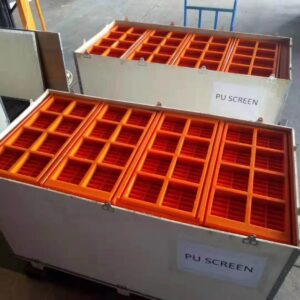
In the dry screening processes of mining operations, traditional metal screen plates often fall short—they wear out rapidly, tear easily, and get clogged frequently. These issues lead to reduced production efficiency and skyrocketing maintenance costs. However, there’s a game-changing solution: wear-resistant and tear-resistant polyurethane tendon screen panels. By leveraging material modification (a polyurethane matrix blended with wear-resistant particles), structural innovation (a tendon frame combined with one-piece molding), and design optimization (trapezoidal screen holes), these panels deliver remarkable results. They double the service life, cut the monthly tear rate to just 0.5%, and keep the clogging rate below 8%.
This article takes a deep dive into the unique advantages of these polyurethane screen panels from five key angles: material properties, structural design, performance comparison, model selection, and real-world application cases. It fully explains how these panels provide long-lasting, durable solutions for mining companies, significantly enhancing the stability and cost-effectiveness of dry screening operations. For mining businesses looking to replace traditional metal screen plates, polyurethane tendon screen panels stand out as an ideal choice.
Uncovering the Core Advantages: What Makes Polyurethane Tendon Screens So Durable?
The outstanding longevity of polyurethane tendon screens isn’t due to a single feature—it’s the result of the synergy between “material modification + structural reinforcement + process optimization.” This is specifically reflected in four key aspects:
1. Polyurethane Material Combined with Wear-Resistant Particle Modification: Doubles Wear Life
Traditional metal screens wear down fast when they come into contact with high-hardness ores like granite and quartz sand, thanks to abrasion and impact. Polyurethane tendon screens address this problem through advanced material technology:
- Elastic Base Material: Made from high-elasticity polyurethane (with a Shore hardness of 85-90A), these panels offer excellent “elastic cushioning.” When coarse ore hits the screen surface, it deflects by 5-10%, absorbing more than 30% of the impact energy. This drastically reduces localized wear—impact wear is 40% lower than that of manganese steel screens.
- Integration of Wear-Resistant Particles: The polyurethane matrix is infused with 20-30% silicon carbide or aluminum oxide wear-resistant particles (5-10μm in diameter). This forms a strong composite structure—a “polyurethane matrix + hard particle” network—that increases the surface hardness to Shore 95A (equivalent to HRC45 metal). According to the ASTM D4060 standard, the wear loss is ≤50mg per 1000 cycles, which is 25% lower than standard polyurethane screens and 50% lower than manganese steel screens.
(Wear Resistance Comparison Table: Test conditions include granite ore with a size of 30-50mm and a screening frequency of 1500 cycles per minute)
2. Tendon Frame Plus One-Piece Molded Structure: Triples Tear Resistance
Mining screens are exposed to high-frequency vibration (1200-2000 RPM), which creates uneven tension. This tension often leads to tearing, especially at the edges and center of the screens. Polyurethane tendon screens overcome this flaw with smart structural design:
- Tendon Frame Reinforcement: Multiple layers of fiberglass or nylon tendon frames (1-2mm thick) are embedded in the edges and key stress points of the screen. This creates a composite structure that “uses the frame for load-bearing and polyurethane for wear resistance,” achieving a tensile strength of 25-30 MPa (60% higher than standard polyurethane) and a tear strength of 80 kN/m (20% higher than manganese steel).
- One-Piece Molding Process: These screens are produced using a seamless, one-piece molding technique. This eliminates the weak joints found in traditional spliced screens—joints that cause 80% of screen failures—and reduces the overall monthly tear rate to just 0.5%.
(Tear Resistance Comparison Table: Test conditions include a screen tension of 50N/cm and a vibration frequency of 1800 cycles per minute)
3. Trapezoidal Holes and Elastic Vibration: Lowers Clogging Rate to ≤8%
Clogging of screen meshes by fine-grained ore (0.15-5mm) and dust is a major bottleneck in dry screening. Conventional square-hole screens usually have a clogging rate of 20-30%. Polyurethane tendon screens solve this problem through optimized geometry and the inherent properties of the material:
- Trapezoidal Hole Design: The “wide-top, narrow-bottom” trapezoidal hole design (e.g., 15mm at the top and 12mm at the bottom) lets fine particles slide through easily, preventing them from getting wedged and stuck. Compared to square holes, this design alone reduces clogging by 60%.
- Elastic Self-Cleaning Vibration: The natural elasticity of polyurethane makes the screen micro-rebound during operation (with an amplitude of 0.5-1mm). This constant, slight movement effectively shakes off fine particles and dust adhering to the hole walls, reducing the dust adhesion rate from 15% to below 5%.
(Anti-Blinding Comparison Table: Test conditions include iron ore dry separation, 15% fines, and an ore size of 10-50mm)
Contact us ↓
Annie Lu
Huatao Group
Mobile: 0086 18032422676 ( Whatsapp/Wechat/Viber)
Web:www.tufflexscreen.com
www.huataoscreen.com
www.puscreenpanel.com
Our Hot-selling Products:
HUATAO Hot-Selling Polyurethane Product List as below:
| Polyweb Urethane Screen | Tufflex Screen |
| Polyurethane Dewatering Screen Mesh | WS 85 Modular Screen |
| Polyurethane Screen Panels | Rotex Replacement Screens |
| Rubber Screen Panel | Vibrating Screen Mesh |
| Self cleaning Wire Mesh | Shale Shaker Screen |
Tags:
admin
personal profile