
Screening equipment plays a vital role in mining, aggregate production, recycling, chemical processing, and food manufacturing industries. The efficiency of the screening process directly affects production capacity, finished material quality, maintenance cost, and energy consumption.
Among various screening systems, linear motion vibrating screens and circular vibrating screens are the two most common options used worldwide. Although both machines are designed for material classification, their working principles, structures, and application ranges differ significantly.
Understanding these differences helps operators avoid problems such as low screening efficiency, excessive screen blockage, unstable throughput, and accelerated equipment wear.
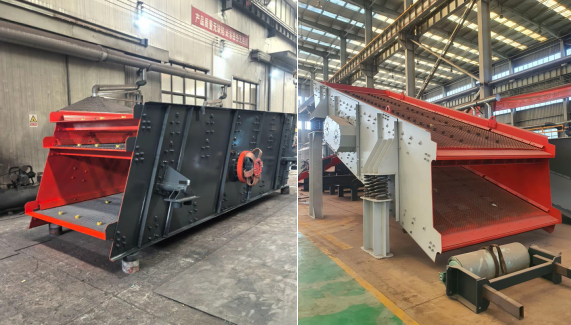
Linear motion vibrating screens transport material forward in a straight-line trajectory across the screen deck. This movement creates highly accurate particle separation and is suitable for fine material classification.
Circular vibrating screens generate circular motion using eccentric excitation force. The circular movement allows material to bounce and disperse efficiently over the screen surface, improving handling capacity and stratification.
Linear screens commonly use dual-shaft exciters powered by dual motors. This structure produces balanced vibration suitable for precise screening applications.
Circular vibrating screens generally adopt single-shaft eccentric block exciters capable of generating stronger vibration intensity for heavy-duty operations.
Circular vibrating screens usually provide better anti-blinding performance due to stronger material bouncing and self-cleaning effects.
Linear motion screens may experience clogging when processing wet or sticky materials, especially under unstable feeding conditions.
Linear screens are often designed with fully enclosed structures that help minimize dust leakage in environmentally sensitive applications.
Circular vibrating screens place the exciter above the screen box center of gravity, allowing faster material spreading and improved throughput.
Linear vibrating screens normally operate at low installation angles between 0–5 degrees.
Circular vibrating screens typically use installation angles around 15–20 degrees to increase material movement speed.
Linear motion screens are commonly used for:
Circular vibrating screens are preferred for:
For applications requiring high screening precision and multi-layer classification, linear motion vibrating screens remain the preferred solution.
For large-scale production involving abrasive and coarse materials, circular vibrating screens provide higher throughput and more reliable heavy-duty performance.
Selecting suitable screening equipment from the beginning helps reduce production downtime, maintenance cost, and long-term operational losses.
HUATAO GROUP also supplies complete mineral processing solutions covering crushing, screening, grinding, classification, flotation, magnetic separation, dewatering, filtration, tailings treatment, and conveyor systems.
Contact us:
Annie Lu
HUATAO GROUP
Email: annie.lu@huataogroup.com
WhatsApp: +86 18032422676
Website: www.tufflexscreen.com
#LinearMotionScreen
#CircularVibratingScreen
#MiningEquipment
#AggregateScreening
#ScreeningSolutions
#VibratingScreen
#MiningPlant
#QuarryEquipment
#MineralProcessing
#ScreenMedia
#PolyurethaneScreen
#BananaScreen
#FlipFlowScreen
#FineScreening
#MiningIndustry
#ScreenPanel
#MiningMachinery
#IndustrialScreening
#OreScreening
#AggregatePlant
can not be empty
can not be empty

HUATAO GROUP - SCREENS
ADD : No.298 Zhonghua North Street, Shijiazhuang 050000 China.
TEL : +86 0311 80690567
EMAIL :market@huataogroup.com
Web: www.tufflexscreen.com
 WhatsApp & WeChat : +86 18033763037