 Conclusion

Self-Cleaning Belt Magnet Dropping Iron Back? 9 Root Causes
-
 admin
- 06 Nov, 2026
Self-Cleaning Belt Magnet Dropping Iron Back? 9 Root Causes
How a Self-Cleaning Belt Magnet Works — and Where It Can Fail
An overband unit is a simple cycle: attract, hold, transport, release. The magnetic body creates a field that reaches down through the burden depth to the belt surface. Ferrous pieces are pulled up out of the ore and held against the underside of the magnet face or against the unit’s own narrow discharge belt. That belt — fitted with rubber cleats, driven by a small motor — travels perpendicular to the main conveyor, dragging captured steel sideways off the field and dropping it into a collection chute. An Electromagnetic Overband Separator does this with an energised coil whose strength can be tuned, while permanent units do it with rare-earth or ceramic magnet blocks.
The failure logic follows the cycle directly:
- Attract failswhen field depth is too shallow for the burden, or the field has decayed from heat or age.
- Hold failswhen a heavy piece out-pulls the field, or vibration and belt slap shake loosely-held steel loose.
- Transport failswhen cleats are worn, the discharge belt slips, the belt is tracked off its pulleys, or the belt runs backwards.
- Release failswhen the chute is blocked, too narrow, lined with packed ore, or positioned so pieces bounce off the chute lip back onto the main belt.

The 9 Root Causes, Ranked by Frequency
- Worn or missing discharge-belt cleats (most common).Cleats are sacrificial. Ore dust, sharp steel edges and repeated flexing grind them down; below roughly 8–10 mm of remaining height they no longer fence captured pieces against sliding. Long, heavy items — drill rods, rebar sections, bucket teeth — are the first to slide off and drop. Confirm by measuring cleat height at three points across the belt width.
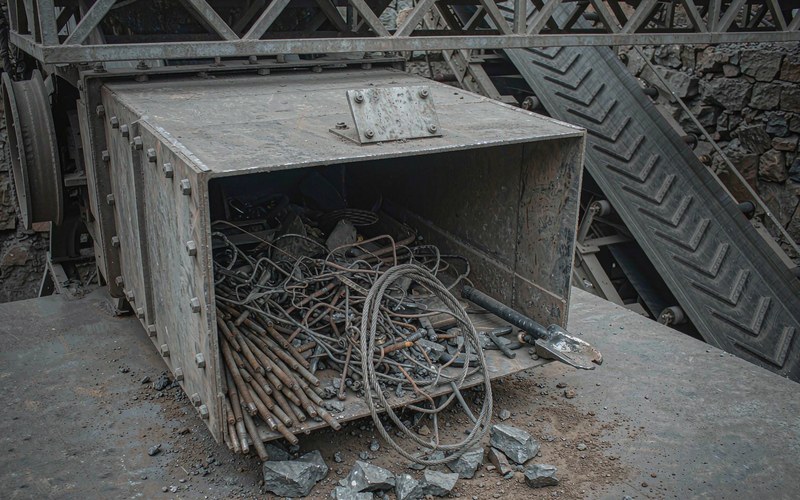
- Blocked or undersized discharge chute.Packed wet ore, tangled wire and accumulated fines build a bed inside the chute. Once the bed level rises above the chute lip, newly discharged iron lands on old iron and rolls back onto the main belt. If re-drop appears suddenly after rain or a sticky ore campaign, check the chute before anything else.
- Loose or slipping discharge belt.A slipping belt runs slower than design, so pieces ride past the release point and are flung off the pulley wherever momentum takes them. Look for glazing on the drive pulley, dusting around the tail pulley, and a drive motor running hot.
- Wrong discharge-belt rotation.After motor or gearbox replacement, reversed rotation carries captured iron the long way round and drops it on the wrong side — often straight onto the return strand. It happens more often than crews admit, and takes thirty seconds to verify.
- Excessive suspension height.Every extra 100 mm of gap costs field strength at the belt surface. Iron captured weakly near the magnet’s outer edges is barely held, and shakes loose over the first return idler. Verify height against the supplier’s calculation for your belt width, speed and burden depth.
- Coil overheating (electromagnetic units).Duty-cycle overload, blocked cooling paths or a failing thermostat let coil temperature climb; resistance rises and field depth shrinks. Iron is still captured near the surface but buried steel gets missed, and lightly-held pieces tear away. A clamp-meter reading against the nameplate current is the fastest confirmation.
- Permanent-magnet decay or heat shock.Ceramic and rare-earth circuits lose strength through repeated heat spikes above their rating and through shock from large falling steel. The loss is gradual and invisible without a pull-test kit or gaussmeter, so it masquerades as “ore got harder.”
- Iron pieces too heavy or too long for the field.A magnet is sized for a maximum piece mass at a given height. Long rods pivot on one end, walk off the cleat line, and drop. If the site’s digging practice changed — bigger excavators, new bucket teeth — the iron inventory changed too, and the magnet may now be under-rated.
- Main-belt misalignment and edge gaps.If the ore stream wanders because the belt tracks off-centre, iron near the edges passes outside the effective field width, gets captured late at the trailing edge, and releases beyond the chute. Fixing tracking — with a properly set Conveyor Belt Trackerand square idler frames — often recovers capture rate without touching the magnet.
-
Conclusion
A self-cleaning belt magnet that drops iron back onto the conveyor is not failing mysteriously — it is failing mechanically, visibly, and almost always fixably. Work the list in order: cleats, chute, tension, rotation, height, then field health, piece weight and belt tracking. Replace what is worn, restore what has drifted, and record baseline measurements so the next drift is caught early. In a market where copper and iron ore prices are keeping plants flat-out, where ageing equipment from the last investment cycle is entering its failure decade, and where rubber-based consumables are getting more expensive, the five-minute daily check on a magnet’s discharge path remains one of the highest-return habits in the plant. HUATAO Group manufactures and supplies mining wear parts and separation equipment — including self-cleaning and electromagnetic overband separators, magnetic drums and rollers, screen panels, crusher wear parts and conveyor protection components — with OEM manufacturing to drawing and export experience across mining projects worldwide.
Related Articles
- Self-Cleaning Screen vs Traditional Woven Wire Mesh: Which One Should You Choose?
- Polyurethane Screen vs Rubber Screen vs Wire Mesh: A Complete Comparison Guide
- Which Manufacturer Offers High-Quality Polyurethane Tufflex Wire Screens for Mining?
Contact Us
Contact: Annie Lu
Email: annie.lu@huataogroup.com
Phone / WhatsApp: +86 180 3242 2676
Website: http://www.tufflexscreen.com
We warmly welcome customers from around the world to contact us and establish mutually beneficial partnerships.
admin
personal profile
No prev page
Previous Post