
What Is the Real Difference Between a Self-Cleaning Magnetic Separator and a Manual Cleaning Magnet?
-
 admin
- 04 Nov, 2026
Quick Answer
A self-cleaning magnetic separator is justified whenever tramp iron arrives continuously, the conveyor runs long hours, or a single crusher shutdown costs more than the price difference. A manual cleaning magnet remains economical only when iron is scarce, cleaning is needed just a few times per month, and planned stops carry no production penalty.
Key Takeaways
✔ A manual magnet converts tramp iron removal into recurring downtime; a self-cleaning unit converts it into a fixed capital cost. ✔ Capture performance stays stable only if the magnet face is kept clear — exactly what a self-clearing cross-belt does automatically. ✔ Burden depth, belt width, iron load per hour, and moisture decide the choice more than the price tag. ✔ Electromagnetic units win at deep burden and high tonnage; permanent magnet units win at shallow burden and low power cost. ✔ For 24/7 mining conveyors feeding a jaw crusher or cone crusher, payback is usually measured in months, not years.
What Is the Real Difference Between a Self-Cleaning Magnetic Separator and a Manual Cleaning Magnet?
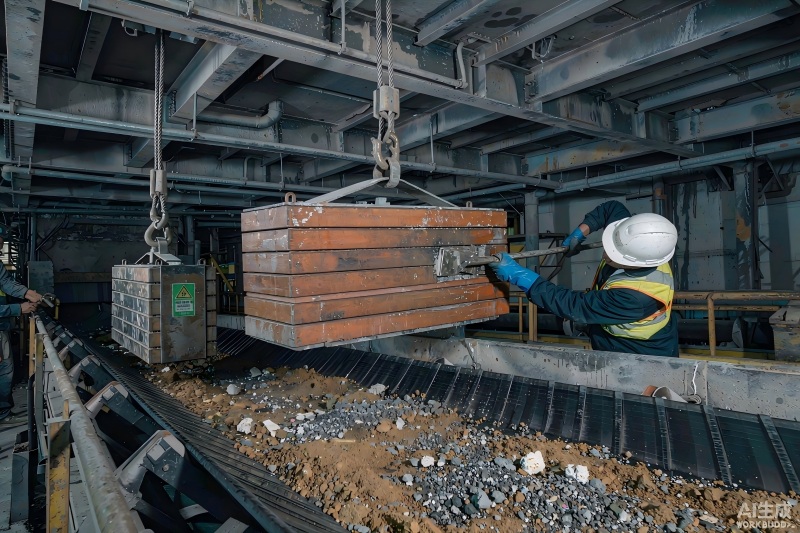
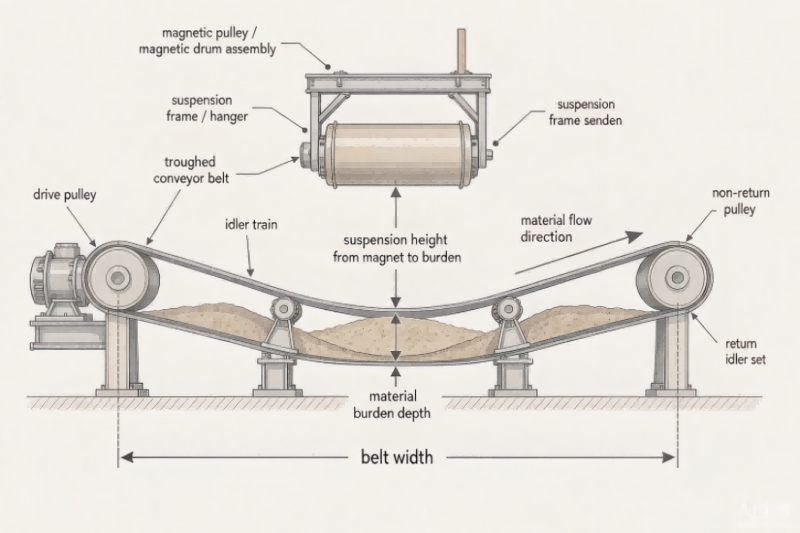
A self-cleaning magnetic separator is an overband magnet with its own discharge belt: captured iron is continuously carried sideways off the magnet face and dropped into a collection chute, while a manual cleaning magnet holds every piece of steel on its face until an operator clears it by hand. Both types protect the same downstream equipment — JAW CRUSHERS, cone crushers, screens — from tramp iron damage, and both are standard members of the MAGNETIC SEPARATORS family used above mining conveyors.
The engineering difference is small; the operational difference is large:
- Manual magnet:iron accumulates on the face → clearance to the burden shrinks → capture depth degrades → the line must stop for scraping. Cleaning frequency depends on human scheduling, so performance dips between stops.
- Self-cleaning unit:a cross-belt runs continuously across the magnet face → discharged iron leaves the product stream immediately → field clearance and capture performance stay constant around the clock.
A typical SELF-CLEANING ELECTROMAGNETIC SEPARATOR adds a drive motor, cross-belt, cleats, scrapers and a discharge hood to the basic magnet block. That mechanism is what you pay extra for — and what eliminates the recurring cost of stopping, climbing, and hand-scraping a live magnet above a conveyor.
Conclusion
The extra cost of a self-cleaning magnetic separator is justified exactly when the alternative stops being cheap: continuous iron loads, high-value uptime, expensive downstream equipment, or safety exposure from manual cleaning. Measure your tramp iron per day, your burden depth, and your real downtime cost — those three numbers answer the question more reliably than any brochure. When the duty is continuous, the self-cleaning design pays; when the duty is occasional and light, the manual magnet remains the correct tool. Both belong in a well-planned MAGNETIC SEPARATION stage of the mineral processing flowsheet, placed before crushing and screening where they protect everything downstream.
Related Articles & Products
- SELF-CLEANING SCREEN VS TRADITIONAL WOVEN WIRE MESH: WHICH ONE SHOULD YOU CHOOSE?
- POLYURETHANE SCREEN VS RUBBER SCREEN VS WIRE MESH: A COMPLETE COMPARISON GUIDE
- HYDROCYCLONE WEAR: ROOT CAUSES, HIGH-WEAR ZONES & MATERIAL SOLUTIONS
- WHICH MANUFACTURER OFFERS HIGH-QUALITY POLYURETHANE TUFFLEX WIRE SCREENS FOR MINING?
Contact Us
Contact: Annie Lu Email: annie.lu@huataogroup.com Phone / WhatsApp: +86 180 3242 2676 Website: http://www.tufflexscreen.com
We warmly welcome customers from around the world to contact us and establish mutually beneficial partnerships.
Tags:
admin
personal profile
No prev page
Previous Post