How Often Should I Replace Hydrocyclone Liners?
Oct 20, 2026
 admin
admin The best hydrocyclone for fine particle classification is one that matches your target particle size, throughput requirements, slurry characteristics, and wear conditions. Smaller-diameter hydrocyclones with optimized vortex finders, apexes, and wear-resistant liners generally deliver the highest classification efficiency and long-term operational stability.
Smaller hydrocyclones usually provide finer cut sizes.
Stable feed pressure is essential for classification accuracy.
Polyurethane and ceramic liners extend service life.
Proper apex and vortex finder sizing improve separation efficiency.
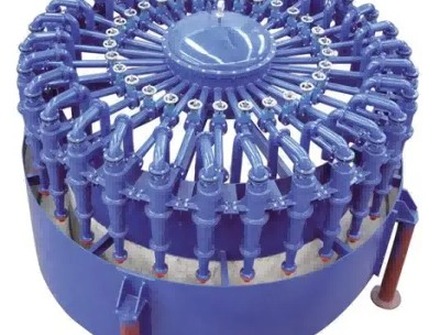
Hydrocyclone clusters often outperform single large units.
Wear management directly impacts classification consistency.
Hydrocyclones are critical between grinding and flotation circuits.
Total operating cost matters more than initial purchase price.
| Item | Description |
|---|---|
| Equipment | Hydrocyclone |
| Function | Fine Particle Classification |
| Process Stage | Classification |
| Feed Source | Ball Mill / SAG Mill |
| Typical Cut Size | 10–300 μm |
| Common Materials | PU, Rubber, Ceramic |
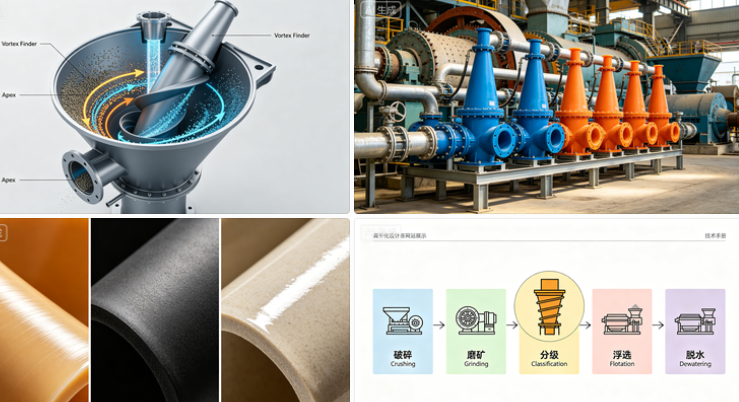
| Main Components | Cyclone Body, Vortex Finder, Apex, Liner |
| Industries | Gold, Copper, Iron Ore, Coal, Lithium |
| Major Benefit | Improved Recovery & Process Stability |
A hydrocyclone is a classification device that separates particles according to size and density using centrifugal force.
In mineral processing plants, hydrocyclones are usually installed after grinding equipment such as:
The primary purpose is to separate fine particles that are ready for downstream processing from coarse particles that require additional grinding.
Hydrocyclones are widely used in:
A hydrocyclone is not an isolated piece of equipment.
It forms part of a complete mineral processing circuit.
Crushing
↓
Screening
↓
Grinding
(Ball Mill / SAG Mill)
Classification
(Hydrocyclone)
Flotation
Gravity Separation
Magnetic Separation
Dewatering
Filtration
Tailings Management
If classification performance declines, downstream recovery and efficiency are immediately affected.
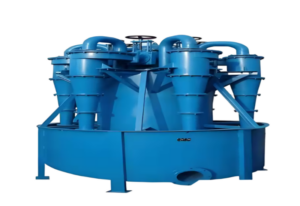
Hydrocyclones operate based on centrifugal force.
Slurry enters the cyclone tangentially under pressure.
A high-speed vortex develops inside the cyclone body.
Coarse particles move toward the outer wall and travel downward.
Fine particles move toward the central vortex.
Fine particles exit through the overflow.
Coarse particles exit through the apex.
The efficiency of this process depends on:
Hydrocyclones can classify particles ranging from approximately:
10 μm – 500 μm
Typical industrial ranges include:
| Industry | Classification Range |
|---|---|
| Gold Ore | 20–150 μm |
| Copper Ore | 20–200 μm |
| Iron Ore | 25–150 μm |
| Lithium Ore | 15–100 μm |
| Silica Sand | 20–200 μm |
| Coal | 50–500 μm |
Smaller-diameter hydrocyclones are generally preferred for ultrafine particle applications.
Cyclone diameter is one of the most influential design variables.
Advantages:
Disadvantages:
Advantages:
Disadvantages:
For fine particle classification, smaller cyclones often deliver better results.
The cone section controls particle residence time.
Longer cones generally provide:
Selecting the correct cone angle is essential for maximizing performance.
Hydrocyclone wear is unavoidable.
As liners wear, internal geometry changes and classification efficiency declines.
Common liner materials include:
Advantages:
Advantages:
Advantages:
Advantages:
| Factor | Polyurethane | Ceramic |
|---|---|---|
| Wear Resistance | High | Extremely High |
| Impact Resistance | Excellent | Moderate |
| Weight | Light | Heavy |
| Installation | Easy | More Complex |
| Cost | Moderate | Higher |
| Service Life | Long | Very Long |
For many operations, polyurethane offers the best balance between cost and performance.
One of the most overlooked factors.
Pressure fluctuations cause:
Higher densities may reduce classification efficiency if not properly controlled.
Feed PSD often affects classification performance more than cyclone size itself.
Worn liners change cyclone geometry and reduce accuracy.
Based on actual mineral processing projects, several patterns consistently emerge.
Many operators focus on hydrocyclone brands rather than operating conditions.
In reality, feed stability often matters more.
Small hydrocyclones generally provide better fine classification, but throughput must be considered.
Hydrocyclone clusters offer greater flexibility than single large units.
Poor classification is often caused by upstream grinding fluctuations rather than the cyclone itself.
Liner wear gradually changes cut size performance over time.
| Ore Type | Recommended Solution |
|---|---|
| Gold Ore | PU Hydrocyclone |
| Copper Ore | Ceramic-Lined Hydrocyclone |
| Iron Ore | Rubber-Lined Hydrocyclone |
| Lithium Ore | High-Efficiency Cyclone Cluster |
| Coal | Polyurethane Hydrocyclone |
| Silica Sand | Fine Classification Cyclone |
Before selecting a hydrocyclone, evaluate:
Consider:
The cheapest hydrocyclone is rarely the most economical long-term solution.
When requesting a quotation, prepare:
✔ Ore Type
✔ Capacity
✔ Feed Particle Size
✔ Slurry Density
✔ Target Cut Size
✔ Operating Pressure
✔ Can you provide OEM replacement parts?
✔ Do you provide engineering support?
✔ Can you supply wear-life recommendations?
✔ Do you have export experience?
✔ Can you provide material reports?
✔ What spare parts are stocked?
| Problem | Cause | Solution |
|---|---|---|
| Roping | Small Apex | Increase Apex Size |
| Poor Classification | Pressure Variation | Stabilize Feed |
| Excessive Wear | Abrasive Ore | Upgrade Liner Material |
| Low Recovery | Incorrect Cyclone Size | Re-select Equipment |
| Frequent Downtime | Low-Quality Wear Parts | Use Premium Liners |
Preventive maintenance significantly reduces operational costs.
Gold Processing Plant
Gold Ore
250 TPH
High circulating load and unstable flotation recovery.
Installed a cluster of smaller polyurethane hydrocyclones with optimized apex and vortex finder configurations.
✔ 28% improvement in classification efficiency
✔ 20% reduction in circulating load
✔ 15% increase in flotation recovery
✔ Reduced maintenance downtime
The best hydrocyclone for fine particle classification is not determined by brand alone. Success depends on selecting the correct cyclone diameter, cone angle, apex, vortex finder, and liner material while maintaining stable operating conditions.
At HUATAO, we provide complete hydrocyclone systems and mining wear solutions designed to improve classification efficiency, reduce downtime, and lower operating costs.
Our product range includes:
Annie Lu
Email: annie.lu@huataogroup.com
WhatsApp / Mobile: +86 180 3242 2676
Website: www.tufflexscreen.com
We warmly welcome customers from around the world to contact us and establish mutually beneficial partnerships.
admin