Conveyor Idlers for Dusty Mining Environments: Why the Sealing System Decides Everything
-
 admin
- 17 Nov, 2026
- The Failure Mechanism: How Dust Reaches and Ruins a Bearing
A conveyor idler consists of a cylindrical roller shell, a shaft, two bearings, bearing housings, seals and lubricant. During operation the roller rotates continuously while supporting the moving belt — millions of revolutions over its service life, each one an opportunity for contamination to work inward.
If dust penetrates the sealing system, it mixes with the bearing grease. Grease is supposed to lubricate; loaded with hard mineral particles it becomes a lapping compound. The paste grinds the raceways and rolling elements, clearances grow, and the bearing responds with higher friction, abnormal vibration, excessive noise and elevated operating temperature. Eventually the roller seizes.
A seized roller is not simply a maintenance item. The belt keeps moving across a stationary shell, scuffing the cover, building localized wear and, in the worst cases, generating dangerous frictional heat. One dead idler can damage the belt it was supposed to protect.
The character of the dust matters. Coarse particles accumulate around roller ends where inspections spot them. Fine particles — especially hard, silica-rich dust — penetrate gaps too small to see. Iron ore fines are aggressively abrasive; fine coal dust arrives with moisture and combustible-dust hazards; limestone powder and silica sand bring their own combinations of hardness and concentration. This is why idlers must be selected against the actual environment, not the material name on the flowsheet.
Watch for the early warnings: dust accumulating around roller ends, rough rotation, unusual noise, hot roller bodies, damaged seals, displaced end caps, contaminated grease and uneven belt wear. Each is an invitation to investigate before the failure migrates into the belt and the surrounding structure.
- Sealing Systems: The Specification That Decides
2.1 Grease-filled labyrinth seals
A labyrinth seal protects by geometry, not by contact. A series of narrow passages and direction changes forces contaminants to travel a long, difficult route toward the bearing, and grease-filled cavities along the way trap dust and reinforce the barrier. Because the main sealing surfaces do not rub continuously, rotational resistance stays low — a genuine advantage on rollers spinning continuously for years.
The limitations deserve equal attention. A labyrinth seal is not automatically dustproof. Its effectiveness depends on the number and geometry of sealing stages, manufacturing tolerances, the grease arrangement and the exposure conditions. Suppliers serving iron mines and taconite terminals document grease-purged labyrinth designs and stress one operational point: the purging procedure must be followed correctly, because careless relubrication can drive contaminants straight past the barriers the seal was built to provide. Labyrinth seals are available in sealed-for-life and regreasable configurations; the right choice depends on access, criticality and the site’s lubrication discipline.
2.2 Contact lip seals
A contact lip seal uses a flexible element pressed against a mating surface — a true physical barrier against dust and water. It earns its place where fine dust arrives combined with moisture, slurry or washdown exposure, conditions where a purely non-contact path eventually loses.
The trade-off is friction. Every contact seal drags, and excessive contact pressure or unsuitable materials raise rotational resistance and heat generation, quietly increasing conveyor power consumption. A lip seal must therefore be selected as part of the complete bearing and roller assembly, with material, contact pressure, surface condition, speed and temperature evaluated together — never added to a design as an afterthought.
2.3 Combined multi-stage systems
The most demanding duties get the combined answer: a non-contact labyrinth stage that strips most of the dust and water load, followed by a contact stage guarding the bearing itself. The stages are complementary — the labyrinth reduces what the contact seal must resist, and the contact seal closes what the labyrinth cannot. The cost is a more complex assembly and slightly higher drag, which is exactly why complete-assembly validation matters more than catalogue claims.
2.4 What buyers should actually ask
Instead of asking whether an idler is “dustproof,” put these questions to every supplier:
- How many sealing stages are provided, and do they combine contact and non-contact barriers?
- Is the bearing assembly sealed for life or regreasable, and what lubricant and temperature range is specified?
- Has the complete roller assembly been tested for dust ingress, and are reports available?
- What rotational resistance does the sealing system introduce?
A sectional drawing or a cutaway sample reveals more about the sealing arrangement in one minute than a product photograph ever will. 📊 Suppliers confident in their seals publish both.
- Shell Material: Steel, HDPE or Rubber-Disc?
3.1 Heavy-duty steel idlers
Steel rollers dominate mining because they provide structural rigidity and can be engineered for demanding loads in carrying, return and impact positions. For abrasive mineral handling, the design factors that matter are shell diameter and wall thickness sized by calculation, shaft diameter and material, bearing load rating, housing construction, weld quality and dimensional accuracy, seal design and lubricant selection, and corrosion protection where the environment demands it. What steel cannot do is compensate for a poor seal: shell thickness decided by fear instead of engineering adds weight and cost without touching the failure mechanism.
3.2 HDPE and composite rollers
High-density polyethylene and composite rollers bring lower weight, corrosion resistance, reduced noise and reduced adhesion of certain materials — real advantages in corrosive environments and where maintenance crews handle rollers by hand. The evaluation list is equally real: load capacity, shell deformation, temperature limits, static electricity, fire requirements and impact resistance. In coal mines and other potentially explosive atmospheres, the complete roller and conveyor system must meet the applicable site safety requirements. HDPE is a strong answer to specific problems, not a universal upgrade.
3.3 Rubber-disc return rollers
Rubber-disc return rollers use spaced discs to reduce contact area between belt and roller, limiting the accumulation of sticky material on the return strand. Rubber-coated rollers similarly change contact characteristics where the application calls for it. But the discs do not protect bearings — the roller still requires an effective sealing system, and the return side remains one of the most contamination-exposed positions on the conveyor.
3.4 The material verdict
For most dusty mining applications, a robust roller with a proven sealing system beats a shell chosen by appearance, weight or habit. Steel, HDPE and rubber-disc rollers all fail the same way once dust reaches the bearing. Choose the shell for the mechanical duty; choose the seal for the environment.
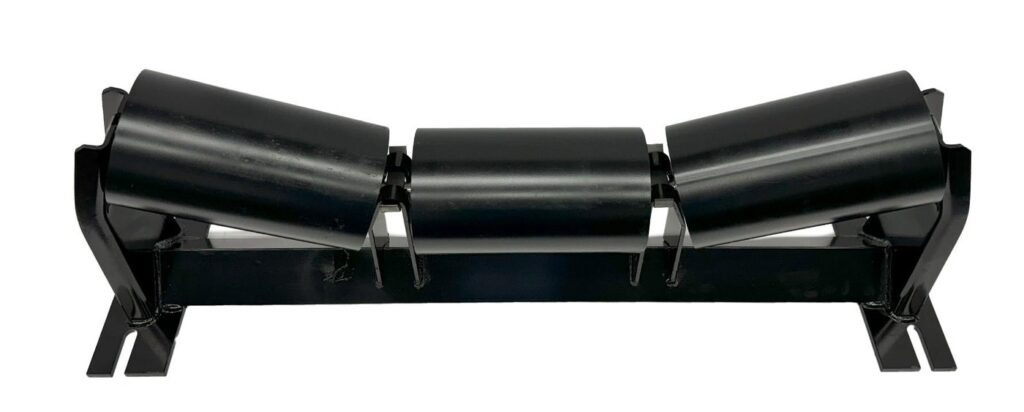
HDPE polymer idler roller for bulk handling
- Right Roller, Right Position
A mining conveyor is several different duties joined by one belt, and specification should follow position:
- Carrying idlerssupport the loaded belt, typically as three-roll troughing assemblies at 20°, 35° or 45°. They need effective bearing seals, appropriate load capacity, accurate alignment and suitable shell strength, with spacing calculated from belt tension, load, sag and operating conditions rather than copied from a universal figure.
- Return idlerssupport the empty strand — which is anything but clean, exposed as it is to residual fines, falling dust and buildup. Sealed return rollers with corrosion protection and accessible mounting are the baseline; rubber-disc variants help where carryback persists, though improved belt cleaning upstream is usually the more effective long-term fix.
- Impact idlersabsorb the energy at loading points with resilient rings and dynamic load ratings. For severe drop heights or large sharp rock, an engineered impact bed can support the belt more continuously than any conventional impact idler. Selection depends on impact energy, belt speed, support geometry and rated limits.
- Training idlerscorrect belt tracking, and in dusty mines their pivoting mechanisms and bearings face the same contamination as everything else — specify them with suitable protection. Use them to correct drift, never to conceal off-center loading, misaligned pulleys, damaged frames or material buildup.
- Bearings: Rating, Speed and the Limits of L10
Bearing selection is the second half of reliability. Roller rotational speed follows n = 60v/(πD): a 3 m/s belt on 133 mm rollers spins about 431 rpm, a number worth knowing when checking bearing speed capability, seal friction and expected life.
Bearing fatigue life is conventionally expressed as L10 — the life 90% of a large group of identical bearings will reach or exceed before classical rolling-contact fatigue, calculated as L10h = (10⁶/60n)(C/P)³ for ball bearings. The equation assumes clean lubrication and rated load. Dust contamination, water ingress, incorrect lubrication, mounting errors and abnormal impact loads all invalidate the assumption, which is why real failures arrive far ahead of the calculated figure. A high L10 rating behind a leaking seal is a scheduled failure wearing a specification.
When evaluating replacement idlers, confirm the whole parameter set: roller diameter and length against the existing frames, shaft dimensions, bearing type and load rating, seal construction, shell thickness by engineering need, total indicated runout, rotational resistance, operating temperature limits for bearing, grease and seal, and the supplier’s inspection and validation records. Metso’s heavy-duty mining rollers emphasise the same combination: bearing selection, dimensional accuracy, low runout and contamination-resistant sealing.
- Cutting Dust at Source: The Other Half of the Answer
Even the best-sealed idlers benefit when the conveyor stops feeding them dust:
- Transfer pointsare the dominant dust source. Falling material displaces air and raises turbulent dust clouds, and the problem worsens when the belt sags between idlers, opening gaps beneath the skirtboards. Practical measures: proper skirt sealing, consistent belt support, enclosure of the transfer point, dust curtains and dust collection equipment where required.
- Belt cleaningcuts carryback before it falls onto return idlers. A properly selected primary cleaner, supplemented by a secondary cleaner where necessary, limits the abrasive buildup that finishes off return-side rollers. Inspect blades for wear, tension and contact.
- A preventive inspection programmefinds dying rollers before they seize: unusual noise, spillage and tracking each shift; dust buildup, roller temperatures and visible seal damage weekly; wear patterns, frame alignment and mounting condition monthly; bearing condition and structural integrity at scheduled shutdowns; failure history and maintenance cost reviewed periodically. Temperature monitoring, acoustic inspection and condition-monitoring systems all help — always under approved safe-access procedures. Never touch, clean or attempt to free a rotating idler; maintenance on hazardous moving parts happens only under isolation and lockout.
Conclusion
The best conveyor idlers for dusty mining environments are not the heaviest, largest or most expensive rollers on the market. They are the rollers whose multi-stage sealing, correctly rated bearings, mechanical construction and operating characteristics match the real conditions at each position on the conveyor — dry abrasive dust answered with engineered labyrinth seals, dust-with-moisture answered with combined systems, and every position specified for its own duty. Pair the right rollers with skirting, belt cleaning and dust suppression, and the idlers you install will finally outlive the failures that made you replace them.
Contact
Annie Lu
Email: annie.lu@huataogroup.com
WhatsApp/WeChat: +86 18032422676
Website: www.tufflexscreen.com
Tags:
 admin
personal profile