
Does a Self-Cleaning Overband Magnet Really Stop Tramp Iron From Reaching Your Crusher — or Just Reduce It?
-
 admin
- 05 Nov, 2026
What Is a Self-Cleaning Overband Magnetic Separator?
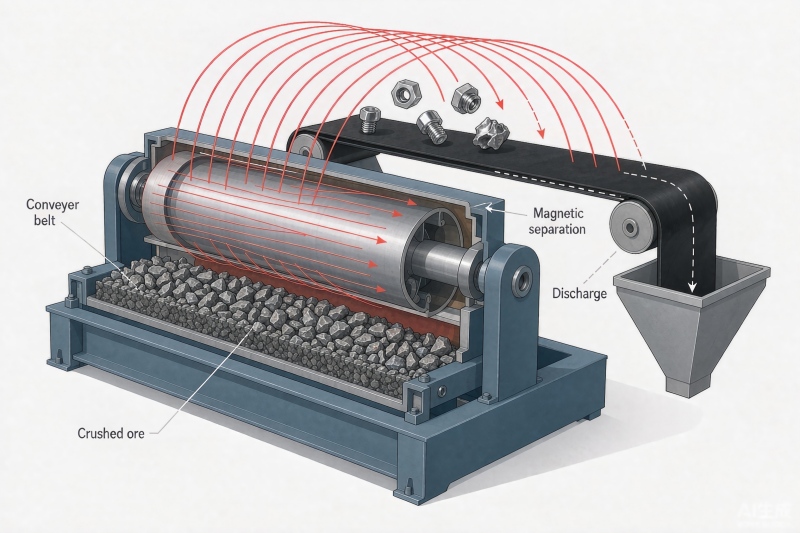
A self-cleaning overband magnetic separator — also called a suspended magnet or cross-belt magnet — is an iron-removal device hung above a conveyor belt. Its magnetic block pulls ferrous objects up out of the material stream, and an endless discharge belt continuously scrapes them off the magnet face and drops them into a collection chute. Unlike a manual-clean suspended Iron Magnet, which must be de-energized and wiped down by workers at intervals, a self-cleaning unit runs unattended around the clock. It sits at the front line of the conveying stage: crushing, screening and grinding all happen downstream of it, so its capture performance defines how much damage the rest of the plant absorbs.
How Does a Self-Cleaning Overband Magnet Capture Tramp Iron?
The working principle is magnetic force competing against gravity and material drag — nothing more. As ore passes beneath the separator, ferrous pieces such as excavator teeth, drill bits, rock bolts and broken liner fragments experience an upward pull. If that pull exceeds the forces holding the piece in the burden, the object lifts to the magnet face, where the self-cleaning belt drags it out of the field and into a collection bin.
Three physical limits decide whether a piece actually makes that journey:
- Burden depth.Magnetic force decays rapidly with distance. A 200 mm-thick ore bed on a 1200 mm belt demands far deeper field penetration than a 50 mm layer of screened gravel. A piece buried at the bottom of a deep bed may never feel enough force to lift.
- Belt speed.Capture happens in the residence time under the magnet — typically well under one second. Faster belts shorten that window; heavy pieces may only tilt before the field zone ends.
- Shape and mass.Long, thin objects (rebar offcuts, wire rope) and heavy compact pieces (a 20 kg excavator tooth) are the hardest cases. This is why deep-field electromagnetic designs are preferred for heavy mining duty.

-
Case Study
Customer Type: Iron ore mine, 2,000 t/h primary crushing line
Ore Type: Magnetite iron ore, high silica
Operating Conditions: 1,400 mm belt at 2.2 m/s, burden depth 180–250 mm, dusty outdoor installation
Problem: Digger teeth and broken drill steel repeatedly reached the primary gyratory crusher. Two liner-damage shutdowns in six months, each costing 2–3 days of lost production.
Solution: Replaced an undersized manual-clean suspended magnet with a deep-field self-cleaning electromagnetic overband, lowered suspension height from 450 mm to 300 mm, flattened the idler spacing under the magnet, and added a metal detector with belt-stop interlock downstream.
Result: Captured tramp iron volume roughly tripled within the first month. No crusher shutdown from tramp metal in the following 12 months; estimated payback period under one year when measured against the two previous shutdowns.
FAQ
Q1: What percentage of tramp iron does a self-cleaning overband magnet actually remove?
A: A correctly sized unit typically captures 90–98% of ferrous tramp iron within its designed burden depth. The exact figure depends on bed depth, belt speed and piece geometry. Treat it as a reduction device and keep a metal detector or inspection routine for the remainder.
Q2: Can it stop non-magnetic stainless steel or manganese steel?
A: No. Any magnet only responds to ferromagnetic material. Stainless, aluminum, brass and many manganese steel fragments pass through untouched. A metal detector with a belt-stop interlock is the only reliable defense against non-magnetic metal.
Q3: Permanent or electromagnetic overband — which should I buy?
A: For aggregate, coal and moderate iron burdens, permanent units are cheaper to run and nearly maintenance-free. For iron ore, deep beds, fast belts or heavy pieces above ~15 kg, an electromagnetic unit’s deeper field justifies its power consumption and higher purchase price.
Q4: How high above the belt should the magnet be mounted?
A: As a rule of thumb, 200–300 mm above the belt surface for a 1,000 mm belt (roughly 0.2–0.3 × belt width), adjusted for burden depth. Lower is better as long as the tallest lumps cannot strike the discharge belt. The supplier should calculate the exact height from your conveyor data.
Q5: Will the magnet work on wet or sticky ore?
A: Partially. Large wet lumps with embedded steel may ride through because fines cement pieces together. Overband magnets are fundamentally dry-process devices; for fine iron removal from wet slurry, wet drum magnetic separation is the appropriate technology instead.
Q6: Does a self-cleaning magnet need power?
A: Permanent models need power only for the small discharge-belt drive motor. Electromagnetic models draw roughly 5–12 kW per metre of magnet width for the coil, plus cooling. Neither type stops the conveyor to discharge its captured steel.
Q7: Can I retrofit it onto my existing conveyor?
A: Yes. Overband separators hang from a support frame above the belt and require no conveyor modification beyond structural space and a collection chute. Confirm headroom, frame load capacity and safe access for clearing captured steel.
Q8: How much does one cost, and what drives the price?
A: Price scales with belt width, field depth and permanent-vs-electromagnetic configuration; electromagnetic units typically cost 1.8–2.5× an equivalent permanent unit. The bigger cost factor is wrong-sizing: an undersized magnet that lets metal through costs far more in one crusher shutdown than the price difference between models.
Q9: How is this different from the screen panels and wear parts I buy for crushing and screening?
A: Magnets remove the threat; wear parts absorb it. Polyurethane screen panels, crusher liners and belt cleaners are engineered to survive abrasion, while the magnet’s job is to keep steel out of those systems entirely. A plant that controls tramp iron gets measurably longer life from every downstream wear part.
Conclusion
A self-cleaning overband magnet genuinely protects a crusher — but honestly, it reduces rather than stops tramp iron. Plan around a realistic 90–98% ferrous capture rate, position the magnet where the burden is thinnest, match field depth to your actual ore and piece sizes, and back it with a metal detector for everything a magnet cannot see. Do those four things and the question stops being “will steel reach my crusher?” and becomes the far better one: “how long until the payback shows up in my liner budget?”
HUATAO Group supplies mining wear parts and separation equipment including self-cleaning and electromagnetic overband separators, magnetic drums and rollers, screen panels, crusher wear parts and conveyor protection components, with OEM manufacturing to drawing and export experience across mining projects worldwide.
Related Articles
- Self-Cleaning Screen vs Traditional Woven Wire Mesh: Which One Should You Choose?
- Polyurethane Screen vs Rubber Screen vs Wire Mesh: A Complete Comparison Guide
- Which Manufacturer Offers High-Quality Polyurethane Tufflex Wire Screens for Mining?
Contact Us
Contact: Annie Lu
Email: annie.lu@huataogroup.com
Phone / WhatsApp: +86 180 3242 2676
Website: <http://www.tufflexscreen.com>
We warmly welcome customers from around the world to contact us and establish mutually beneficial partnerships.
admin
personal profile
No prev page
Previous Post