
Quick Answer
What Is a Hydrocyclone?
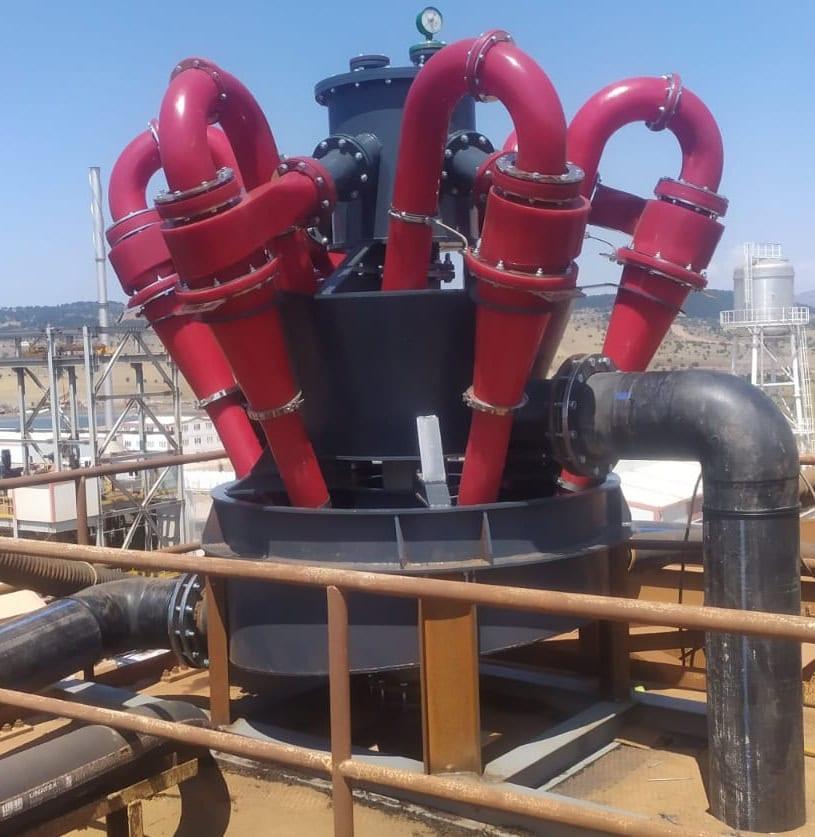
A hydrocyclone is a static, pressure-driven device that uses centrifugal force to separate particles by size and density. Slurry fed tangentially spins, with fine particles exiting through the overflow and coarse particles through the apex. It is a high-capacity, compact classification solution.
Key Takeaways
✔️ High Capacity & Efficiency: Hydrocyclones offer superior classification at fine cut points.
✔️ Compact Design: Hydrocyclones require minimal floor space.
✔️ No Moving Parts: Hydrocyclones have low mechanical maintenance.
✔️ Spiral Classifier Robustness: Spiral classifiers offer reliable operation for coarse applications.
Summary Table
| Item | Description |
|---|---|
| Function | Separates particles by size and density. |
| Hydrocyclone | Uses centrifugal force (pressure-driven). |
| Spiral Classifier | Uses gravity settling & mechanical raking. |
| Best Application | Hydrocyclone: Fine cuts (< 150 microns); Spiral: Coarse cuts (> 150 microns). |
| Key Wear Parts | Cyclone liners, vortex finder, apex, or classifier shoes. |
Definition and Working Principle
In mineral processing, classification is the process of separating ground material into fine and coarse particles. It is a critical bridge between grinding and concentration.
A hydrocyclone works on the principle of centrifugal sedimentation. Slurry is injected under pressure, creating a vortex that separates particles based on mass.
A spiral classifier works on the principle of gravity settling in a pool. Heavy coarse particles sink and are transported up the incline by the rotating spiral.
Benefits & Applications
Hydrocyclone: The main benefit is its ability to handle high volumes and produce a very precise fine cut, which is essential for maximizing recovery in flotation. It is the primary classifier in modern ball mill circuits and is used extensively in copper, gold, iron ore, and lithium processing.
Spiral Classifier: The main benefit is its robustness and simplicity. It is often used for coarser classifications and in applications where feed conditions are not perfectly consistent. It is commonly found in smaller plants, coal preparation plants, and older concentrators.
Material Comparison & Selection Guide
The performance of either system depends heavily on the wear resistance of its components. For hydrocyclones, the choice of liner material (Polyurethane, Rubber, Ceramic) is paramount. Tufflex's polyurethane screen panels offer excellent wear resistance for vibrating screens in the circuit.
When choosing your system, consider:
Capacity: Hydrocyclones are for high tonnages.
Cut Point: Hydrocyclones for finer (< 150 µm), Spiral classifiers for coarser (> 150 µm).
Space: Hydrocyclones are compact; Spiral classifiers need a large footprint.
Maintenance: Hydrocyclones have high wear-part costs; Spiral classifiers have high mechanical costs.
Procurement Guide
When procuring classification equipment:
Define Requirements: Clearly specify the required capacity and cut point.
Material Selection: Specify the correct wear material (Polyurethane, Rubber, Ceramic).
OEM Compatibility: Ensure the supplier can provide parts that match your existing equipment specifications.
Supplier Evaluation: Assess the supplier's manufacturing capabilities, quality control, and export experience.
Failure Analysis
| Problem | Possible Cause | Recommended Solution |
|---|---|---|
| Hydrocyclone coarse cut point | Worn vortex finder. | Replace the vortex finder. |
| Hydrocyclone fine cut point | Worn apex. | Replace the apex. |
| Spiral classifier not conveying | Worn classifier shoes. | Replace classifier shoes. |
Maintenance Guide
Daily: Monitor operating pressure and overflow condition for hydrocyclones; check lubrication and mechanical sounds for spiral classifiers.
Weekly: Inspect all visible wear surfaces.
Monthly: Measure and record critical wear part dimensions (e.g., apex and vortex finder diameter).
Replacement: Replace parts before they cause a complete failure or significant drop in performance.
Case Study: Copper Concentrator
Customer Type: Copper Mine
Ore Type: Copper Ore
Operating Conditions: 400 t/h, target P80 of 75 microns.
Problem: The existing spiral classifier could not achieve the required P80, limiting flotation recovery.
Solution: Replaced the spiral classifier with a new hydrocyclone cluster.
Result: Achieved the 75-micron target, increased ball mill throughput, and improved flotation recovery by 5%.
FAQ
Question: Which is more efficient, a hydrocyclone or a spiral classifier?
Answer: For fine particle separation, a hydrocyclone is significantly more efficient. For coarse separation, the efficiency is comparable, but the spiral classifier is simpler and more forgiving of feed variations. Your choice should be based on your target cut point and capacity requirements.
Question: How often should I replace hydrocyclone wear parts?
Answer: Replacement frequency depends on ore abrasiveness and operating pressure. In highly abrasive applications, apexes and vortex finders may need replacement every 2-4 weeks. Regular monitoring of performance indicators like overflow density and pressure drop will help you establish an optimal replacement schedule.
Question: Are polyurethane screen panels used in classification circuits?
Answer: Yes, polyurethane screen panels are widely used in screening equipment that often works in conjunction with classifiers. They provide excellent wear resistance and help achieve sharp separations in the grinding circuit before or after classification. Tufflex offers a full range of high-quality polyurethane screen panels for these applications.
Question: What is the typical service life of a spiral classifier?
Answer: With proper maintenance, a spiral classifier can last 15-20 years or more. However, wear components like the classifier shoes, spiral blades, and bearings require periodic replacement. The frequency depends on the abrasiveness of the material being processed.
Question: Can a hydrocyclone replace a spiral classifier in an existing plant?
Answer: Yes, but it requires careful engineering. You will need to ensure sufficient pumping capacity for the required feed pressure, modify piping, and potentially adjust the grinding circuit configuration. The benefits typically include improved classification efficiency and reduced floor space requirements.
Question: What causes a hydrocyclone to produce a roping condition?
Answer: Roping occurs when the underflow discharge is too thick and discharges in a continuous stream rather than a spray. Common causes include excessive feed solids concentration, a worn or oversized apex, or insufficient feed pressure. Adjusting these parameters usually resolves the issue.
Question: How do I select the correct apex size for my hydrocyclone?
Answer: Apex size is selected based on the required cut point and underflow density. A smaller apex produces a finer cut but requires higher pressure. A larger apex produces a coarser cut and lower underflow density. Start with the manufacturer's recommendations and adjust based on actual plant performance data.
Question: What are the advantages of polyurethane wear parts for classifiers?
Answer: Polyurethane offers excellent abrasion resistance, good elasticity, and a long service life. It is lighter than steel or ceramic, making installation easier, and its flexibility helps resist impact damage. Polyurethane wear parts also provide a smooth surface that reduces material buildup, improving flow characteristics.
Conclusion
Choosing between a hydrocyclone and a spiral classifier is a critical decision that affects your entire mineral processing circuit. Hydrocyclones offer superior fine classification, high capacity, and a compact footprint, making them the preferred choice for modern, high-tonnage operations. Spiral classifiers remain a robust, reliable option for coarse classification and smaller plants where operational simplicity is valued. By carefully evaluating your process requirements and working with an experienced supplier like HUATAO, you can select the optimal solution for your specific needs.
Related Articles
Related Products: High Wear Resistance PU Lined Hydrocyclone For Mining, Classifier Shoes, Polyurethane Screen Panel, Rubber Screen Panel, Overflow Ball Mill
Related Technical Guides: Mineral Technical News, Hydrocyclone Selection Guide, Hydrocyclone Sizing Guide, Grinding Process Guide, OEM Crusher Wear Parts Guide
Related Buyer Guides: Hydrocyclone Suppliers In China, Flotation Equipment Spare Parts Suppliers, Mining Screen Manufacturers In China
Related Comparison Articles: Hydrocyclone Vs Vibrating Screen, PU Vs Rubber Screen Panels, Best Alternative To Metso Crusher Wear Parts
Contact:
Annie Lu
Email: annie.lu@huataogroup.com
Mobile: +86 18032422676
Tags: Hydrocyclone, Spiral Classifier, Tufflex, Classification, Mineral Processing, Polyurethane Screen Panels, Mining Equipment
can not be empty
can not be empty

HUATAO GROUP - SCREENS
ADD : No.298 Zhonghua North Street, Shijiazhuang 050000 China.
TEL : +86 0311 80690567
EMAIL :market@huataogroup.com
Web: www.tufflexscreen.com
 WhatsApp & WeChat : +86 18033763037