
In modern dewatering and classification processes, screen structure plays a decisive role in operational performance. Conventional flat screens often suffer from clogging and poor stratification, while fully raised designs lack precision.
To overcome these limitations, an optimized solution has emerged:
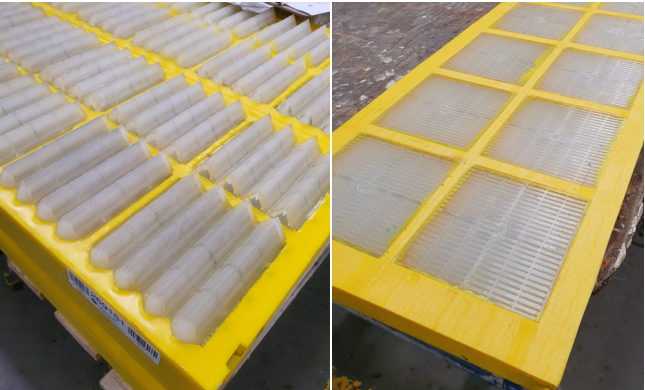
the combined raised and flat surface screen design.
The wavy or inverted-V structure forces particles to move dynamically under vibration, effectively breaking moisture-induced surface tension and preventing blockage.
The three-dimensional flow path ensures that particles repeatedly contact new openings, significantly improving screening efficiency.
The raised peaks disperse accumulated material, enabling quick separation of coarse and fine particles.
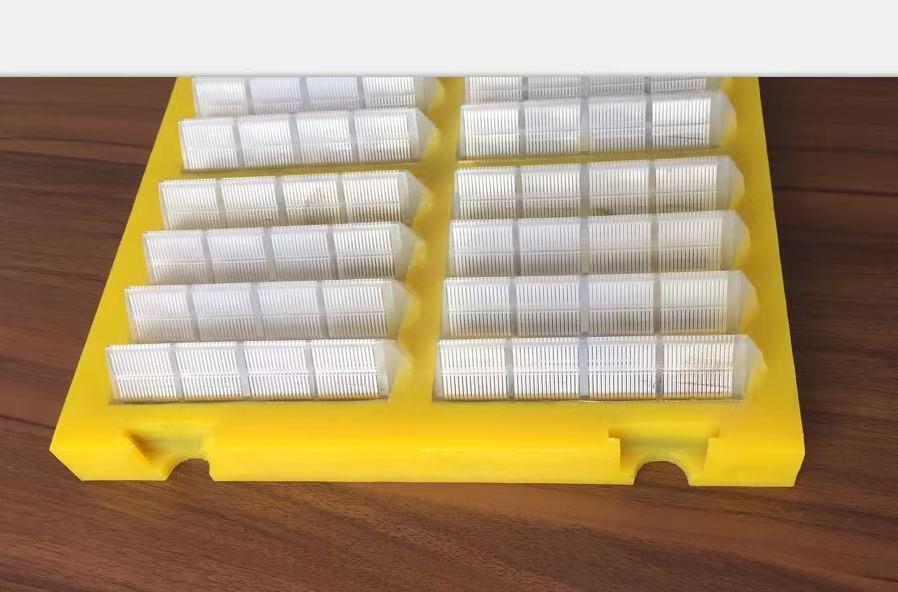
The flat section provides uniform apertures for accurate particle sizing, ensuring consistent product quality.
With higher rigidity, the flat area serves as the primary load-bearing section, resisting wear and prolonging service life.
| Section | Function | Benefit |
|---|---|---|
| Raised (Front) | Pre-screening & dewatering | Anti-clogging, high throughput |
| Flat (Rear) | Final grading | Precision, durability |
This integration allows the system to achieve both high capacity and high accuracy simultaneously.
This design is widely applied in:
To maximize performance:
The combination of raised and flat surfaces represents a significant advancement in dewatering screen technology. It effectively addresses clogging, improves efficiency, and ensures precise separation, making it an ideal solution for modern industrial applications.
Annie Lu
Huatao Group
Email: annie.lu@huataogroup.com
Mobile: +86 18032422676
Website: www.tufflexscreen.com
#DewateringScreen #MiningScreen #ScreeningTechnology #PolyurethaneScreen #AntiClogging #MineralProcessing #VibratingScreen #MiningEquipment
can not be empty
can not be empty

HUATAO GROUP - SCREENS
ADD : No.298 Zhonghua North Street, Shijiazhuang 050000 China.
TEL : +86 0311 80690567
EMAIL :market@huataogroup.com
Web: www.tufflexscreen.com
 WhatsApp & WeChat : +86 18033763037