
What Are Jaw Crusher Wear Parts and Where to Buy Them?
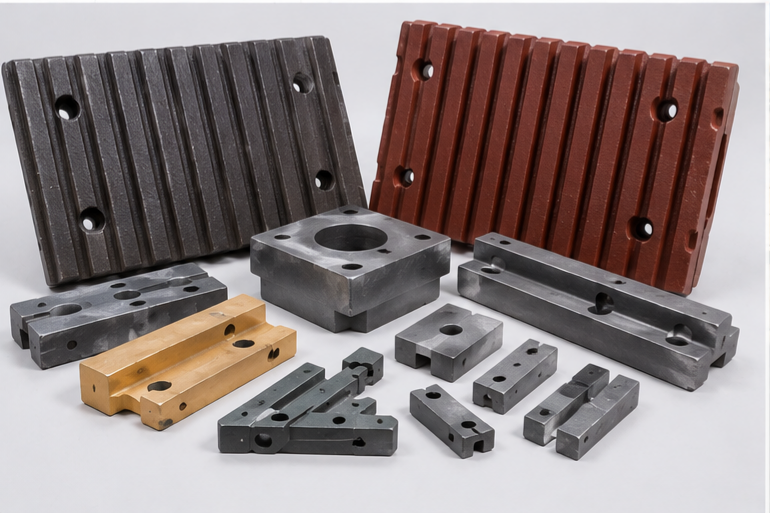
Jaw crusher wear parts are manganese steel components (fixed jaw plate, swing jaw plate, cheek plates, toggle plate) that crush material in primary mining applications. High-quality parts require correct Mn grade (Mn13/18/22), precise heat treatment, and dimensional accuracy. Buy from suppliers with in-house foundries, ISO 9001, and custom manufacturing capability – such as HUATAO – to achieve 30–50% cost savings vs OEM.
✔ Mn13 (high toughness), Mn18 (balanced), Mn22 (high abrasion)
✔ Dimensional accuracy prevents efficiency loss and frame damage
✔ Verified heat treatment prevents premature cracking (key failure mode)
✔ Aftermarket OEM-compatible parts equal or exceed OEM wear life
✔ Always request spectrometer and hardness test reports
✔ HUATAO manufactures from drawings or samples – no MOQ for trials
| Item | Description |
|---|---|
| Function | Primary compression crushing of ore and rock |
| Core Materials | Mn13, Mn18, Mn22 manganese steel |
| Typical Parts | Fixed jaw plate, swing jaw plate, cheek plates, toggle plate |
| Industries | Gold, copper, iron ore, lithium, aggregates, coal |
| Service Life | 800–2,500+ hours (ore-dependent) |
| Key Benefits | Lower cost/ton, custom profiles, shorter lead time (4–6 weeks) |
Jaw crusher wear parts are consumable liners that directly contact and crush material. They include:
Fixed jaw plate (stationary)
Swing jaw plate (moving)
Cheek plates (side liners, protect crusher frame)
Toggle plate (safety/overload protection)
Wedges (for clamping)
The jaw crusher uses compressive force. Material enters the V-shaped chamber between fixed and moving jaws. The moving jaw plate exerts pressure, crushing material against the fixed plate. Manganese steel work-hardens: surface hardness increases significantly under impact, providing wear resistance while maintaining a tough core.
Extended wear life: Up to 2× longer with correct Mn grade and profile.
Lower operating cost: Reduced cost per ton (not just part price).
Stable product size: Maintains closed side setting (CSS) longer.
Less downtime: Fewer liner changes per year.
Custom optimization: Tooth profile designed for your feed size.
| Industry | Ore Type | Typical Crusher Model | Recommended Mn Grade |
|---|---|---|---|
| Gold mining | Quartz vein | Metso C106, Sandvik CJ411 | Mn18 |
| Copper mining | Porphyry | Terex JW42, Symons 4.25 | Mn18 |
| Iron ore | Hematite/magnetite | Sandvik CJ612, Metso C160 | Mn22 |
| Lithium | Pegmatite | Trio CT3254 | Mn18 |
| Aggregates | Granite, basalt | Various | Mn18 or Mn22 |
| Coal mining | Soft rock | Single toggle | Mn13 |
| Attribute | OEM (Metso, Sandvik, Terex) | HUATAO Aftermarket |
|---|---|---|
| Dimensional accuracy | Reference standard | Verified via CMM/3D scan |
| Material range | Mn13, Mn18 (limited) | Mn13, Mn18, Mn22, custom |
| Heat treatment control | Good | Documented + certified |
| Custom tooth profile | No | Yes (drawing or sample) |
| Engineering support | General | Direct application engineer |
| Lead time (typical) | 8–12 weeks | 4–6 weeks |
| Cost | High | 30–50% lower |
| Wear life (abrasive ore) | Baseline | +30–80% possible |
| Mn Grade | Initial BHN | Work-hardened BHN | Impact Toughness (J/cm²) | Best Application |
|---|---|---|---|---|
| Mn13 | 180–220 | 450+ | >180 | Very high impact, tramp iron risk, large feed, coal |
| Mn18 | 200–240 | 500+ | 150–180 | Standard hard rock, copper, gold, average abrasion |
| Mn22 | 220–260 | 550+ | 120–150 | High abrasion (Ai>0.6), iron ore, basalt, silica |
| Industry | Abrasion Index (Ai) Range | Recommended Mn Grade | Expected Wear Life Improvement vs Mn18 |
|---|---|---|---|
| Gold – low silica | 0.2–0.4 | Mn18 | Baseline |
| Gold – high silica | 0.5–0.7 | Mn22 | +40–60% |
| Copper | 0.3–0.5 | Mn18 | Baseline |
| Iron ore | 0.6–0.8 | Mn22 | +50–80% |
| Lithium pegmatite | 0.4–0.6 | Mn18 | Baseline |
| Aggregates (hard) | 0.5–0.7 | Mn22 | +30–50% |
| Coal | <0.2 | Mn13 | Similar to Mn18 but tougher |
Step 1 – Data collection
Crusher model, serial number, OEM part number
Feed size distribution (P80, top size)
Ore work index (Wi) and abrasion index (Ai)
Desired closed side setting (CSS)
Step 2 – Initial material selection
Ai < 0.3 → Mn13 (if high impact) or Mn18 (standard)
Ai 0.3–0.6 → Mn18
Ai > 0.6 → Mn22
Step 3 – Request trial set from qualified supplier with material test reports.
Step 4 – Installation and monitoring
Install with proper torque
Measure CSS weekly
Record hours and tons at each CSS adjustment
Step 5 – Optimization
If wear is uneven → adjust toggle plate or jaw profile
If life too short → upgrade to higher Mn grade or modified tooth design
Information required for accurate quotation:
Crusher make and model (e.g., Metso C106, Sandvik CJ612)
OEM part number (stamped on old plate)
Drawing (PDF, DXF, or 3D STEP) – preferred
Physical sample (if no drawing)
Desired manganese grade (Mn13/18/22)
Quantity (sets or pieces)
Target lead time
Destination port
Supplier evaluation checklist (score 1–5 each, minimum 40/50):
Own foundry? ______
In-house heat treatment furnace? ______
ISO 9001:2015 certification? ______
Spectrometer for chemical analysis? ______
Brinell hardness tester? ______
Dimensional inspection (CMM or gauges)? ______
Engineering team (not just sales)? ______
Can produce from drawing or sample? ______
Provides material test reports with every shipment? ______
References from same industry/ore type? ______
Typical commercial terms:
MOQ: 1–5 sets (negotiable for trial)
Lead time: 4–6 weeks standard, 2–3 weeks expedited (extra cost)
Packaging: Steel pallet or fumigated wooden crate
Shipping: FOB Xingang, CIF destination port, EXW
Inspection: Supplier internal + optional third-party (SGS, BV)
| Failure Mode | Observable Signs | Root Cause | Corrective Action |
|---|---|---|---|
| Premature cracking | Linear cracks through plate thickness | Poor heat treatment (too fast cooling) or wrong Mn grade for impact | Require certified Mn steel + impact test report; use Mn13 for very high impact |
| Uneven wear (top vs bottom) | Fixed jaw top worn out, bottom nearly new | Incorrect toggle plate angle or flywheel timing | Adjust crusher setting per OEM manual |
| Uneven wear (left vs right) | One side worn more | Uneven feed distribution | Install and maintain proper chute/splitter |
| Rapid overall wear | Plate life <50% of expected | Mn grade too low for abrasion (e.g., Mn18 in iron ore) | Upgrade to Mn22 |
| Cheek plate breakage | Cracked or fragmented side liner | Poor fit, incorrect clamping, or low ductility | Verify dimensions, tighten bolts, use Mn13 for cheek plates |
| Excessive plastic deformation | Plate edges curled | Over-torquing or soft material | Verify torque spec; increase Mn grade |
Daily (operator):
Listen for unusual knocking or metallic sounds.
Check for excessive dust leakage (indicates wear).
Weekly (maintenance supervisor):
Measure closed side setting (CSS) using lead ball or laser tool.
Visually inspect jaw plates for cracks or uneven wear patterns.
Record tons crushed, CSS, and visual findings in logbook.
Every replacement (engineer):
Clean jaw seat, wedge, and clamping areas thoroughly.
Inspect seat for wear or damage.
Apply anti-seize to bolts and wedges.
Torque bolts to OEM specification (use calibrated wrench).
Record installation date, hours, and photo of new plates.
Long-term tracking:
Calculate cost per ton = (jaw plate cost + direct labor) / tons crushed since last replacement.
Target reduction every quarter via material or profile optimization.
Customer: Medium-sized iron ore producer, 1.2 million tons per year.
Crusher: Terex JW42 jaw crusher, primary crushing, 16 hours/day.
Ore: Hematite with high silica content, Ai = 0.74, Wi = 17.
Original parts: OEM Mn18 jaw plates.
Problem:
Wear life only 920 hours.
CSS drifted from 150mm to 180mm within 300 hours → oversize product.
Monthly replacement required: 1.3 sets per month.
Cost per ton: $0.094.
Solution provided by HUATAO:
Mn22 jaw plates with deeper tooth profile for better grip on high-silica ore.
Supplied as trial set (1 fixed + 1 swing plate) with material test reports.
Result after 3-month trial:
Wear life increased to 1,580 hours (+71.7%).
CSS stable for first 1,000 hours.
Monthly replacement reduced to 0.75 sets.
Cost per ton dropped to $0.059 (37% reduction).
Annual savings for this single crusher: ~$78,000.
Customer feedback: “We were skeptical about aftermarket, but HUATAO’s Mn22 plates outperformed our OEM parts significantly. Now standardizing across our site.”
Q1: Where can I buy high-quality jaw crusher wear parts that fit Metso crushers?
A: HUATAO manufactures OEM-compatible jaw plates for Metso, Sandvik, Terex, Symons, Trio, and others. We require a drawing or OEM part number to ensure exact fit.
Q2: Are aftermarket jaw crusher parts as good as OEM?
A: Yes – when sourced from a qualified foundry with proper heat treatment and QA. Many aftermarket parts (e.g., HUATAO Mn22) exceed OEM wear life on abrasive ores.
Q3: How do I know if I need Mn13, Mn18, or Mn22?
A: Provide your ore’s abrasion index (Ai). If Ai<0.4 → Mn18. If Ai>0.6 → Mn22. For very high impact with tramp iron → Mn13.
Q4: Can you make jaw plates from my old sample or drawing?
A: Yes – we reverse-engineer from physical samples or manufacture directly from your CAD drawing (PDF, DXF, STEP).
Q5: What is the typical lead time for custom jaw plates?
A: 4–6 weeks from drawing approval and deposit. Repeat orders: 4 weeks.
Q6: Do you provide material test reports?
A: Yes – every batch includes chemical composition (spectrometer) and Brinell hardness test results.
Q7: What is the minimum order quantity (MOQ)?
A: For trial orders, 1 set (1 fixed + 1 swing jaw plate). Larger quantities for production.
Q8: How are jaw crusher wear parts packaged and shipped?
A: Steel pallets or fumigated wooden crates. Shipped by sea or air. FOB Xingang, CIF your port, or EXW.
Q9: Do you offer any warranty?
A: Dimensional conformance and material certification are guaranteed. Wear life depends on application; we guarantee our alloy and heat treatment.
Q10: How to prevent premature cracking of new jaw plates?
A: Ensure the supplier uses proper heat treatment (water quenching controlled). Avoid Mn22 on very high impact applications with tramp iron.
Q11: Can you design a custom tooth profile for my ore?
A: Yes – we analyze your feed size and wear pattern, then optimize tooth depth and angle.
Q12: How do I start a trial order with HUATAO?
A: Contact Annie Lu with your crusher model, OEM part number, or drawing. We will provide a quotation, material recommendation, and commercial terms.
High-quality jaw crusher wear parts are essential for cost-effective primary crushing in gold, copper, iron ore, lithium, and aggregate operations. While OEM brands like Metso set a high standard, qualified aftermarket suppliers such as HUATAO now offer OEM-compatible jaw plates with superior metallurgy (Mn18, Mn22), exact dimensional accuracy, and shorter lead times – at 30–50% lower cost.
When selecting a supplier, verify in-house foundry capability, heat treatment control, material testing (spectrometer, hardness), and custom manufacturing from drawings or samples. Use cost per ton – not purchase price – as your primary metric.
HUATAO combines engineering expertise, strict quality control, and global export experience to deliver jaw crusher wear parts that improve productivity and reduce operating costs. Contact us for a free wear life assessment.
Contact:
Annie Lu
Email: annie.lu@huataogroup.com
Phone / WhatsApp / WeChat: +86 18032422676
Website: http://www.tufflexscreen.com
We warmly welcome customers worldwide to contact us and establish mutually beneficial partnerships.
can not be empty
can not be empty

HUATAO GROUP - SCREENS
ADD : No.298 Zhonghua North Street, Shijiazhuang 050000 China.
TEL : +86 0311 80690567
EMAIL :market@huataogroup.com
Web: www.tufflexscreen.com
 WhatsApp & WeChat : +86 18033763037